A resident messages at 11pm about a leak under the kitchen sink. An hour later a prospect asks whether the building takes pets, and a second resident chases a payment date.
By the time the office opens, the enquiries have stacked up across several channels, and the leasing team is behind before the day has begun.
Property support runs around the clock and sits on top of revenue and retention, which is why a growing number of operators now ask AI to carry the first response rather than leave it for the morning queue.
This article covers what AI can resolve on its own and when a human still needs to step in, with the metrics and compliance that come with the shift.
Why Tenant Support Is Different from Standard Customer Service
Standard customer service is the help a business gives a customer around a purchase. The customer buys a product or service, the company answers questions and fixes problems, and the relationship usually ends once the sale is complete.
Tenant support is the help a property team gives prospects and residents across the whole time they rent a home. It runs from a first enquiry about a unit through to the day a resident moves out, often over months or years.
The core difference is time. Standard customer service is built around a single sale. Tenant support is built around a relationship that can last for years, which changes what good support looks like.
That longer relationship shows up in three ways:
- It does not end at the sale: a prospect asking about availability today may be a resident reporting a broken boiler next winter, and the same inbox holds both.
- Speed carries more weight: a lockout or a heating failure cannot wait 2 days in a queue without real consequences for the resident and your reputation.
- The law is always present: fair housing rules govern how you speak to prospects, so a single support message can create compliance risk as easily as an advert.
What AI Can Handle in Property Support Without Human Intervention
A large share of property enquiries are repeat questions with settled answers, which AI-led support resolves end to end because the information already exists and the next step is clear.
Across a typical portfolio, AI can own the following conversations on its own:
- Availability and pricing: a prospect gets live availability and the true cost of a unit the moment they ask, with no wait for office hours.
- Policy questions: rules on pets, parking, deposits and notice periods draw the same accurate answer every time, rather than depending on which agent picks up.
- Viewing and booking: AI offers a slot, confirms the appointment and reschedules when plans change, so a viewing is booked without the back-and-forth.
- Maintenance triage: a reported fault is captured, logged against the right unit and routed to the correct vendor before it stalls in an inbox.
- Rent and payment queries: residents get clear answers on balances and due dates, while early payment reminders keep arrears from building.
- Move-in and check-in: a new resident is guided through documents, keys and first steps with check-in support, so day one runs smoothly.
- Feedback capture: AI prompts for and records resident feedback while the experience is fresh and the answers are most honest.
- After-hours and multilingual cover: a resident gets the same quality of reply at 2am as at 2pm, in their own language.
When AI Hands Over to a Human Agent
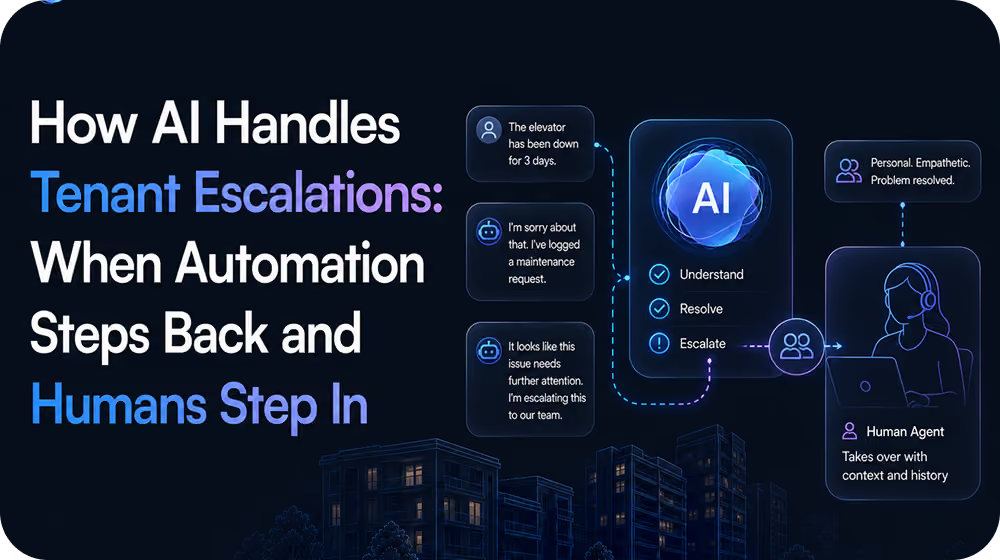
AI can finish the conversations with settled answers on its own. The ones that need human judgement are a different matter. Handover is the point at which AI routes one of these conversations to a member of your team. A well-designed handover carries the full context with it, so the resident does not repeat themselves and the agent picks up where the conversation left off.
Four situations should trigger a handover almost every time:
- Emotional or vulnerable conversations: a distressed resident or a welfare concern needs a person's judgement and tone, which automation cannot replicate.
- Out-of-scope or ambiguous requests: when a question falls outside the knowledge base, or the intent is unclear, a person should take over rather than let AI guess.
- Commercially sensitive decisions: rent negotiations and lease exceptions belong with someone who holds the authority to agree them.
- Anything with legal weight: eviction, discrimination and formal disputes carry consequences that demand a person and a documented process.
Conversations that need a person reach one with full context, while routine volume never reaches a desk.
Key Metrics AI Improves in Property Support
The case for AI support rests on numbers a property team already tracks. Five metrics tend to move first.
- First response time: AI replies in seconds at any hour, which matters most early, where the first operator to respond usually shapes the shortlist.
- After-hours coverage: a large share of enquiries arrive outside office hours, and AI closes the gap that staffing alone cannot.
- First-contact resolution: routine questions are answered in the first message rather than bounced between people or days.
- Agent handling time: with repeat questions removed, your team focuses on the conversations that need judgement.
- Resident satisfaction: faster and more consistent answers raise satisfaction scores, which feed directly into renewals.
These gains compound. A faster first response lifts conversion, and lower support volume protects renewals.
Compliance and Fair Housing Considerations
The Fair Housing Act prohibits discrimination in housing on the basis of seven protected characteristics:
- Race and colour
- Religion
- Sex
- Disability
- Familial status
- National origin
Those protections apply to advertising and to ordinary conversation, including a message sent by an automated system on your behalf.
For AI support, this cuts two ways. Consistency can be a compliance asset, because a system that gives every prospect the same answer removes the ad hoc comments and informal steering that create risk in human conversation. Left ungoverned, that same automation introduces risk, and responsibility for what it says sits with the operator.
A few controls keep automated support on the right side of the line:
- Approved knowledge base: responses are grounded in policy you have signed off, not open-ended generation.
- No differential treatment: the system answers the same enquiry the same way, regardless of who is asking.
- Audit trail: every conversation is logged, so you can show what was said and when.
- Human review for sensitive cases: screening decisions and accommodation requests route to a person rather than an algorithm.
- Accessible and multilingual responses: support reaches residents in their own language and meets accessibility needs.
Handled this way, automation supports fair housing rather than threatening it.
How to Choose an AI Support Platform for Your Portfolio
Most platforms can answer a simple question. For a portfolio, the difference is in the details that decide whether AI reduces workload or quietly adds to it. Weigh these before you commit:
- Channel coverage: voice, web chat, email, and WhatsApp in one system, so a resident gets the same standard wherever they reach you.
- Integration with your stack: a clean link to your CRM and PMS so records stay current and nothing is rekeyed by hand.
- Brand-safe responses: answers grounded in your approved knowledge base rather than generic output.
- Handover design: context-aware escalation to your team, not a dead end that frustrates the resident.
- Reporting and visibility: clear data on what is being handled automatically and where humans are still needed.
- Security and compliance: recognised standards such as ISO 27001 and SOC 2, with GDPR-ready controls.
- Built for real estate: a platform that understands leasing and resident operations, not a generic engine retrofitted to property.
The right platform is the one that fits how your team already works, integrating cleanly and escalating well rather than offering the longest feature list.
Real Results from Property Teams Using AI Support with VerbaFlo
VerbaFlo is a conversational AI platform built for real estate operators, so property support is a core use case.
It handles conversations across every channel through four connected products.
- VerbaChat: real-time web chat with tailored answers and multilingual support.
- VerbaCall: inbound and outbound voice handled around the clock, with no wait times and no script fatigue.
- VerbaMail: email is read, understood and answered with personalised replies and automatic follow-ups.
- VerbaMessenger: WhatsApp conversations for reactivation, support and re-engagement.
Operators using VerbaFlo report the pattern this article describes.
Enquiries are handled in seconds, after-hours cover holds, and answers stay consistent across sites even as staff change. The result is more conversations handled by the same headcount, with people freed for the on-site work that needs them.
Book a demo to see how VerbaFlo handles resident and prospect support across every channel.