
A prospect types "hey do u have any 1beds in the Riverside bldg for june? got a small dog". There is a typo, an abbreviation, a shorthand building name, a vague date and a pet question buried at the end.
A leasing agent reads that in a second and knows what to do. A keyword-matching system sees "1beds" and returns nothing useful.
The technology that closes that gap is natural language processing. It turns messy human phrasing into something a system can act on, and it decides whether your AI feels like a colleague or a wall.
This article explains what NLP is, how it works inside conversational AI, and where it still falls short.
What Is Natural Language Processing? A Plain-English Explanation
Natural language processing (NLP) is the branch of artificial intelligence that lets computers understand and produce human language as people actually speak and write it. IBM defines it as a field that uses machine learning to enable computers to understand and communicate with human language, combining computational linguistics with statistical and deep learning models.
The practical meaning for a property manager is simpler. NLP is what allows a renter to write the way they would text a friend and still get the right answer.
Two terms sit underneath it, and the distinction matters when you evaluate a platform:
- Natural language understanding (NLU): the interpretation side. It works out what the person means, including intent and the specific details in the message.
- Natural language generation (NLG): the response side. It composes a reply in fluent language rather than pulling a fixed script off a shelf.
A system with strong NLU and weak NLG understands the renter and answers stiffly. One with the reverse writes fluently and misses the point.
How NLP Sits Inside Conversational AI (The Technical Stack Simplified)
Conversational AI is the full system a renter interacts with, and NLP is the engine inside it that handles language. Around that engine sit the pieces that make a reply useful, including your property data and the systems that hold availability and resident history.
A single enquiry moves through the stack in a few steps. TechTarget describes the underlying phases as data preprocessing, feature extraction, algorithm development and model training. In a leasing context, that translates into something more recognisable:
- Clean up the message: the text is broken into units and standardised, so "1beds", "1 bed" and "one bedroom" are treated as the same thing.
- Work out the intent: the system classifies what the renter wants, whether that is availability, a repair, or a question about fees.
- Pull out the details: building names, unit numbers, dates and budgets are identified and tagged.
- Fetch the facts: the system queries your live data for what is actually available or what the policy says.
- Compose the reply: the answer is written in natural language, in your brand voice, and sent back on the channel the renter used.
Steps two and three carry the value, and they are worth testing hardest during a demo.
The 5 NLP Capabilities That Matter Most for Property Management
NLP covers a wide research field, but only a handful of its capabilities change what happens in a leasing office.
- Intent detection: works out what the renter wants so the enquiry can be answered or routed correctly.
- Named entity recognition: extracts the concrete details, including property, unit, date and budget.
- Context retention: holds the thread across a conversation, so "what about the other one?" still makes sense three messages in.
- Sentiment analysis: reads the emotional register, which lets a frustrated resident jump the queue rather than wait behind a routine question.
- Language generation: produces a reply that reads like your team wrote it rather than a template.
A platform can score well on the first two and still frustrate people if it forgets context. The weakest capability sets the ceiling on the experience.
How NLP Handles Accents, Abbreviations, and Informal Renter Language
Renters do not write in complete sentences. They abbreviate, they use the local name for a building rather than its legal name, and on a call they speak with every accent in the market.
Modern NLP handles it through learned patterns rather than a fixed dictionary. Trained on large volumes of real language, it maps "2br", "2 bed" and "two bedroom" to one concept without a rule written for each. The same applies to your market's shorthand, from "the Riverside" for Riverside Court to "utils included" for a bills-inclusive rent.
Accents remain a genuine constraint on voice. TechTarget notes that a model trained on speech in one accent can struggle when it meets a different one, which matters for portfolios serving international students or diverse metros. The mitigations are ordinary engineering:
- Train on your own conversation history: real transcripts from your market teach the system your renters' actual phrasing.
- Confirm rather than guess: when confidence is low, a good system asks "did you mean Riverside Court?" instead of quietly picking wrong.
- Offer a channel choice: a renter whose accent trips the voice model can switch to chat and get the same answer.
Intent Detection: How AI Knows What a Renter Actually Wants
Intent detection is the classification step that decides what a message is asking for. It sorts the enquiry into a category your workflow understands, which is what makes automated routing possible.
It needs machine learning because one intent has endless surface forms. "Anything available in June?", "u got units for summer?" and "when's your next move-in date" are three phrasings of one request. Keyword matching treats them as three separate problems, or misses two of them, and a missed availability question is a missed first response.
A leasing-specific model works with intents like these:
- Availability enquiry: the renter wants to know what is free and when.
- Pricing and fees: questions about rent, deposits, parking or pet charges.
- Tour booking: a request to see a unit, which needs a live calendar rather than a promise to follow up.
- Maintenance request: a resident reporting a problem, which needs urgency assessed before anything else.
- Policy question: pets, guarantors, subletting and the rules a renter checks before applying.
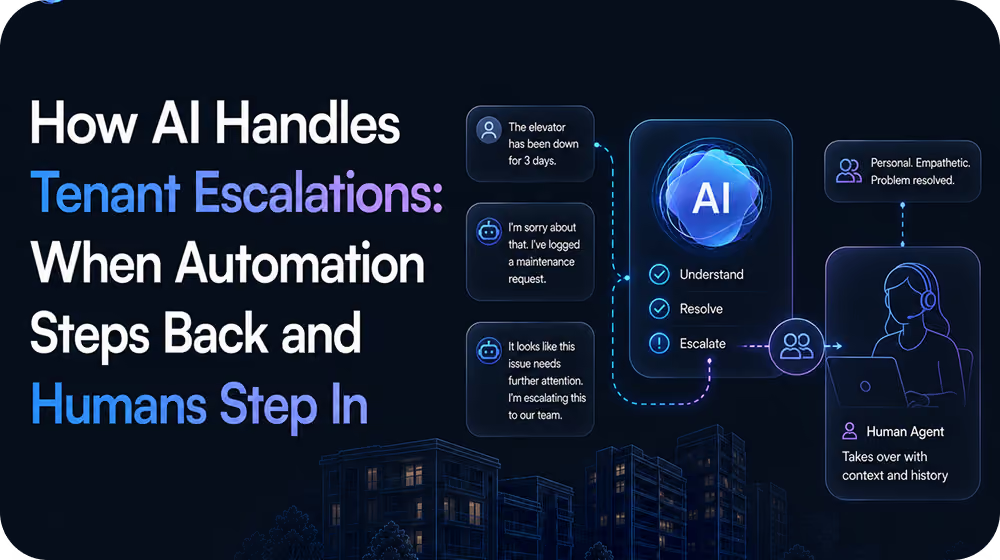
Intent detection also carries the handover decision. A lease exception or a legal question should reach a person, and a system that recognises the limits of its own categories escalates cleanly instead of improvising. That judgement is where human handover belongs in an AI leasing workflow.
Named Entity Recognition: How AI Understands Property Names, Unit Numbers, and Dates
Named entity recognition (NER) is the step that pulls specific items out of a sentence and labels them. IBM describes it as the task of identifying words or phrases as useful entities, such as recognising a place name or a person's name in running text.
Intent tells you the renter wants availability. NER tells you they want a one-bedroom, in that specific building, from June, with a dog. Without it, the system knows the category and none of the specifics, which means a human still has to read the message.
Property management puts unusual demands on NER, because the entities are local and irregular:
- Property names: "The Riverside", "Riverside Court" and a typo'd "Riverside Ct" all point to one asset in your portfolio.
- Unit numbers: "4B", "Apt 4B" and "unit four bee" on a call are the same address.
- Dates: "June", "next month", "the 1st" and "ASAP" all need resolving to a real date against today's calendar.
- Budgets: "around 1800", "under $2k" and "1.8k max" describe one price ceiling.
This is why a generic model underperforms on a portfolio. Your property names, floor plan codes and market shorthand sit outside general training data, so the entity layer has to learn your estate specifically.
The payoff is a structured record. A guest card arrives with property, unit type, move-in date, budget and pet status filled in, ready to route as a qualified lead rather than a message someone has to triage by hand.
The Limits of NLP and Where AI Still Struggles
NLP has real boundaries, and knowing them separates a deployment that works from one that embarrasses you.
IBM is direct about the failure modes. Systems get confused by dialect, mumbling, slang and background noise. TechTarget adds that NLP does not easily pick up sarcasm or understand emotions like confusion.
For a leasing team, the constraints land in specific places:
- Sarcasm and frustration: "Great, another week without hot water" reads as positive to a naive sentiment model. Handled badly, an upbeat reply lands on an angry resident.
- Ambiguity that needs judgement: "Can I get out of my lease early?" has a legal answer that depends on the document, the jurisdiction and the circumstances.
- New vocabulary: language moves, and a model that is not retrained drifts away from how your renters actually talk.
- Bias in training data: a model learns the patterns in what it was shown, which in housing carries Fair Housing exposure if the data skews.
The response to all four is the same. Keep a person in the loop for judgement calls, set a confidence threshold below which the system escalates rather than guesses, and review the transcripts where it hedged.
How VerbaFlo Puts NLP to Work Across Your Portfolio
NLP earns its place when it turns messy renter language into an action your systems can complete. That means reading intent correctly, extracting the details that matter, and knowing when to hand over.
That is what VerbaFlo is built to do for residential real estate:
- Understands how renters actually write: typos, abbreviations and shorthand building names resolve to the right property and unit type across voice, chat, WhatsApp and email.
- Turns a message into a record: intent and entities become a structured guest card or ticket, tagged by category and urgency, with no manual re-keying.
- Escalates with the full thread: when a question needs judgement, it reaches a person with the whole conversation attached, so the renter never repeats themselves.
- Works across asset classes: the same engine serves multifamily, build-to-rent and student accommodation, where phrasing and enquiry patterns differ.
Because VerbaFlo is API-first and sits on top of the CRM and PMS you already run, the structured output lands in your system of record and your team keeps the conversations that need them.
See how VerbaFlo reads renter language across your portfolio. Book a demo.