
At 2:14am a resident hears water running behind a wall. She calls the office number on her lease, reaches a voicemail recorded during business hours, and leaves a message. Then she texts the email address she once used for a parcel question.
By the time anyone opens either inbox at nine, water has run for seven hours. The unit below has a ruined ceiling, two insurance claims are in play, and a resident who followed the process exactly has watched a wall darken all night.
None of that was a maintenance problem. The repair would have taken twenty minutes. What broke was the intake.
This article covers how conversational AI triages emergencies as they arrive and where human judgement belongs, then how dispatch works overnight and what the audit trail does for your liability.
Why Emergency Maintenance Is a 24/7 Problem (And Currently Managed Badly)
Emergencies keep their own hours, and those hours are the ones you are not staffed for. Pipes burst overnight because that is when temperatures drop. Heating dies in the first hard frost, on a Sunday, across forty units at once. A nine-to-five office covers forty hours of a week that runs to 168, and the failures that cost the most rarely respect the difference.
The systems built to catch them run nine to five. Operators bridge that gap three ways, and each fails differently:
- The answering service: a stranger with no access to your systems takes a message and reads from a card. They cannot see the unit, the resident's history or where the stopcock is, so what reaches your team at eight is a name and a vague complaint about water.
- The on-call rota: one person holds the phone for the whole portfolio. They are asleep, driving or already on another emergency, and when two land together the second waits with no one aware it exists.
- The voicemail box: the cheapest and the most expensive. It converts a live emergency into a recording, and the recording waits until someone presses play.
The deeper flaw sits above all three. Every one of them assumes the resident has already worked out that this is an emergency, because your lease gives them one number for a crisis and a portal for everything else.
That assumption fails at the exact moment it matters. Someone standing in the dark watching a stain spread across a ceiling is not reading a lease appendix to find the correct escalation path. They reach for the channel that worked last time, which is often the one nobody is watching. Your triage is being performed, unknowingly, by the person least equipped to do it.
How Conversational AI Triages Emergency vs Non-Emergency Requests
Triage sorts a request by severity so the response matches the risk. For emergencies it has to happen at the moment of contact rather than at nine the next morning.
A conversational AI layer runs that interview immediately on whichever channel the resident reaches for. It asks the questions a skilled dispatcher would ask, and the answers determine what happens next:
- Is water actively flowing? A running leak and a dried stain sit on different clocks.
- Is anyone at risk? Gas smell, no heat in freezing weather, a sparking outlet and a failed lock escalate past the queue.
- Is the unit habitable tonight? No water, no heat and no power change the resident's night as well as their week.
- Can it wait until morning? A dripping tap or a broken dishwasher survives eight hours.
The two errors are asymmetric. Treating a burst pipe as routine floods a building, while treating a dripping tap as an emergency wakes a plumber at 3am and burns money. The same conversation captures the location, access notes and a photo where the resident can safely take one, so whoever attends knows what they face.
The Escalation Framework: What AI Resolves vs What Requires a Human
Automation belongs on repeatable work and judgement belongs with people. Draw that line deliberately rather than discovering it during an incident.
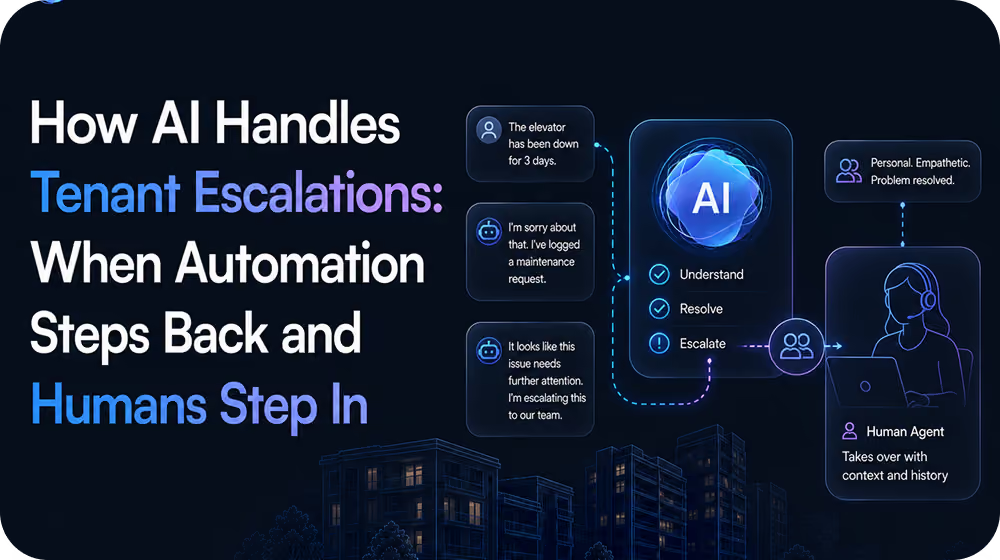
AI handles the volume that follows a pattern:
- Intake and classification: capturing the report, asking diagnostic questions and assigning severity.
- Immediate safety guidance: where the shut-off is, which breaker to flip, or to leave and call the gas emergency line.
- Work order creation: writing a structured ticket into your system at the correct priority.
- Status communication: confirming receipt, giving an ETA and posting updates.
People take the calls that carry risk:
- Anything with injury or evacuation: a fire, gas leak or structural concern needs a human on site.
- Ambiguous severity: when the description does not resolve cleanly, a person makes the call.
- Repeat failures: a third callout to the same unit in a month is a pattern that needs someone to think about the cause.
- Distress: a frightened resident at 3am needs a person, and the system should recognise it.
The threshold is the decisive design choice. Set it so the system escalates when unsure, and every borderline case reaches a person with the full conversation attached. That is where human handover belongs in an AI workflow, and emergencies carry the highest price for getting it wrong.
Vendor Dispatch at 2am: How AI Coordinates Emergency Work Orders
Classifying an emergency correctly achieves nothing if the next step waits for someone to wake up. Dispatch is where after-hours response dies.
The manual version is phone tag in the dark. A coordinator wakes, reads a thin message and works out who covers plumbing at night, then calls three numbers hoping someone answers. Every step is a delay while water spreads.
Automated emergency dispatch compresses it:
- Match to the on-call vendor: the system knows which contractor covers that trade, property and hour, so the right phone rings.
- Send a complete brief: the vendor gets the unit, access notes, photo and diagnostic answers before the van moves.
- Chase the acceptance: when the first vendor does not respond inside a set window, the system moves to the next.
- Log the timeline: every attempt, acceptance and arrival is timestamped automatically.
A leak contained in forty minutes is a repair. The same leak at nine the next morning is an insurance claim across two units.
Resident Communication During Emergencies: Keeping Residents Informed Automatically
The silence between a report and an arrival is where trust breaks. A resident who hears nothing for two hours assumes nothing is happening, calls again, and starts building a complaint in their head.
Automated communication removes that silence:
- Immediate acknowledgement: the resident knows within seconds that the report landed and what happens next.
- Safety instructions first: they get the shut-off location or the instruction to leave, which is what limits the damage.
- A real ETA: "Vendor accepted, arriving within ninety minutes" is a fact the resident can act on. "We will look into it" is not.
- Progress and confirmation: updates while the job runs, then a check that the fix held.
When a leak affects the units below, those residents need telling before they find out from the ceiling, and the system reaches the whole stack at once.
Reducing Liability: How Documentation and Audit Trails Work With AI
Emergency maintenance carries legal weight. Cornell's Legal Information Institute describes the implied warranty of habitability as requiring landlords to keep property safe and fit for human habitation, even where the lease does not say so, with habitability meaning substantial compliance with housing codes.
Where an operator fails that standard, tenants may withhold rent or pursue remedies through the courts. Timeframes vary by state and city, so your jurisdiction governs.
When a dispute arrives months later, the argument turns on what you knew and when you acted. A phone call at 2am leaves no evidence. An AI-run intake produces that record as a by-product of doing the work:
- Time of report: timestamped to the second, on the channel the resident used.
- What was said: the full transcript, including diagnostic answers and any photo.
- What was done: classification, dispatch attempts, acceptance and arrival, logged automatically.
- What the resident was told: every update, with its timestamp.
None of this replaces legal advice or your compliance team. It changes what you can show. Rather than reconstructing a night from three people's recollections, you hold a continuous record when an insurer or a court asks.
What an Emergency AI Maintenance Workflow Actually Looks Like
Put the pieces together and the 2:14am call runs differently. The resident messages whichever channel she has to hand. The system responds in seconds, asks whether water is actively flowing and whether she can reach the shut-off, then tells her where it is.
It classifies the report as an emergency and writes the work order at top priority. The on-call plumber is paged with the unit, access code and photo attached. The plumber accepts at 2:19am, she gets an ETA, and the resident below is warned about his ceiling.
At 2:52am the plumber is on site. By the time the property manager opens her laptop at eight, the job is closed and the sequence is logged in order.
The repair took twenty minutes in both versions of this story. Everything separating them happened before the plumber arrived.
How VerbaFlo Handles Emergency Maintenance Around the Clock
Emergency response comes down to the first five minutes, on whichever channel a resident reaches for overnight. That is the layer VerbaFlo is built to be for residential real estate:
- Always on, every channel: a leak reported by voice, chat, WhatsApp or email reaches the same system at 2am and at 2pm.
- Tagged by category and urgency: each report is classified on arrival, so a burst pipe escalates at once while a dripping tap waits for morning.
- Escalated with the full thread: when a case needs a person, the whole conversation goes with it, so a resident in distress never starts again.
- Logged end to end: every message, classification and update is recorded and synced to your systems, leaving the audit trail an insurer or court would ask for.
Because VerbaFlo is API-first and sits on top of the CRM and PMS you already run, work orders land in your system of record, and the approach holds across multifamily, build-to-rent and student accommodation.
See how VerbaFlo handles emergency maintenance across your portfolio. Book a demo.