
Most of the trend pieces about AI age badly because they predict a revolution and describe a demo. The useful version looks at what already works, notices where the momentum is genuinely building, and separates the shifts worth planning for from the ones worth watching.
That is the aim here. Conversational AI in property management has moved past the novelty stage, and the next two years will decide which capabilities become standard and which stay optional.
This article sets out where the technology stands today, five trends shaping 2027, and what each one means for the decisions you make about your own stack now.
Where Conversational AI for Property Management Is Today (Baseline)
Start with an honest picture of the present, since the trends only make sense against it.
Today, a capable conversational AI handles the high-volume, repetitive layer of resident communication. Four jobs make up most of that work:
- Resident and prospect enquiries: questions across voice, chat, WhatsApp and email, handled instantly and around the clock.
- Lead qualification and tour booking: screening leads and booking tours against live availability, so the top of the funnel runs on its own.
- Maintenance request logging: requests captured, tagged and written into the system your team already uses.
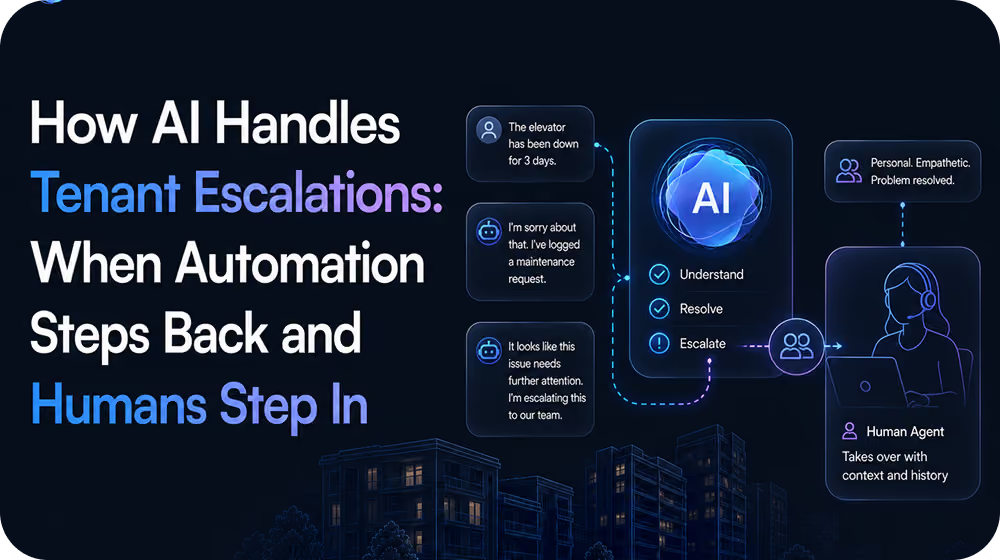
- Handover to a person: anything beyond its scope passed on with the context attached.
That is real, deployed and working in thousands of buildings today.
The wider market signal is strong. Gartner projects that by 2029, agentic AI will autonomously resolve 80% of common customer-service issues without human intervention, with a 30% reduction in operational costs. That figure covers customer service broadly, not property management, but the direction it points is the one this article traces.
What the technology does not yet do reliably is act across a whole workflow on its own. It answers and routes. It does not, in most deployments, complete a multi-step task end to end without a person. That gap is exactly where the first trend sits.
From that baseline, five shifts are set to define the next two years. The first three sharpen what the AI already does. They move it from answering to acting, from text to voice and from reactive to predictive. The last two widen its reach, into the physical building and down to the individual resident. Each builds on the same foundation.
Agentic AI Takes Over More End-to-End Workflows
The shift worth understanding first is the move from AI that answers to AI that acts.
Today's conversational AI is mostly reactive. A resident asks, it responds. Agentic AI adds the ability to carry out a multi-step task on its own, deciding what to do next rather than waiting for an instruction.
In property terms, that is the difference between an AI that logs a maintenance request and one that logs it, checks the vendor's availability, then books the slot and confirms with the resident.
This is where Gartner's 2029 projection lands hardest. Autonomous resolution of routine issues is the headline capability, and leasing is full of routine, multi-step work to hand over.
A note of caution belongs here. Gartner has separately predicted that a share of companies cutting service staff on the assumption AI would cover the gap will end up rehiring. The lesson for property teams is to hand agentic AI the genuinely routine workflows and keep judgement calls with people. The trend rewards a measured rollout rather than a wholesale one.
Voice-First AI Becomes the Default in Leasing
Text handled the first wave of conversational AI because it was easier to build. Voice is where the second wave is heading, and for leasing the logic is strong.
A large share of prospects still call, often after hours, and a call that goes to voicemail is a lead cooling by the minute. Voice AI that answers, qualifies and books a tour on the phone closes the gap a text-only system leaves open.
The technology has crossed a threshold. Voice AI that once sounded robotic now holds a natural back-and-forth, handles interruptions and passes cleanly to a person when needed. As that quality becomes standard, a leasing operation that cannot answer the phone with AI will feel the absence during every after-hours enquiry.
Voice will not replace text. Residents will keep using whichever channel suits the moment. What changes by 2027 is that voice becomes one more channel a serious platform is expected to cover.
Predictive AI Replaces Reactive Tenant Management
The conversational AI most teams run today waits to be asked. The next version anticipates.
Predictive AI uses the patterns in your data to flag what is likely to happen before it does. A resident whose payment is usually early going quiet, a renewal window approaching for someone who has raised three complaints, a maintenance issue that recurs in a particular unit type. The AI surfaces these so a person can act early rather than react late.
For resident retention the value is direct. A renewal conversation that starts thirty days before a resident was going to leave is a different one from the conversation that starts after they give notice. Predictive signals move the whole relationship earlier, from reactive to ahead of the problem.
This trend depends entirely on data. An AI can only predict from what it can see, so the operators who benefit are those whose systems give the AI a full picture. The prediction is only as good as the plumbing underneath it.
AI Integration Into Smart Building Systems
Conversational AI has lived in the communication layer. The next step connects it to the physical building.
Smart building systems already generate a stream of data, from access control to HVAC to leak sensors. Wiring conversational AI into that stream lets a resident's report and the building's own signals meet in one place. A resident messaging about a cold flat and the heating system reporting a fault become a single, faster resolution rather than two disconnected events.
The clearest near-term wins are in maintenance and access. A leak sensor triggering before a resident notices, an access issue resolved through the channel the resident already uses. The conversation becomes the interface to the building itself, extending past the leasing office.
This is the least mature of the five trends, and the most dependent on hardware standards still settling. It is worth watching more than building around for now, but clear enough to factor into a longer-term roadmap.
Hyper-Personalisation at the Resident Level
Early conversational AI treated every resident the same. The trend now is communication shaped to the individual.
Personalisation here means the AI drawing on what it already knows about a resident to make each interaction fit. Their preferred channel and language, their history with the property, the open issues on their account. A resident who always messages in Spanish and has an unresolved maintenance ticket should not be met with a generic English greeting that ignores the open request.
Done well, this makes a large portfolio feel small. A resident gets the sense of being known, which is the thing on-site teams do naturally and scaled operations usually lose. The AI holds the context that a busy manager across twenty buildings cannot.
The line to hold is between personal and intrusive. Personalisation should draw on what a resident has shared and what serves them, not on surveillance that makes them uneasy. The operators who get this right treat the resident's data as something held in trust.
What This Means for Your Technology Roadmap Today
Trends are only useful if they change a decision. Here is how these five translate into action now.
- Build on a platform, not a point tool: every trend rewards a system holding one record per resident and connecting to everything else. A narrow tool that does one job well ages badly as the workflows widen.
- Fix the data plumbing first: predictive AI, personalisation and agentic workflows all depend on the AI seeing a full, current picture. The operators who benefit from the next two years are the ones whose systems connect cleanly now. This is the least glamorous investment and the one the rest depends on.
- Adopt agentic AI where the work is routine: hand over the multi-step tasks that are genuinely repetitive, and keep judgement with people. A measured rollout captures the gain without the reversal that catches teams who cut too fast.
- Treat voice as a requirement, not a bonus: a platform with no phone capability is losing after-hours leads today, before any 2027 trend arrives.
The work does not require betting on the furthest-out trend, only building on foundations the near-term trends already reward, so you are positioned rather than exposed when the rest arrives.
How VerbaFlo Is Built for What Comes Next
The trends above share a single requirement. They all depend on a platform that holds the full resident relationship and connects to everything around it, rather than a tool bolted to one workflow.
That is the foundation VerbaFlo is built on for residential real estate:
- One record, every channel: enquiries across voice, chat, WhatsApp and email feed a single resident history, which is what personalisation and prediction both need.
- Voice built in: the platform answers and qualifies calls, so the after-hours lead reaches a system rather than a voicemail.
- Specialised agents: separate agents for leasing, maintenance and resident engagement, each handling its own workflow, which is the architecture agentic AI builds on.
- Connected to your systems: because the platform is API-first and connects to the CRM and PMS you already run, the AI works from live data rather than a stale snapshot.
The same foundation holds across multifamily, build-to-rent and student housing, so the roadmap you build now carries into what comes next. See how the platform fits your portfolio. Book a demo.