Six weeks after go-live, a leasing manager notices something. The AI that kept escalating questions about the pet deposit now answers them cleanly, and the parking-permit questions that used to get vague replies land right.
Nobody rebuilt the system that week. It got better at the questions residents ask, the way a new hire does after a month of shifts.
That improvement is real, and widely misunderstood. The phrase "the AI learns" suggests a system rewriting its own brain on your data. Something more specific is going on.
This article explains what learning actually means for conversational AI, the feedback loops behind it, and how long improvement takes to show.
What 'Learning' Actually Means for Conversational AI (It's Not Magic)
Learning does not mean the AI rewrites its own brain. The underlying model is trained once, before it reaches your property, and it stays fixed. Your residents' conversations never retrain it, and any vendor implying otherwise is overselling.
What learns is the layer around that model. Salesforce describes a conversational AI as a well-trained representative who has studied every manual and knows every policy. Learning means that representative getting a better manual, not a new brain.
Three things change over time:
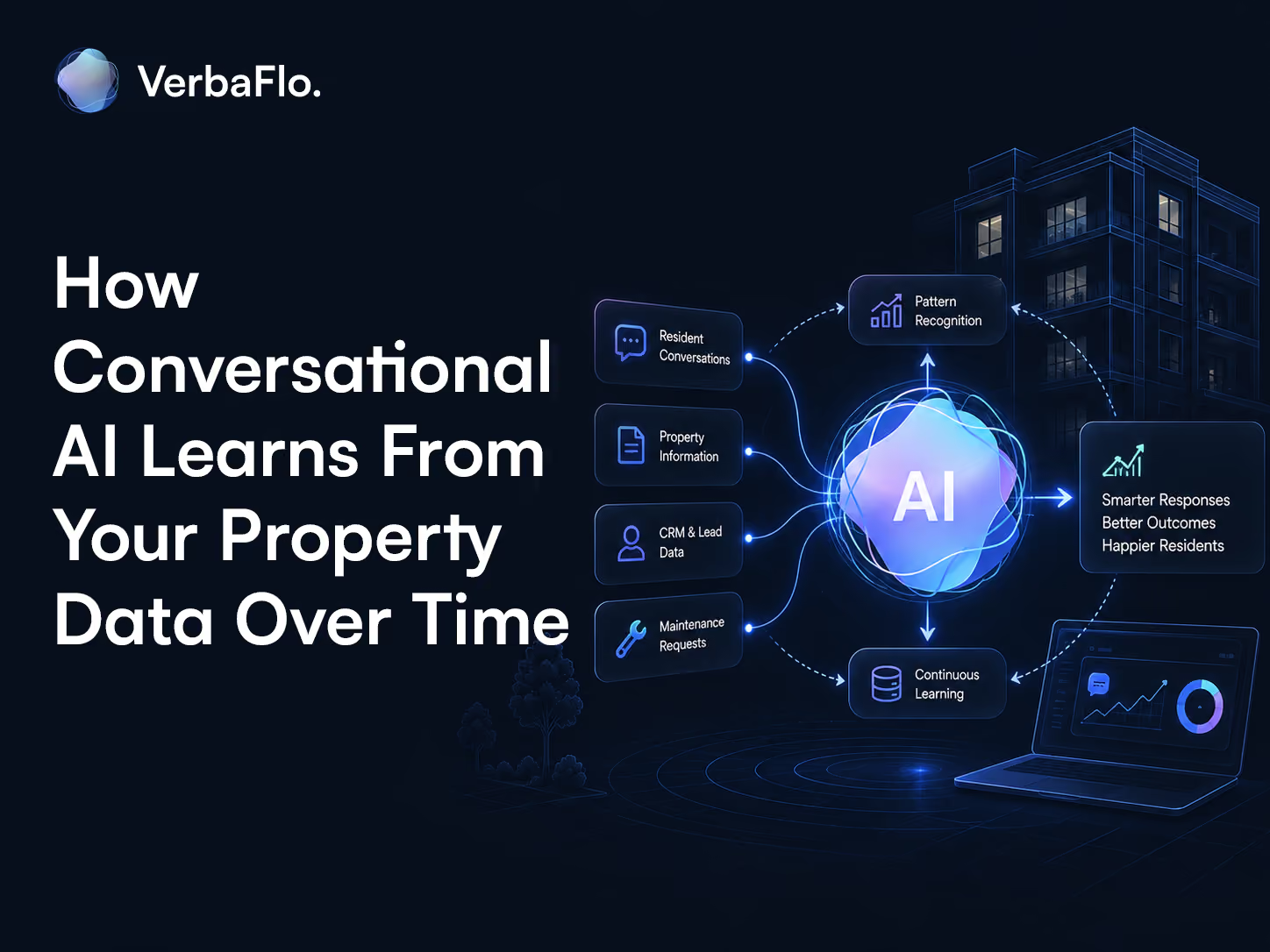
- The knowledge it draws on: the answers and property details it retrieves from, which grow as gaps get filled.
- The routing rules: how it classifies a question and decides where it goes, tuned as you see what it gets wrong.
- The escalation triggers: when it hands to a person, refined as you learn which questions it should never attempt.
That is why it is not magic. The system improves because people feed it better inputs, which makes it something you steer rather than wait on.
The Data Your AI Starts With vs What It Learns Over Time
On day one, a conversational AI knows two kinds of thing. It has the general language ability from its base training, and whatever you loaded during setup, your unit types, pricing rules, pet policy and the answers to common questions.
That starting knowledge is a snapshot. It reflects your property as it was the week you configured it, and says nothing about how your residents phrase things.
What accrues over time is the gap between snapshot and reality:
- The questions you did not anticipate: a resident asks about bike storage, the AI has no answer, and the gap surfaces in the escalation log. You add it, and the next resident gets an answer.
- The phrasings you did not predict: residents call the same thing a dozen names, and the AI learns which local terms map to which policy as they show up.
The starting data gets you a system that works. The accumulated data gets you one that fits your building.
Feedback Loops: How Resident Interactions Train the Model
A feedback loop turns a conversation into an improvement. IBM describes conversational AI as combining language processing with machine learning in a constant feedback loop that improves the system over time. In a leasing deployment, that loop has a specific shape.
It runs in four steps. A resident asks something, and the AI answers or escalates. A person reviews what happened, correcting a wrong answer or noticing a repeated escalation. That review updates the knowledge base or the routing rules, and the next resident with the same question gets a better result.
The loop only closes if a person is in it, because an AI cannot tell on its own that its confident answer was wrong. The useful signal lives in specific places:
- Escalations: every handover tells you what the system could not do. A cluster on one topic is a knowledge gap with a return address.
- Corrections: when an agent fixes an answer, that correction is the most valuable training input you have, because it names both the error and the fix.
- Repeated questions: the same query arriving fifty times a week is a candidate for a better answer than the generic one.
Feed those signals back and the loop tightens. Ignore them and the AI stays exactly where it started.
How AI Gets Better at Routing, Escalation, and Response Accuracy
Improvement shows up in three measurable places, and each one moves for a different reason.
Routing accuracy is how reliably the AI sends a question to the right place. Early on it might treat a maintenance emergency and a general query alike. As you review misroutes and adjust the rules, a burst pipe reaches the on-call queue while a repainting question waits for business hours.
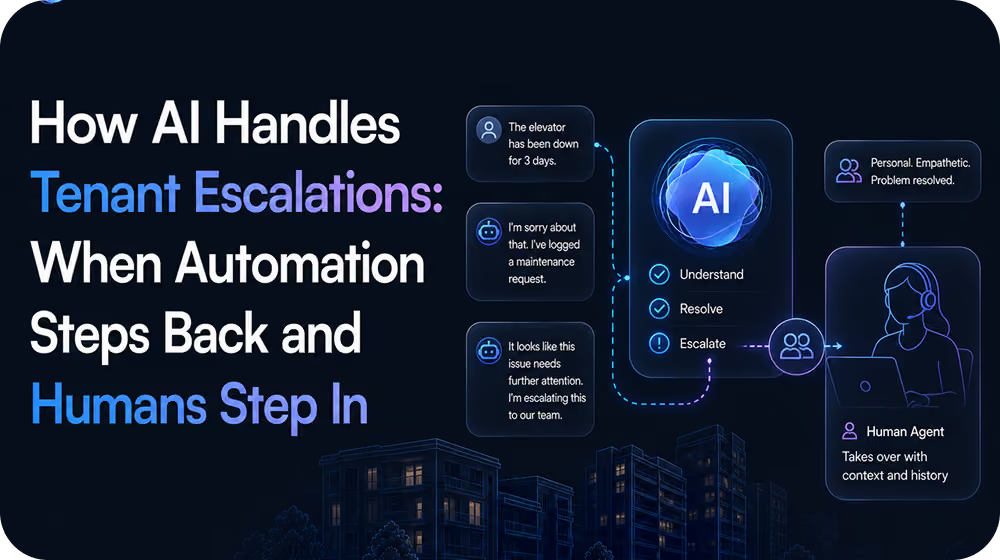
Escalation gets sharper in both directions. A well-tuned system escalates less overall, because it now answers questions it used to pass on, and escalates faster on the ones that need a person. A clean handover that carries the full thread makes that useful rather than a dead end.
Response accuracy climbs as the knowledge base fills. Watch how many questions it answers correctly rather than how many it answers, which is why reviewing transcripts matters more than reading a dashboard. A confidently wrong answer about a fee looks identical to a right one until a person reads it.
What You Need to Set Up to Enable Continuous Improvement
Continuous improvement is a process you run, not a feature you switch on. It needs three things.
It needs an owner. Someone has to hold the review, even for an hour a week, because a loop with no owner never closes. This is the most common reason a capable AI plateaus.
It needs the right data connected. The AI has to read live from your PMS and write back to it, so its answers reflect real availability. A tool cut off from your systems cannot learn your building, because it never sees its current state.
It needs a review rhythm:
- Weekly: scan the escalation log for clusters. A spike in one category is a content gap you can close in minutes.
- Monthly: read a sample of transcripts, starting with escalations, to catch confident wrong answers a dashboard hides.
- Quarterly: review the questions the AI answers most and decide whether any deserve a fuller, better response.
Set those up and improvement compounds. Skip them and you have a static tool with a learning label.
Privacy and Data Governance: What Data Stays Where
The moment an AI handles resident conversations, it handles personal data, raising questions you should have clear answers to before you sign.
The questions worth asking every vendor are concrete. Where are conversations stored, and under whose control. Whether your residents' data ever trains models other customers benefit from. How long transcripts are retained, and who on your side can access them. A vendor who cannot answer these plainly is telling you something.
Look for recognised certifications as a baseline. ISO 27001 covers information security management, SOC attestation shows how a provider safeguards customer data, and GDPR compliance governs the rights of the people whose data you hold.
VerbaFlo holds ISO 27001 and SOC certification, and works to the principle that your data stays yours. Hold any platform you evaluate to the standard of answering the storage, training and retention questions without hedging.
Realistic Timelines: When Does the AI Start Performing Better?
It depends on volume and attention, but the shape of the curve is predictable.
In the first two weeks, the AI runs on its starting configuration. It handles common questions well and escalates the rest, and the escalation log fills fastest here, because every gap is open.
Across weeks three to six, the first review cycles pay off. The frequent gaps close, routing settles, and the escalation rate on well-trodden topics drops. This is when a leasing team first notices the AI handling questions it once escalated.
By three months, a well-run deployment has cleared the bulk of its common gaps and reaches a steadier state. Improvement continues in smaller increments, on the long tail of rarer questions.
Two things set the pace. Volume decides how fast gaps surface, since a high-traffic property exposes them faster than a quiet one. Attention decides whether they get closed, and it is the one you control. An AI with high volume and no owner learns slowly, while one with modest volume and a weekly review learns fast.
How VerbaFlo Turns Resident Conversations Into a Sharper System
Improvement over time comes down to a loop that closes when the signal reaches the people who can act on it.
That is how VerbaFlo is built for residential real estate. Enquiries across voice, chat, WhatsApp and email arrive tagged by category and urgency, so the escalation clusters that reveal a knowledge gap are visible rather than buried. Every handover carries its context, so a correction arrives complete.
Because the platform is API-first and connects to the CRM and PMS you already run, the AI reads live property data and writes outcomes back where your team tracks them, so its answers reflect the current state of your building rather than a setup snapshot.
The same loop runs across multifamily, build-to-rent and student housing, and your team keeps the review that steers it.
The system gets sharper because your people feed it, not because it works alone. Put the review rhythm in place and see how VerbaFlo compounds it. Book a demo.