
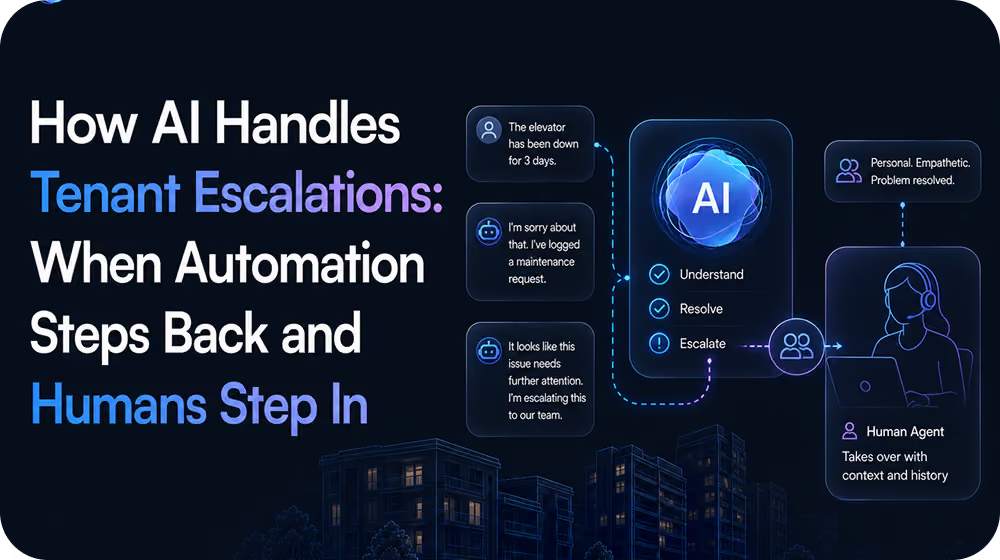
A resident messages at 11pm. Water is coming through the ceiling and the message ends with three exclamation marks. The AI, trained to be helpful, offers the standard guidance on submitting a maintenance request and links to the portal.
That is the wrong answer, and not because of the AI's language skills. What it missed was the moment to stop answering and get a person involved.
Escalation is the discipline of knowing that moment.
This article covers the triggers that should route to a human, how to design a framework, and how to tell whether your logic works.
What Is AI Escalation and Why Does It Matter in Property Management?
Escalation is the process of passing a conversation from the AI to a person. Zendesk describes it as the point where the system routes the issue to the right team with full context for a smooth handoff, naming the two things that make escalation work, the right person and the full context.
In property management the stakes are specific. A resident is not a support ticket. They live in the building, their problem is physical and urgent, and a wrong answer at the wrong moment has consequences a refund cannot fix.
Two failures sit at opposite ends. Escalate too little and the AI answers questions it should have passed on, which is how a burst pipe gets a portal link at 11pm. Escalate too much and it hands over every routine question, burying your team.
Good escalation design is the line between those two. It defines what the AI handles, what it never touches, and how it moves a conversation to a person.
The 7 Triggers That Should Always Route to a Human
Some situations should reach a person every time, regardless of how confident the AI is. These seven are the ones worth hard-coding.
- Emergencies: safety, flooding, gas, fire, no heat in winter, a lockout. Speed matters more than resolution, and the AI should route to an on-call person immediately.
- Explicit requests for a human: when a resident asks to speak to someone, the AI hands over without arguing. Making them fight for it loses their trust fast.
- Detected frustration or distress: repeated messages, capital letters, language signalling anger. A frustrated resident needs a person, not a better-worded automated reply.
- Legal, financial, or lease disputes: eviction, deposit disputes, anything with a legal edge. These carry consequences the AI is not equipped to weigh.
- Requests outside policy: a lease exception, a payment plan, a rule waiver. Any answer requiring discretion belongs with someone who holds it.
- Repeated failure to resolve: when the AI has tried twice and the resident is still stuck, a third attempt is worse than a handover.
- Sensitive personal situations: domestic issues, hardship, bereavement, anything where a human touch is the whole point. An automated reply reads as cold at exactly the wrong moment.
The through-line is that these are judgement calls, not information lookups. The AI is strong at retrieving facts and weak at weighing consequences, so the second belongs with a person.
How to Design an Escalation Framework for Your Property Team
A framework turns those triggers into a system your team can run. Zendesk's guidance is to develop an escalation strategy before launch rather than bolting it on after. Build it in four steps.
- Define the boundary: write down what the AI may handle and the categories it must never attempt. The seven triggers above are your starting list, and anything on it routes to a person by rule.
- Map each trigger to a destination: an emergency and a lease dispute both escalate, but to different people. Decide in advance who receives what, so a flood reaches on-call maintenance while a deposit question reaches the property manager.
- Set the rules for time and availability: decide what happens at 2am, on a weekend, or when the assigned person is unavailable. A framework that only works during office hours is not a framework, so define the after-hours path before you need it.
- Decide what travels with the handover: the person picking up needs the whole thread and the reason for the escalation. Settling this once, at design time, makes every handover clean.
Work through them in order. Each step depends on the one before it, and skipping the after-hours rule is the gap that shows up first at 2am.
Warm Transfer vs Cold Transfer: How AI Hands Over Context
How the AI passes a conversation matters as much as when. The two methods differ in what the receiving person sees.
A cold transfer drops the resident into a queue with nothing attached. The person who picks up sees a new conversation and has to ask the resident to start over, so an already-frustrated resident repeats every answer the AI already had.
A warm transfer carries the full context across. The person receives the conversation history and a summary of why the escalation happened, so they open it already knowing the situation. Zendesk's own voice handoff works this way, passing a full transcript, a summary and the detected intent so the agent starts informed.
For property teams the warm transfer is the only one worth building. A resident reporting a flood at midnight should not have to explain it twice. A handover that carries the full thread is the difference between escalation that helps and escalation that adds a step.
Resident-Facing Communication During Escalation
The resident does not see your routing logic. They see the words on their screen when the AI stops and a person takes over, and those words decide whether the handover feels like help or abandonment.
Three things make the difference:
- Acknowledge, do not apologise: offering to get the right person reads better than saying you cannot help. The first frames the handover as intent, the second as failure.
- Set a real expectation: tell the resident what happens next and roughly when. A conservative estimate they can trust beats an optimistic one they cannot.
- Do not vanish: the gap between the AI stopping and a person arriving is where trust leaks away. Confirm the handover happened and the resident is not shouting into an empty channel.
An emergency changes the tone. The message should convey speed and certainty, confirming that a person is being reached right now rather than that a ticket has been logged.
How to Measure If Your Escalation Logic Is Working
Escalation logic that nobody checks drifts. These measures tell you whether yours is tuned.
- Escalation rate by reason: not the overall number, but the breakdown. A cluster on one topic is a knowledge gap the AI could close. A cluster of frustration escalations points to answers that are correct but landing badly.
- Context-completeness on handover: ask the receiving person a simple question after each handover. Did you have what you needed, yes or no. A pattern of no means your warm transfer is dropping something.
- Time to human after escalation: how long a resident waits once the AI steps back. A long wait is the worst outcome, because the resident has already been told help is coming.
- False escalations: conversations the AI passed on that a person handled with a standard answer the AI could have given, pointing to thresholds set too cautiously.
Read these together rather than in isolation. A low escalation rate looks good until you find the AI answering lease disputes it should pass on. The number to protect is whether the right conversations reach a person.
Common Escalation Mistakes and How to Fix Them
Most escalation problems come from a handful of predictable errors.
- Chasing zero escalations: treating every handover as a failure and tuning the AI to avoid them, which produces a system that answers questions it should pass on. Fix: track whether the right conversations escalate, not whether few do.
- The cold handover: escalating without context, so the resident repeats themselves. Fix: pass the full thread and reason with every transfer, without exception.
- No after-hours path: an escalation framework that works at 2pm and fails at 2am. Fix: define the out-of-hours route, including who is on call, before launch.
- Escalating to a black hole: the handover fires, but nobody owns the queue it lands in. Fix: assign a named owner to every destination and alert them.
- Set and forget: building the logic once and never reviewing it. Fix: read the bottom quartile of handovers monthly and adjust the triggers that misfire.
The pattern underneath all five is treating escalation as a feature you switch on rather than a system you run. Given an owner and a monthly review, the misfires stay small.
How VerbaFlo Handles the Handover From AI to Human
Escalation done well comes down to two things. The AI knows when to step back, and the handover carries enough context that the person stepping in starts informed.
That is how VerbaFlo is built for residential real estate:
- Tagged by category and urgency: enquiries across voice, chat, WhatsApp and email arrive classified, so an emergency and a routine question route to different places by rule.
- Escalation with full context: when a conversation needs a person, the whole thread goes with it, so nobody asks the resident to start over.
- Routed to the right person: an emergency reaches an on-call line while a lease question reaches the manager, rather than everything landing in one queue.
- Connected to your systems: because the platform is API-first and connects to the CRM and PMS you already run, every escalation is logged where your team already works.
Your team keeps the judgement calls while the AI handles the volume up to the point where judgement is needed. The same holds across multifamily, build-to-rent and student housing. Book a demo.