Search for "automated tenant check-in" and most results are about tenant screening. The two get treated as the same thing, when in fact one decides whether someone gets housing and the other welcomes someone who already has it. Automating them means very different things, and confusing them creates real risk.
The distinction carries real weight. It is the line between a regulated decision that can deny someone a home and an operational task that helps a new resident settle in.
This article defines both workflows, explains why the line between them is legal as much as operational, and sets out where automation safely belongs in each.
Why "Check-In" and "Screening" Get Confused
The confusion is partly linguistic and partly commercial. Both words describe something that happens around the start of a tenancy, so search engines and buyers treat them as interchangeable, and vendors selling one often borrow the language of the other. As AI spreads across the leasing process, keeping the two straight matters more, not less.
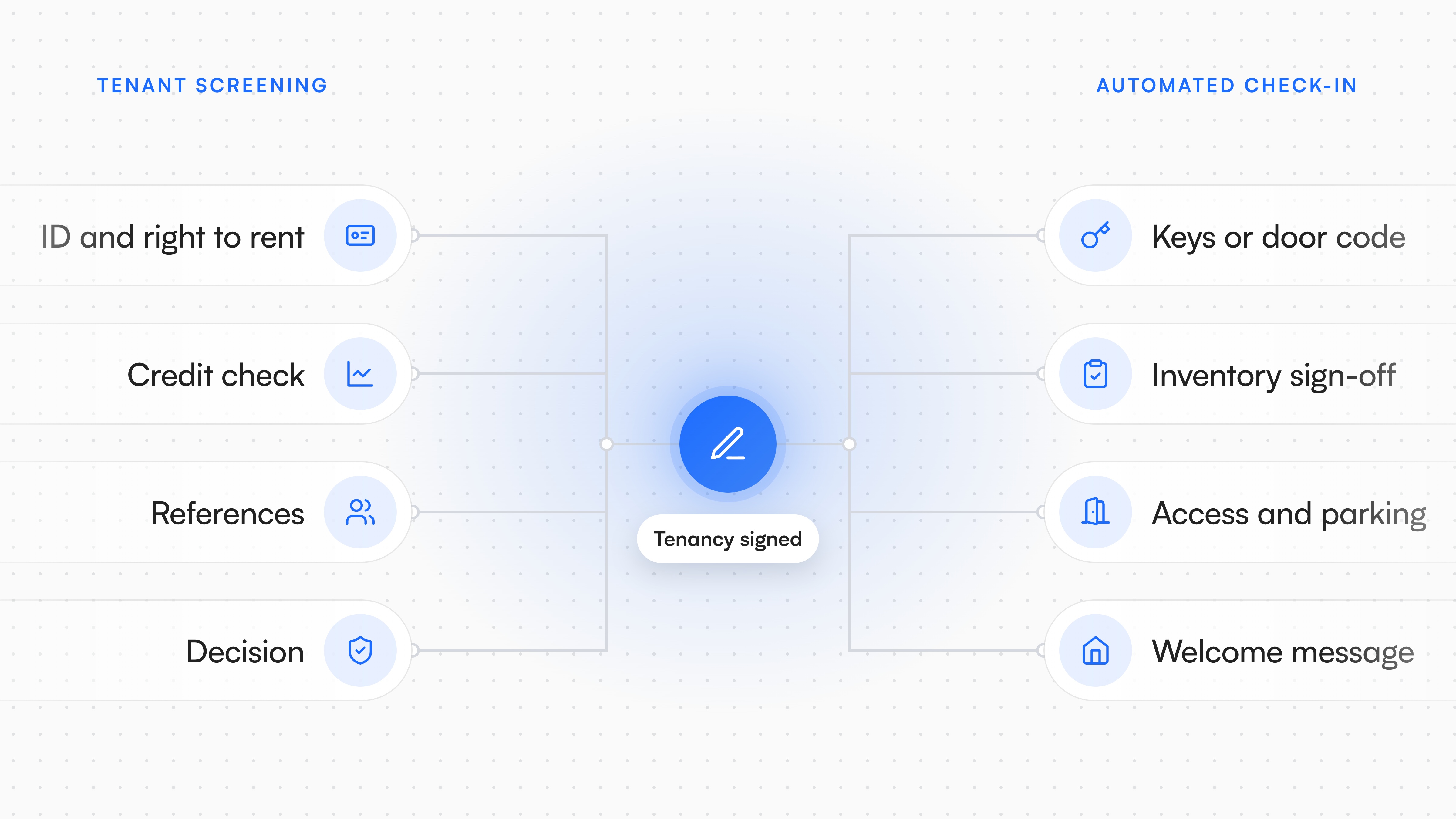
The problem is that the two sit on opposite sides of the single most important event in the leasing process, which is the decision to grant a tenancy. Screening happens before that decision and informs it, while check-in happens after it, once the person is already a resident.
That timing is everything. Before the decision, an operator is choosing who to house, which is regulated territory. After it, the operator is onboarding someone they have already accepted, which is not.
Treating the two as one workflow risks applying the wrong level of caution to each, either over-restricting a simple welcome or, more dangerously, letting an "onboarding" tool drift into decisions it should never make.
What Tenant Screening Actually Is (And Why It's High-Risk)
Tenant screening is the pre-tenancy evaluation of an applicant that decides whether to offer a tenancy. It typically covers credit, income, rental history and background checks, and it is a decision about who gets housing, which places it squarely under fair housing law.
That legal weight is not theoretical. The National Fair Housing Alliance reported 32,321 housing discrimination complaints filed in 2024, among the highest totals in more than two decades. Its analysis singles out algorithmic tools in tenant screening as an emerging source of bias.
The risk is specific. Screening algorithms draw on data, including credit scores, eviction records and criminal history, that carries the imprint of existing inequality. A model applying that data can produce outcomes that fall harder on protected groups even where no discrimination is intended.
HUD's 2024 guidance made clear that the Fair Housing Act applies to tenant screening including when artificial intelligence performs it, and that unjustified discriminatory effects are covered alongside intent.
This is why screening is the workflow where automation must be handled with the most care. AI can gather and organise the information, but the decision to accept or reject an applicant is a regulated judgement that belongs with a person, applied consistently against a documented policy.
What Automated Check-In Actually Is
Automated check-in, or resident onboarding, is everything that happens after an applicant has been accepted and becomes a resident. No eligibility decision is being made, because it has already been made. The work is operational rather than evaluative.
A typical check-in covers a defined set of tasks:
- Document collection: gathering signed agreements, proof of insurance, guarantor forms or right-to-rent evidence from a new resident who has already been approved.
- Move-in scheduling: booking a move-in slot, arranging key or access-code collection, and confirming the date.
- Access and account setup: provisioning building access, resident portal logins and payment arrangements.
- Welcome and orientation: explaining how things work, from bin collection to maintenance requests, so a new resident settles in without needing to ask.
None of these decides whether the person may live there. They are the logistics of getting an accepted resident moved in and oriented, which is precisely the kind of repetitive, high-volume work a conversational AI layer handles well.
In student accommodation especially, where hundreds of residents arrive in the same short window, a manual check-in process strains a team that an automated one would not.
The Line That Matters: Before vs After the Tenancy Decision
The cleanest way to keep the two workflows separate is to locate each relative to the tenancy decision. Everything that informs the decision is screening. Everything that follows it is check-in.
The table makes the practical point. These are different activities with different legal exposure, rather than two versions of the same task, and the automation strategy for each follows from which side of the decision it sits on.
Where Automation Safely Belongs in Each
Because the two workflows carry different risk, the right role for automation differs between them.
In screening, automation belongs on the information side and nowhere near the decision. AI can retrieve and organise an applicant's history, flag missing documents and present a complete file, which saves time and improves consistency.
What it must not do is score an applicant and treat that score as the decision, because that is where documented discrimination occurs. The determination stays with a trained person, applied against a written policy, with the reasoning recorded.
In check-in, automation can safely run most of the process, because no eligibility decision is in play. Collecting documents, scheduling a move-in, issuing access details and answering questions are all tasks an AI layer can handle end to end, escalating to a person only when something genuinely needs judgement.
The risk profile that makes screening sensitive is not present once the tenancy has been granted.
The single principle that keeps an operator safe is to never let a check-in tool make, or appear to make, an eligibility decision. Onboarding automation should assume the person is already a resident, because they are.
How VerbaFlo Handles Check-In and Onboarding
The thread through this article is that check-in and screening sit on opposite sides of the tenancy decision, and automation belongs in different places in each. Check-in, on the safe side of that line, is where a communication platform does its most useful work.
VerbaFlo is a conversational AI platform for residential real estate operators, and its role is check-in and resident onboarding rather than screening decisions:
- Onboarding, not eligibility: it handles the check-in workflow, document collection, move-in scheduling and resident questions, for people who have already been accepted, so it never touches the regulated screening decision.
- Built for the arrival peak: in student accommodation and build-to-rent, where residents arrive in a concentrated window, it runs the repetitive onboarding tasks across every channel without a team working through the backlog by hand.
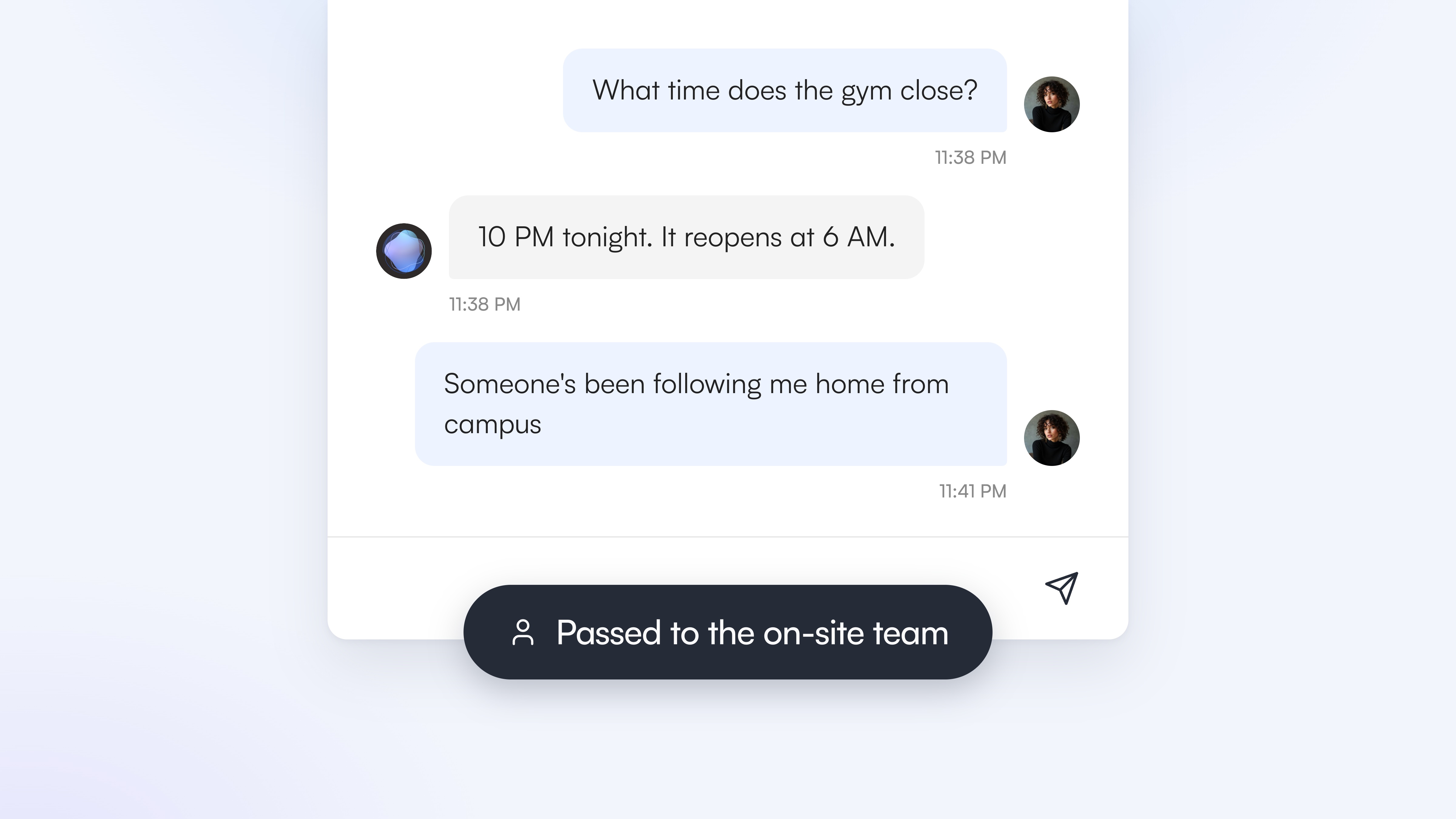
- A person when it matters: where a resident's question needs judgement, it hands over to a member of the team with the conversation history intact.
The distinction is the point. Screening is a regulated decision for people; check-in is operational work that automation is well suited to, and keeping the two apart is what makes onboarding automation safe. See how it handles your move-in season. Book a demo.