
The 2026 State of AI in Real Estate: From Experiment to Infrastructure
The real estate industry has crossed a threshold earlier than expected. What many anticipated for 2028 has already arrived. AI is no longer in pilot mode. It is embedded across portfolios, influencing how properties are marketed, managed, and monetised.
The shift is structural. AI is no longer treated as an add-on or a productivity tool. It is becoming a core layer of infrastructure that connects systems, processes, and customer interactions.
For property managers and institutional operators, the conversation has fundamentally changed. The question is no longer whether to adopt AI, but how to scale it across the entire organisation. Those who treat AI as infrastructure are building long-term advantages. Those who delay are already seeing measurable performance gaps.
How AI Is Transforming Real Estate Operations?
The most immediate impact of AI is visible in day-to-day operations, where efficiency gains translate directly into cost savings and improved service delivery.
According to research by Morgan Stanley, a significant share of real estate tasks can be automated, unlocking billions in efficiency gains over the next decade. It is already reflected in how leading operators are running their portfolios.
Property management teams are reporting:
- 10% to 15% reductions in operating costs
- Faster lease processing cycles
- Lower vacancy periods due to quicker response times
In multifamily portfolios, the operational shift is even more pronounced. A majority of AI adopters report measurable cost reductions, while a large percentage see improvements in lead-to-lease conversion. This indicates that AI is not just reducing workload but directly impacting revenue performance.
One of the most significant changes is in tenant communication.
Traditionally, tenant interactions, calls, emails, and maintenance queries consume the majority of a property manager’s day. In many cases, up to 70–75% of working hours are spent responding to repetitive enquiries. This creates bottlenecks, delays, and inconsistent service.
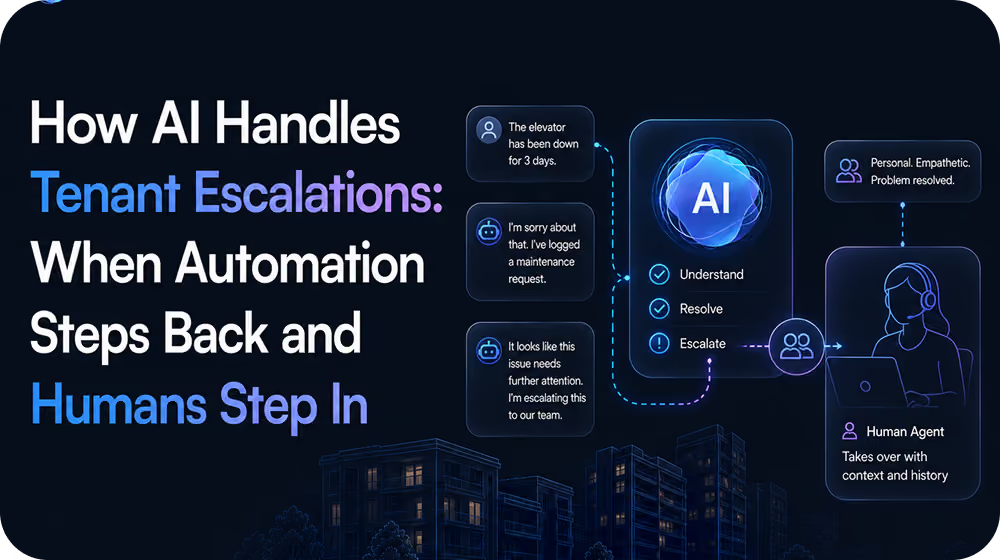
AI-powered communication systems are now handling a large portion of these interactions. In mid-sized portfolios, automated voice and messaging agents can manage bulk inbound queries without human intervention. This leads to:
- Faster response times across all hours
- Improved handling of urgent or emergency requests
- Increased booking rates for after-hours viewings
The operational impact is not just efficiency. It is consistency. Every enquiry receives an immediate and accurate response, reducing friction for both tenants and property managers.
AI is also reshaping other operational areas:
- Predictive maintenance: Systems analyse sensor data to identify potential failures before they occur, reducing downtime and unexpected repair costs
- Lease processing: AI automates document review, cutting down turnaround time from days or weeks to hours
- Portfolio insights: Operators can analyse large datasets to identify performance trends, optimise pricing, and improve occupancy strategies
These changes collectively shift property management from reactive to proactive operations.
How AI Is Changing Real Estate Marketing
While operations benefit from efficiency, marketing benefits from precision.
Real estate marketing has historically struggled with inefficiency. A large portion of leads never convert, yet teams spend significant time engaging with them. This creates a mismatch between effort and outcome.
AI addresses this by introducing intent-driven engagement.
Modern AI systems analyse behavioural signals such as:
- Website activity
- Listing interactions
- Email engagement
- Messaging patterns
This allows operators to understand not just who a lead is, but how likely they are to convert and when they are ready to take action.
Firms that have adopted AI at scale expect significantly higher portfolio growth compared to those that have not. The difference is driven by faster response times and more targeted engagement.
Speed is critical in real estate. Research consistently shows that the probability of conversion drops sharply when follow-ups are delayed. AI eliminates this delay by enabling instant, 24/7 engagement across channels.
This is where VerbaFlo plays a central role. Instead of managing fragmented communication across calls, emails, and messaging apps, operators can centralise all interactions into a single system.
This results in:
- Immediate response to every enquiry
- Consistent follow-ups without manual effort
- Unified tracking of lead interactions across channels
The impact on conversion is significant. AI-managed pipelines ensure that no lead is lost due to slow or inconsistent communication.
Financially, the results are compelling. Industry benchmarks indicate that early AI investments can generate multiple times their cost through a combination of increased conversions and reduced operational overhead.
Marketing is no longer about reaching more people. It is about engaging the right people at the right time with the right context.
Operational ROI: What Operators Are Seeing
AI adoption in real estate is now being measured in financial terms, not just efficiency metrics.
A broader analysis by the McKinsey Global Institute highlights the economic potential of AI across industries, with real estate standing out for its reliance on data, processes, and customer interactions.
At the operational level, the return on investment comes from multiple sources:
- Cost reduction through automation of repetitive tasks
- Revenue growth through improved lead conversion
- Asset optimisation through better pricing and occupancy strategies
Specific outcomes reported across the industry include:
- Reduced maintenance costs through predictive systems
- Increased equipment lifespan due to proactive servicing
- Lower energy consumption through smart building technologies
- Improved tenant satisfaction driven by faster service delivery
These improvements directly impact net operating income.
In commercial real estate, early adopters are reporting consistent returns driven by:
- Faster deal execution
- More accurate underwriting
- Reduced dependency on manual processes
The key insight is that AI compounds value. Small efficiency gains across multiple areas combine to create a significant financial impact at the portfolio level.
AI is no longer viewed as an experimental investment. It is a measurable contributor to profitability.
Risks and Limits of Not Adapting AI in 2026
As adoption accelerates, the risks of not implementing AI are becoming more visible.
Industry data shows a rapid increase in AI adoption among property managers. At the same time, the number of firms choosing not to adopt AI is shrinking.
The implications are clear.
Operators who delay adoption are facing:
- Slower response times
- Higher operational costs
- Lower lead conversion rates
More importantly, they are losing business to competitors who are already using AI to operate more efficiently.
Many organisations operate with disconnected tools that do not share data effectively. This limits the ability of AI systems to deliver consistent results.
The longer adoption is delayed, the harder it becomes to catch up. AI-driven systems improve over time through data and usage. Early adopters benefit from compounding advantages, while late adopters face increasing integration challenges.
This is creating a structural divide in the industry between AI-enabled operators and those still relying on manual processes.
What Forward-Looking Operators Are Doing Differently
Leading operators are not approaching AI as a standalone tool. They are redesigning their systems around it.
The first step is consolidation.
Instead of using multiple disconnected platforms, forward-looking firms are centralising communication and workflows into unified systems. This includes integrating voice, messaging, email, and web interactions into a single layer.
The goal is to create a continuous flow of information in which every interaction contributes to a complete view of the customer.
Platforms like VerbaFlo are enabling this shift by providing a centralised AI layer that manages conversations across all channels. This eliminates fragmentation and ensures consistent engagement.
Beyond tools, these operators are prioritising:
- High-quality, structured data
- Strong integration between systems
- Teams trained to work alongside AI
There is a growing trend toward technology consolidation, as firms move away from fragmented solutions toward integrated platforms.
Importantly, AI is changing how teams operate.
Rather than reducing headcount, AI is enabling teams to focus on higher-value activities:
- Building stronger tenant relationships
- Making strategic portfolio decisions
- Identifying growth opportunities
This represents a shift from task-based work to outcome-driven operations.
Final Takeaway
AI in real estate has moved beyond experimentation. It is now a foundational layer of the industry's operations.
The evidence is consistent. Operators using AI are achieving lower costs, higher conversion rates, and stronger portfolio growth. Those who are not are facing increasing competitive pressure.
The decision in 2026 is not whether to adopt AI. It is how quickly and effectively it can be integrated into existing systems.
The most successful operators are not adding AI to their workflows. They are rebuilding workflows around it.
Platforms like VerbaFlo are designed for this transition. By centralising communication and enabling AI-driven engagement across channels, they help property managers operate at scale while maintaining consistency and quality.
The shift to AI as infrastructure is complete. The organisations that act on it now will define the next phase of real estate performance.