
What the PBSA Booking Journey Looks Like Today
The PBSA booking journey in 2026 is fluid, fast, and multi-channel. See how AI-led conversations cut response times, hold context across platforms, and turn fleeting student enquiries into consistent bookings.

What the PBSA Booking Journey Looks Like Today
The PBSA booking journey in 2026 no longer follows a neat, linear path. It has become far more fluid and, in many ways, less predictable.
A few years ago, the process felt structured. Students would visit a website, fill out a form, wait for a response, and then move through each stage one after the other. That model still exists in parts of the market, but it no longer reflects how most bookings actually happen.
Today, the journey feels more like a series of interactions than a defined process. Students move quickly. They browse multiple properties at once, ask questions as they think of them, and switch between platforms without much consideration. There is very little patience for delays.
Often, the journey starts with something simple. A short message asking about availability or pricing. It does not feel like a formal enquiry, but it is. And what happens next usually determines whether that student continues or disappears entirely.
This shift is closely tied to broader changes in digital behaviour. As expectations around speed and convenience have increased, the tolerance for slow or fragmented responses has dropped just as quickly. For PBSA operators, that has changed where the real pressure lies. It is no longer about attracting attention. It is about responding to it in time.
How AI Is Reshaping Each Stage of the Booking Journey
Artificial intelligence has gradually worked its way into each part of the booking journey. It did not arrive as a complete replacement for existing processes. Instead, it started by removing friction in small areas and then expanded from there.
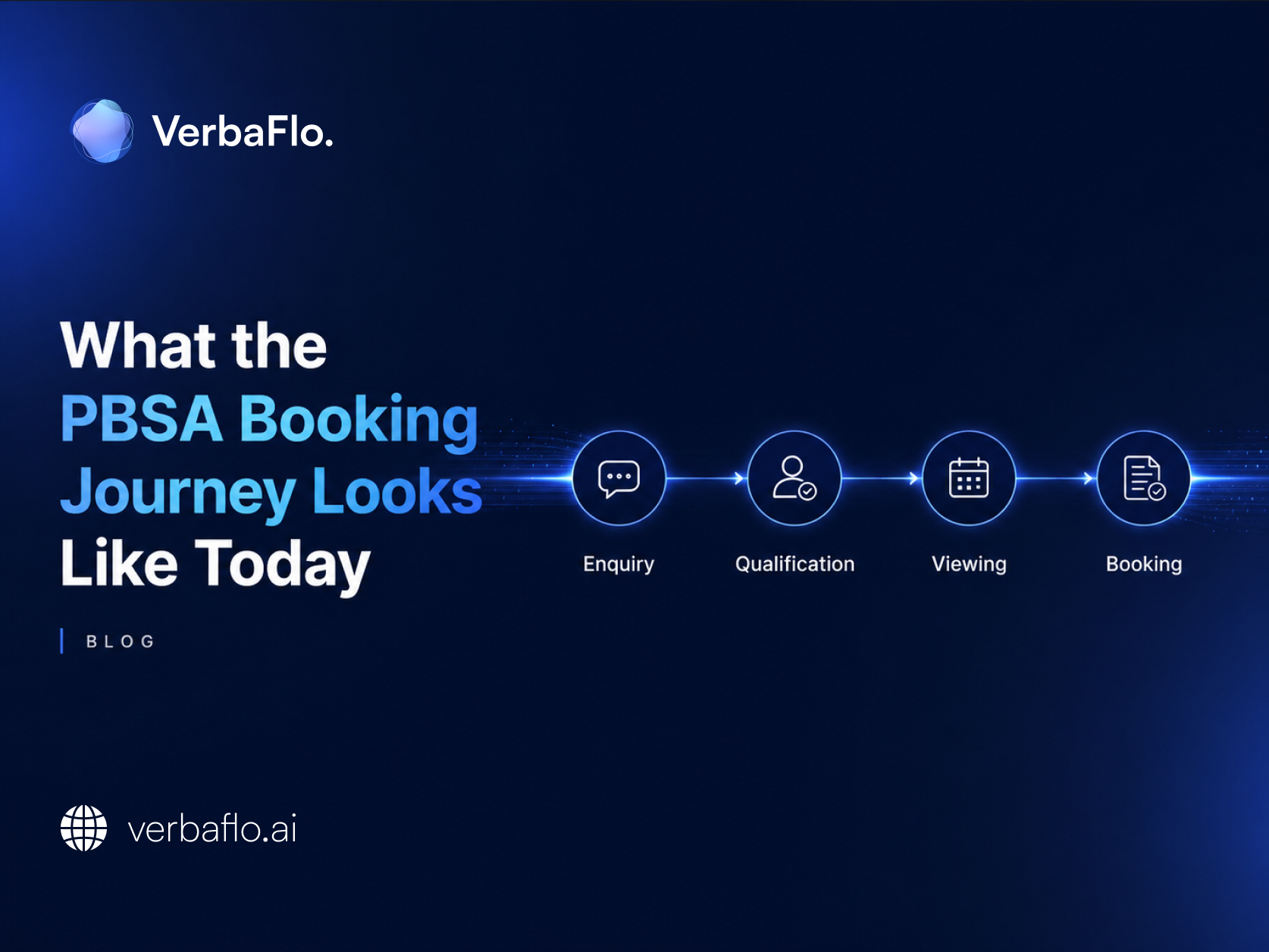
If you look at the journey step by step, the differences become clearer.
| Stage | Earlier approach | Current approach | What changed |
|---|---|---|---|
| Enquiry | Forms and delayed replies | Immediate responses | No waiting time |
| Qualification | Manual follow-ups | Information gathered in conversation | Less effort for the student |
| Viewing | Scheduled visits | Virtual access on demand | Faster decisions |
| Booking | Complex documentation | Guided process | Fewer drop-offs |
The Multi-Channel Mandate: Meeting Students Where They Live
One of the more subtle changes in the booking journey is how often it moves between platforms.
Students do not stay in one place when they enquire about accommodation. They might discover a property on social media, send a message there, continue the conversation elsewhere, and complete the booking on a different platform entirely.
A typical flow might look like this:
- Initial discovery through Instagram
- A quick message to ask a question
- Follow-up on WhatsApp
- Final steps completed on a website
From the student’s point of view, this is completely normal. They do not think about channels. They only think about whether the conversation continues smoothly.
The difficulty for operators is keeping that continuity intact. When systems are not connected, conversations break. Students are asked to repeat information, and small interruptions start to add up.
This is where VerbaFlo becomes important. Instead of treating each channel separately, they maintain a single thread of interaction across all touchpoints. The student moves between platforms, but the conversation itself stays consistent.
That consistency does more than improve the experience. It reduces the chances of losing a lead midway through the journey.
Why Speed Matters: The Economics of Instant Response
Speed has always played a role in real estate, but in PBSA, it has had a much more direct impact.
Students rarely wait for responses now. If they do not hear back quickly, they assume the property is either unavailable or not worth pursuing. In most cases, they move on without following up.
Let's look at it in simple terms:
| Response time | Likely outcome |
|---|---|
| Immediate | High engagement |
| Within a few minutes | Moderate interest |
| Delayed | Drop-off becomes likely |
This becomes even more important when you consider international demand. Many enquiries arrive outside standard working hours. Without automation, those enquiries sit unanswered for long periods.
Conversational systems remove that gap. Every message is handled as it comes in, which keeps the interaction active and prevents early disengagement.
Personalisation for the International Market: Breaking Language Barriers
A large portion of PBSA demand comes from international students. For many of them, booking accommodation involves a degree of uncertainty.
They often make decisions from a different country, in a different time zone, and sometimes in a language that is not their first. Small misunderstandings can quickly lead to hesitation.
Clear communication makes a noticeable difference here.
AI systems help by adapting conversations based on context rather than relying on fixed responses. They support multiple languages and provide explanations that are easier to understand. Financial terms, lease conditions, and processes are presented in a way that feels more approachable.
Personalisation driven by AI improves user confidence and engagement, particularly in complex decision-making environments.
When students feel that they understand what they are committing to, they are more likely to move forward without hesitation.
Real-World Impact: What PBSA Operators Are Reporting
The move towards AI-led booking journeys is no longer theoretical. It is already showing results across portfolios.
While the exact figures vary, the overall pattern is consistent.
| Area | Observed impact |
|---|---|
| Lead engagement | More conversations continue beyond the first interaction |
| Response time | Reduced to near zero |
| Team workload | Fewer repetitive tasks |
| Conversion consistency | More stable outcomes |
Operators using platforms such as VerbaFlo often describe the same shift. Teams spend less time answering routine questions and more time supporting students who are closer to making a decision.
That change in focus has a direct impact on both efficiency and overall experience.
Balancing AI With the Human Touch
Despite all these changes, the human role has not disappeared. It has simply shifted.
AI handles the volume. It deals with the repetitive, time-sensitive parts of the journey. But there are still moments where human input matters more.
Complex situations, specific concerns, or conversations that require judgment still benefit from a human’s involvement.
The balance usually works like this:
- AI manages initial enquiries and routine interactions
- Human teams step in when conversations become more detailed
- Transitions between the two remain smooth and unobtrusive
Platforms like VerbaFlo are designed with this balance in mind. The goal is not to replace human interaction, but to make it more meaningful when it happens.
How to Start: A Practical AI Roadmap for PBSA Operators
Introducing AI into a PBSA portfolio works best in stages. Trying to change everything at once usually creates more friction than it removes.
A more practical approach tends to follow a simple progression.
Start by identifying friction points
Look at where students drop out of the journey or where delays tend to occur.
Introduce a focused pilot
Apply AI to a specific area, such as enquiry handling or early qualification.
Connect existing systems
Ensure that the AI platform integrates with existing tools so that information remains accurate.
Refine based on real usage
Use actual interactions to improve how the system responds.
Expand gradually
Once the process is stable, extend it across more assets or stages of the journey.
This approach allows operators to improve performance without disrupting what already works.
The PBSA booking journey today is no longer defined by steps, but by moments. Moments where a question is answered instantly, where a conversation flows without interruption, and where a student feels confident enough to move forward. AI has made these moments smoother, faster, and more intuitive, but its real value lies in how it supports both the student and the operator simultaneously. For PBSA operators, the opportunity is clear. Those who adapt to this more dynamic, multi-channel, and expectation-driven journey will not only capture more enquiries, but convert them with far greater consistency. And in a market where attention is fleeting, that ability to respond, guide, and close in real time is what ultimately sets leading operators apart.
Ready to hear it for yourself?
Get a personalized demo to learn how VerbaFlo can help you drive measurable business value.
You may also like
Ready to hear it for yourself?
Get a personalized demo to learn how VerbaFlo can help you drive measurable business value.
