Finding the right home should be challenging because of location, budget or availability, not because the leasing process itself is difficult to access.
Yet for many renters with disabilities, barriers can appear long before they move in. A leasing website that is incompatible with screen readers, application forms that cannot be navigated using a keyboard, or maintenance requests that require a phone call can all make an otherwise suitable property feel inaccessible. For multifamily operators, accessibility is more than good customer service. It is a legal and operational responsibility. Creating an inclusive leasing experience means ensuring prospective and current residents can access information, communicate with property teams and request support in ways that meet their individual needs.
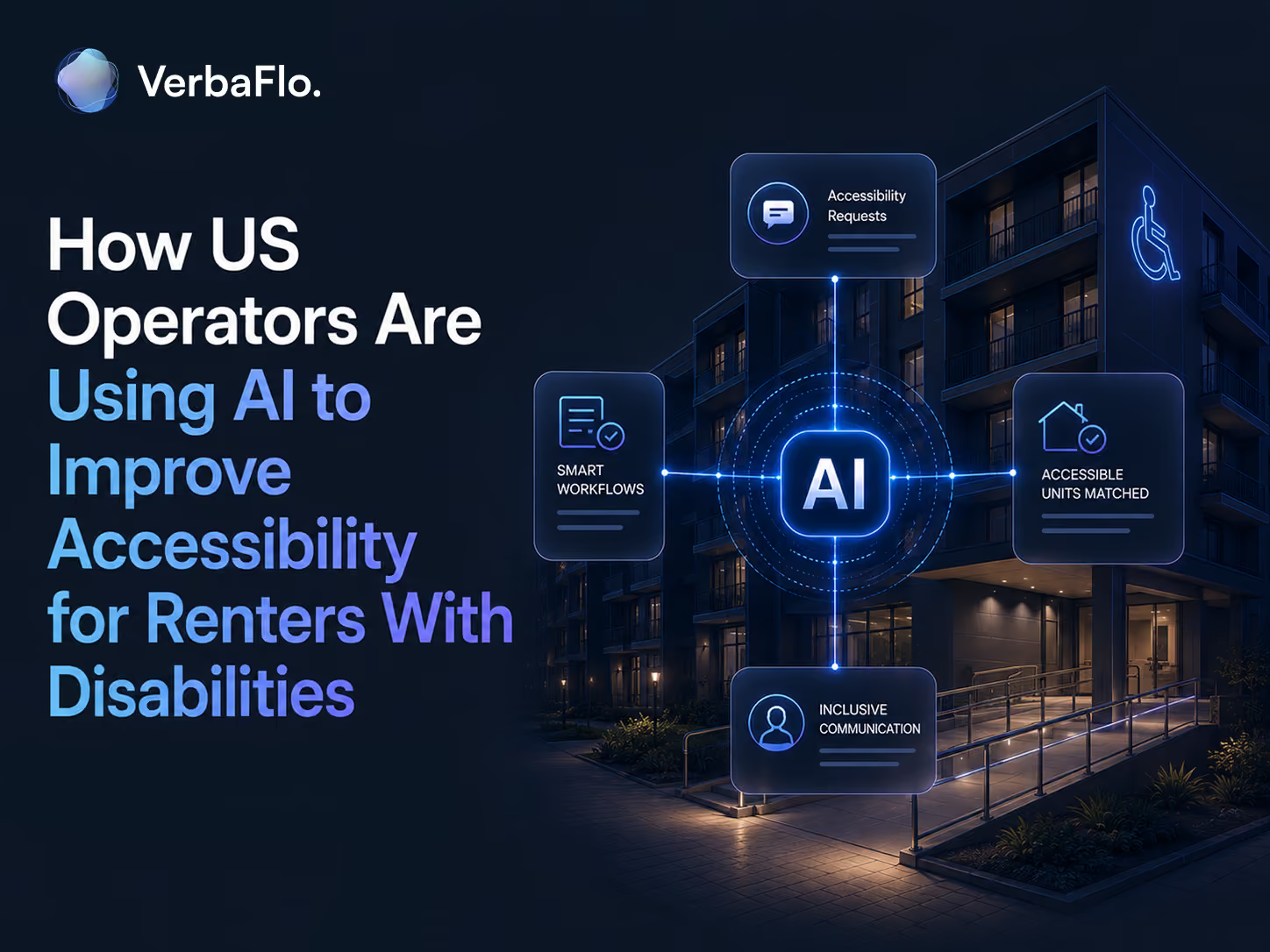
Artificial intelligence is helping operators make these interactions more accessible. From simplifying communication to supporting alternative formats and streamlining accommodation requests, AI is becoming a practical tool for improving the resident experience while helping leasing teams manage accessibility more consistently.
As expectations around digital accessibility continue to evolve, operators are recognising that accessibility is not a one-time compliance exercise. It is an ongoing commitment to making every stage of the resident journey easier to navigate.
ADA and Fair Housing Act Requirements for Multifamily Accessibility
Accessibility in multifamily housing is guided by several important federal laws, including the Americans with Disabilities Act (ADA) and the Fair Housing Act (FHA). While these laws apply in different ways depending on the property and services provided, both aim to ensure individuals with disabilities have equal access to housing opportunities.
For operators, accessibility extends beyond physical features such as ramps, lifts or accessible parking. Digital experiences increasingly play a role as well. Prospective residents often complete applications online, schedule tours through websites, communicate with leasing teams digitally and submit maintenance requests through resident portals. If these systems are not accessible, they can unintentionally create barriers for people with visual, hearing, cognitive or mobility disabilities.
Meeting accessibility obligations therefore requires operators to consider both the physical and digital resident journey, ensuring communication remains inclusive from the first enquiry through long-term residency.
How AI Makes the Leasing Process More Accessible for All Renters
Accessibility does not always require creating entirely new processes. Often, it means giving people more ways to complete the same task. Consider a prospective resident who has difficulty navigating a lengthy online application because of a visual impairment. Another applicant may find typing difficult because of a mobility-related disability. Someone with a cognitive disability may simply benefit from receiving information in smaller, clearer steps.
AI helps create more flexible leasing experiences by adapting communication to individual needs. Instead of requiring every applicant to follow the same pathway, AI-powered systems can answer questions conversationally, guide applicants through forms one step at a time, provide clarification when needed and reduce unnecessary complexity during the leasing process.
By making communication easier to understand and navigate, operators create a more inclusive experience without changing the underlying leasing requirements.
AI for Alternative Communication Formats: Screen Readers, Voice, and Large Text
People access digital information in different ways. Some rely on screen readers to interpret website content. Others use voice commands rather than keyboards. Some benefit from larger text or simplified language that makes complex information easier to understand.
AI can support these different communication preferences by making information more adaptable. For example, AI-powered communication systems can present responses in clear, structured language that is easier for assistive technologies to interpret. Voice-enabled interactions may allow applicants to ask leasing questions without navigating multiple webpages, while well-structured digital conversations can complement screen readers by presenting information in a logical sequence.
These capabilities do not replace established accessibility standards or website design requirements. Instead, they enhance the overall communication experience by providing additional ways for residents to obtain information and complete common leasing tasks.
How AI Handles Reasonable Accommodation Requests Automatically
Requesting a reasonable accommodation can be an important part of securing or maintaining suitable housing. Whether a resident is requesting an accessible parking space, permission for an assistance animal, or another accommodation related to a disability, the process often begins with documentation, communication and careful review by the property team.
AI helps organise these requests without making the decision itself. Instead of relying on emails, paper forms or multiple phone calls, AI can guide residents through the submission process, explain what information may be required, confirm receipt of documentation and keep applicants informed about the status of their request throughout the review process.
This is where conversational AI can play a valuable supporting role. Rather than leaving residents uncertain about what happens next, solutions like VerbaFlo can provide timely updates, answer common process-related questions and help ensure communication remains clear and consistent while property teams complete the necessary review.
By reducing administrative delays and improving transparency, operators create a more supportive experience while ensuring accommodation requests continue to receive appropriate human consideration.
AI for Accessible Maintenance Request Submission
Accessibility does not stop once a resident signs the lease. Submitting a maintenance request is one of the most common interactions residents have with their property team, and it should be just as accessible as the leasing process itself.
For some residents, calling the leasing office may not be the easiest option. Others may find online portals difficult to navigate because they are not fully compatible with assistive technologies. Even something as simple as describing a maintenance issue can become frustrating if the communication channel does not meet a resident's needs.
AI offers multiple ways for residents to report maintenance issues. Instead of relying on a single portal or communication method, residents may be able to submit requests through a conversational interface, use voice-enabled interactions, or receive guided prompts that make it easier to explain the issue. AI can also ask follow-up questions to gather essential information before routing the request to the appropriate maintenance team. By providing more accessible ways to report problems, operators improve both the resident experience and the quality of information received by maintenance staff.
The Documentation Trail: How AI Protects Operators in ADA Compliance
Accessibility is not only about responding to requests. It is also about maintaining clear and consistent records. Whether a resident submits a reasonable accommodation request, reports an accessibility concern or asks for additional support during the leasing process, property teams benefit from having a well-documented communication history.
AI helps create this documentation automatically. Every interaction can be organised chronologically, making it easier for leasing teams to track requests, record responses, monitor follow-up actions and demonstrate that communications were handled consistently.
This level of documentation supports operational transparency while helping teams respond more efficiently if questions arise later about how a request was managed. It is important to remember that AI supports record-keeping rather than compliance itself. Operators remain responsible for ensuring requests are reviewed appropriately and that all actions comply with the Fair Housing Act, the Americans with Disabilities Act where applicable, and relevant state and local requirements.
Building an Accessibility-First AI Communication Workflow
Creating a more accessible resident experience does not require replacing existing leasing processes. It begins with designing communication that gives every resident an equal opportunity to engage. An accessibility-first workflow typically focuses on making every interaction easier to complete, regardless of how a resident chooses to communicate.
This may include:
- Multiple channels: offering several communication methods instead of relying on a single one.
- Assistive-friendly formats: presenting information in formats compatible with assistive technologies.
- Step-by-step guidance: walking residents through applications and requests one stage at a time.
- Timely updates: keeping residents informed on accommodation or maintenance requests.
- Consistent documentation: maintaining records throughout every interaction.
- Human escalation: passing complex or sensitive situations to trained staff for review.
When accessibility is built into everyday communication rather than treated as a separate process, residents experience fewer barriers while property teams benefit from more organised and consistent workflows. The objective is not simply to adopt AI. It is to create an environment where every resident can access information, request assistance and communicate with confidence.
Accessibility is an essential part of delivering a positive resident experience. As more leasing and resident services move online, operators have an opportunity to remove digital barriers alongside physical ones. AI supports this effort by making communication more flexible, simplifying routine interactions, improving access to information and helping property teams manage requests more consistently. From the first leasing enquiry to ongoing resident support, these tools enable operators to create experiences that are easier to navigate for everyone. Book a demo to see how it works.