
Managing a 100-unit apartment community and managing a portfolio of more than 1,000 units are fundamentally different operational challenges. As portfolios grow, complexity increases across every function. Leasing enquiries multiply, maintenance requests arrive around the clock, resident communications become harder to standardise, and property teams must coordinate operations across multiple communities while maintaining consistent service levels.
Traditional property management processes that work well for a single community often struggle under enterprise-scale demands. Manual workflows, fragmented communication and disconnected systems can slow operations, increase administrative workloads and make it difficult for leadership teams to maintain visibility across an entire portfolio.
Artificial intelligence is helping multifamily operators navigate this complexity by automating repetitive workflows, improving operational consistency and turning large volumes of portfolio data into actionable insights. Rather than replacing onsite teams, AI enables property managers to scale operations more efficiently while allowing staff to focus on resident relationships, strategic decision-making and exceptional service.
As enterprise portfolios continue to expand, large portfolio property management AI is becoming an important part of building resilient, scalable operations that can grow without proportionally increasing operational overhead.
Why Scale Changes Everything in Property Management
Growth creates opportunity, but it also introduces operational complexity. Every additional property increases the number of residents, vendors, maintenance requests, leasing activities, compliance requirements and financial transactions that property teams must manage. What begins as a manageable workload across one or two communities quickly becomes difficult to coordinate across dozens of properties.
One of the biggest challenges is maintaining consistency. Enterprise operators need every community to deliver the same standard of service while allowing onsite teams enough flexibility to respond to local resident needs. Without standardised workflows, response times, communication quality and operational performance can vary significantly across the portfolio. As operations become more data-driven, AI is helping connect workflows that have traditionally existed in separate systems.
The Problems That Only Emerge at 500+ Units (And How AI Solves Them)
Operational challenges change significantly as portfolios grow beyond a few hundred units. Higher leasing volumes, increased maintenance activity, larger vendor networks and thousands of resident interactions create operational bottlenecks that are difficult to manage using manual processes alone. Small inefficiencies that may go unnoticed at a single property can quickly become portfolio-wide issues affecting resident satisfaction, staff productivity and operating costs.
Some of the most common challenges include:
- Slow responses: delayed replies to resident enquiries as volume outgrows the team.
- Maintenance backlogs: requests accumulating faster than they are resolved.
- Missed leasing opportunities: prospects lost to slow follow-up.
- Inconsistent communication: service quality varying from one community to another.
- Limited visibility: little portfolio-wide insight into performance.
AI helps operators address these challenges by automating routine workflows while creating a centralised view of portfolio operations. Instead of relying on multiple disconnected tools, leadership teams gain greater visibility into leasing, maintenance, resident communication and operational performance across every property.
The objective is not simply to manage a higher volume of work. It is to deliver a consistent resident experience while giving regional and corporate teams better visibility into portfolio performance.
Communication at Scale: How AI Maintains Consistency Across Multiple Communities
Communication is one of the first areas where operational complexity becomes visible at scale. Across dozens of communities, residents expect timely responses to questions about leasing, maintenance, rent payments, amenities, renewals and community policies, often outside traditional office hours. Without standardised communication processes, response times and messaging can vary from one property to another, creating inconsistent resident experiences.
AI helps establish greater consistency by responding to routine enquiries, sharing accurate property information and supporting residents whenever assistance is needed. Common applications include answering frequently asked questions, providing leasing information, sharing maintenance updates, sending rent payment reminders, confirming appointments and tours, and supporting residents beyond office hours.
As portfolios continue to expand, VerbaFlo helps standardise resident communication across communities, enabling onsite teams to spend more time addressing complex resident needs while routine interactions are handled efficiently. This allows operators to scale communication without compromising the quality of the resident experience.
Maintenance at Scale: How AI Handles Hundreds of Requests Each Week
Maintenance operations become significantly more complex as portfolios grow. A large multifamily operator may receive hundreds of work orders every week, ranging from routine service requests to urgent repairs. Coordinating these requests across multiple communities while meeting service-level expectations can quickly overwhelm onsite teams.
AI helps streamline this process by automating maintenance workflows from request intake to work order completion.
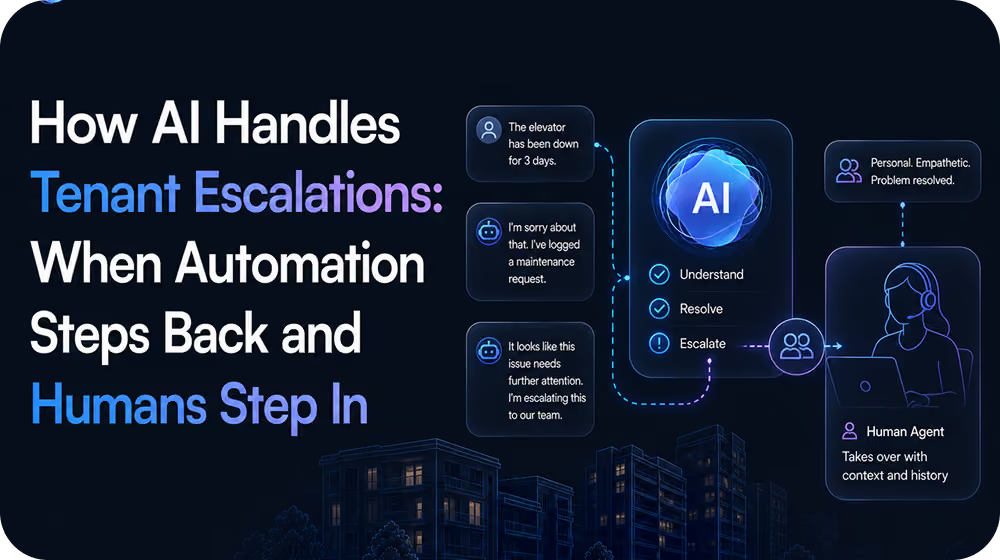
When residents submit maintenance requests through a resident portal or conversational assistant, AI can categorise the issue, assess its urgency, recommend the appropriate trade and route the request to the right internal team or vendor. Throughout the process, residents receive automated updates, reducing uncertainty while minimising follow-up calls to the leasing office.
As maintenance volumes continue to increase, VerbaFlo fits naturally into existing property operations, helping teams automate routine maintenance conversations while keeping residents informed at every stage of the service journey.
Leasing at Scale: Ensuring No Lead Is Lost
For enterprise operators, every missed leasing enquiry represents a potential loss in revenue. Managing high lead volumes across multiple communities makes it increasingly difficult for onsite teams to respond consistently, particularly outside business hours. AI helps reduce this risk by engaging prospective residents the moment an enquiry is received.
Routine questions about pricing, floor plans, availability, amenities and community features can be answered instantly. AI can also qualify prospects, schedule tours and capture lead information, ensuring every enquiry enters the leasing pipeline without delay.
This significantly improves speed-to-lead, one of the most important factors influencing leasing conversion. Instead of spending valuable time answering repetitive questions, leasing teams can focus on building relationships with qualified prospects and guiding them through the decision-making process.
Data at Scale: Turning Portfolio-Wide Information Into Better Decisions
Enterprise property management generates enormous amounts of operational data every day. Maintenance requests, leasing activity, resident communications, occupancy trends, renewals, vendor performance and financial metrics all provide valuable insights. The challenge is bringing this information together in a way that supports better decision-making. This is where enterprise property management through AI creates value beyond workflow automation.
Rather than reviewing reports from individual properties, AI can identify portfolio-wide patterns and surface insights that may otherwise go unnoticed. Leadership teams can quickly understand which communities are experiencing higher maintenance volumes, where leasing conversions are slowing, which properties have declining renewal rates, what resident concerns are becoming recurring themes, and which operational processes require additional support.
Best Practices for Implementing AI Across Large Portfolios
Successfully scaling AI requires more than introducing new technology. It requires thoughtful implementation supported by clear operational goals. Operators adopting portfolio-scale AI in real estate should focus on the following:
The most successful enterprise operators treat AI as an operational partner rather than a standalone technology. By automating repetitive work while providing better visibility into portfolio performance, AI helps teams scale without sacrificing service quality.
Scaling property management is about far more than adding units. It requires managing increasing operational complexity while delivering a consistent experience for residents across every community. Artificial intelligence is helping enterprise operators meet this challenge by automating routine workflows, improving communication, streamlining maintenance and leasing operations, and transforming portfolio-wide data into actionable insights.
Rather than replacing property professionals, AI gives them the tools to manage larger portfolios with greater efficiency and confidence. Organisations that combine experienced property teams with intelligent automation will be better positioned to improve resident satisfaction, strengthen operational performance and support sustainable portfolio growth. Book a demo to see how it works at scale.