
A resident starts parking a second vehicle in a single-space allocation. Another sublets a room without approval. A third generates noise complaints from two neighbours in a month.
None is dramatic alone, and each can sit unaddressed until it becomes a pattern that is harder and more expensive to fix.
Lease compliance monitoring exists to catch those situations early, while a conversation can still solve them. This article covers what it involves, how AI supports detection and documentation, and why the enforcement decisions need to stay with people.
What Is Lease Compliance Monitoring and Why Does It Matter?
Lease compliance monitoring is the practice of tracking whether the terms both parties agreed to are being met, and addressing gaps before they escalate. The obligations run in both directions:
- The resident's side: paying on time, keeping to occupancy limits, and observing pet, parking and nuisance rules.
- The operator's side: maintaining the property, respecting notice requirements and providing habitable conditions.
Monitoring that only looks at one side of that agreement misses half the picture.
Early intervention is what makes it worthwhile. A parking issue raised in week one is a conversation. The same issue raised in month six, after neighbours have complained repeatedly, is a confrontation. Most lease issues are resolved more cheaply, and with less damage to the relationship, when addressed promptly.
Unaddressed violations also affect other residents, drive turnover among those who complain, and in serious cases create safety or liability exposure.
The Most Common Lease Violations (And How They're Currently Missed)
The violations that cause the most trouble tend to be the mundane ones that nobody owns.
- Unauthorised occupants: people living in a unit who are not on the lease, affecting occupancy limits, insurance and sometimes safety compliance.
- Pet policy breaches: undisclosed animals, or animals outside the agreed terms, complicated because assistance animals are protected under fair housing law.
- Parking and common area misuse: persistent issues generating complaints out of proportion to their apparent seriousness.
- Noise and nuisance: usually reported by neighbours, and among the hardest to substantiate.
- Unauthorised alterations: changes to the unit discovered at inspection or move-out, long after they were made.
They are missed for structural reasons rather than negligence. Information arrives in fragments, through a maintenance note, a verbal complaint at the desk, a comment to a caretaker, and sits in different systems or in nobody's system. The person who hears about it may not be the person who could act, and by the time a pattern is visible it has run for months.
How AI Detects Lease Violations: Data Sources and Signal Detection
Detection works by connecting information the operator already holds, and the choice of data sources matters as much as the analysis.
Legitimate operational signals include maintenance requests mentioning circumstances inconsistent with the lease, resident complaints logged across a period, and work order histories showing repeated issues at a unit. Systems generating access or parking data can also produce relevant signals, where residents have been told what is collected and why.
AI adds value by connecting these across sources and over time. Three noise complaints from different neighbours in a fortnight is a pattern no single member of staff may see, because each arrived separately. Surfacing it to a person is the useful function.
Two limits belong here, and both are essential.
The first is privacy. Monitoring residents in their homes carries legal and ethical constraints, and a technology's ability to generate a signal is separate from whether an operator should collect it. Stay with data the operator has a clear operational reason to hold, tell residents what is collected, and check state and local law on surveillance and data use.
The second is that detection differs from determination. A signal indicates something worth looking at, and a person establishes whether a violation actually occurred. A maintenance note mentioning an extra bed is a reason to ask, and nothing more than that.
Automated Violation Notices: Timing, Tone, and Legal Compliance
A violation notice is a legal document, and in many jurisdictions it is the first step in a process that can end in eviction. That status shapes how much of it can be automated.
The mechanics automate well. Templates hold the required content, systems track cure periods and deadlines, and records show what was sent and when. Consistency is protective, since a notice missing statutory content or served incorrectly can invalidate the process an operator later relies on.
Tone matters more than it might appear. A first notice about a parking space is best written as a reminder, because most first violations are resolved once the resident knows. Escalating language at the first step produces disputes that a straightforward request would have avoided.
The authorisation stays human. A person should review and approve every notice before it is served, for two reasons. Notices carry legal consequences and need to be right, and a queue of pending notices is where an operator can see whether enforcement is consistent across the property. Automating the drafting is sensible. Automating the decision to serve removes the check that catches errors and inconsistency.
How AI Supports Escalation Decisions on Repeat Violations
Repeat violations are where a compliance process either works or creates serious exposure, and where the case for human authorisation is strongest.
AI supports this by maintaining the record. It tracks what was raised, when, what response was received and whether the issue recurred, so a manager considering the next step has the full history. It can flag when a matter reaches a threshold defined in the operator's own policy.
The step beyond that is where caution belongs. Escalation moves towards proceedings that can cost a household their home, and those decisions require context a system does not hold. Whether the resident disputes the facts, whether an accommodation request is pending, whether the underlying issue is a repair the operator has failed to make.
There is a fair housing dimension that makes this concrete. A threshold triggering escalation after a set number of complaints or emergency calls can fall hardest on households with disabilities, or on domestic violence survivors who called for help.
HUD has stated that the Fair Housing Act applies to housing practices including when artificial intelligence and algorithms perform them, and that it prohibits practices with an unjustified discriminatory effect as well as intentional discrimination.
The defensible design is straightforward. AI assembles the history and presents it. A person decides what happens next, and the reasoning behind that decision is recorded.
The Documentation Trail: How Consistent Records Protect Operators
Documentation is the part of compliance monitoring that delivers the clearest value, and it protects operators in more ways than the obvious one.
A complete record shows what was reported and when, what notice was issued and how it was served, and what the operator did next. Assembled as a by-product of the process, it exists without anyone reconstructing it later.
The obvious benefit is evidential. Where a matter reaches a formal process, contemporaneous records carry considerably more weight than recollection.
The less obvious benefit matters more. Consistent records let an operator check whether enforcement is applied evenly. If notices for the same violation are issued at different rates across a property, that pattern is a fair housing risk, and documentation makes it visible while it can still be corrected.
Building a Compliance Monitoring Workflow With AI
A workable process keeps automation on the administrative work and people on the decisions.
- Define the rules first: write down what constitutes a violation, what the response is at each stage and who authorises it, before configuring any system. Automating an unclear policy multiplies the confusion.
- Connect existing sources: start with maintenance records, complaint logs and payment data rather than new collection, and be explicit with residents about what is held.
- Route signals to a person: treat AI output as a queue for review, not a trigger for action.
- Require authorisation at every stage: human approval for each notice and each escalation step, recorded with the reasoning.
- Audit for consistency: review enforcement patterns by property and violation type, checking similar situations are treated similarly.
- Check the legal position: confirm notice content, cure periods and service requirements with counsel who knows local landlord-tenant law.
The first step determines everything after it. A compliance process is only as fair as the policy underneath it, and automation makes an inconsistent policy inconsistent faster.
Where Compliance Communication Meets VerbaFlo
Most lease issues are resolved by a conversation rather than a notice. A resident who did not know about a rule usually complies once told, and operators with the fewest formal disputes raise issues early and clearly.
That early contact is communication work, and it sits separately from the enforcement decisions around it. VerbaFlo is a conversational AI platform for residential real estate operators that runs this layer. Three parts of it fit compliance communication:
- Reaching residents promptly: it handles resident enquiries and support across webchat, WhatsApp, email and voice, so an issue can be raised while it is still minor.
- Consistent explanations: answers about rules, policies and procedures come from the operator's own approved content, so every resident receives the same information.
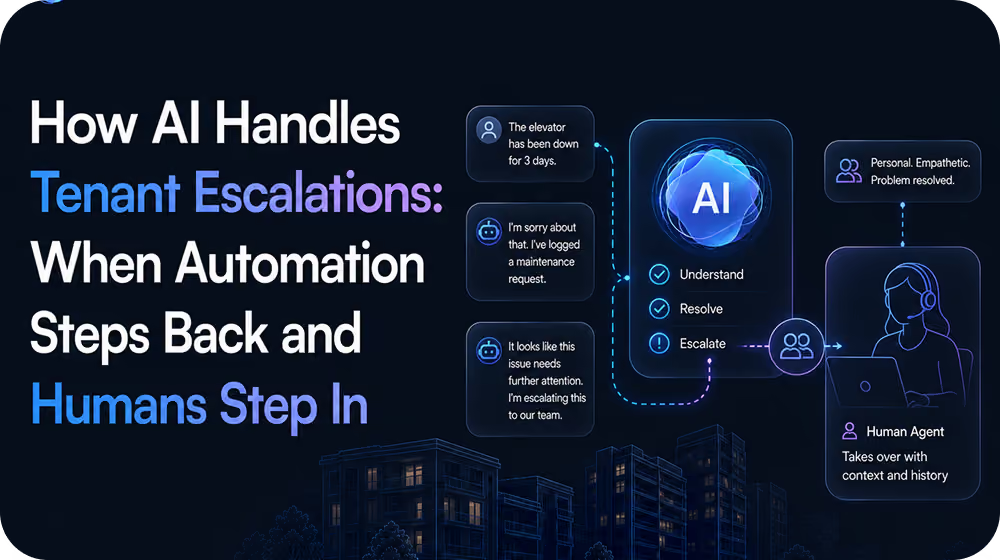
- Escalation with context: anything contested or sensitive passes to a person with the conversation history attached, which is what a disputed matter needs.
The division is worth stating plainly. Issuing notices, deciding escalations and judging whether a violation occurred are decisions for qualified staff, with a record of who decided and why. Keeping residents informed is communication work, and doing it early stops most issues from becoming formal matters.
Book a demo to see how it handles resident communication at scale.