The person approving a six-figure roof replacement at a homeowners association is usually not a property professional. They are a resident who volunteered, who has a full-time job elsewhere, and who now carries a fiduciary duty to several hundred neighbours.
That gap, between the scale of the responsibility and the hours available to meet it, is the defining problem in community association management. It is also where AI is proving most useful.
This article covers how HOA management differs from standard property management and the operational challenges AI is addressing. It then looks at what associations gain across communication, maintenance, finance and governance.
How HOA Management Is Different From Standard Property Management
Both models involve managing residential property, and the two are often confused. They differ in who owns the property, who decides and what the manager answers to.
Standard property management covers rental property. An owner or operator holds the asset, tenants pay rent to occupy it, and a manager runs the property on the owner's behalf. The relationship is commercial, with the manager delivering a service the tenant pays for.
Community association management covers property owned collectively. A homeowners association is a private organisation of the owners in a development, formed to govern and maintain the shared property. Every owner is automatically a member, pays assessments rather than rent, and elects a board from among the membership. That board carries legal responsibility for the association.
The table sets the two side by side:
Three consequences follow for anyone applying technology here:
- The residents are the owners: homeowners hold membership in the association. They vote, they can stand for the board, and they have rights to inspect records and question decisions.
- The decision-makers are volunteers: a board of unpaid residents holds legal and financial responsibility, usually without formal training in governance or finance.
- The work is governance as well as operations: meetings must be noticed and minuted, rules enforced consistently, and reserves funded, all under state statutes that vary and are tightening.
This is a substantial housing sector. The Foundation for Community Association Research estimates more than a third of US housing sits within a community association, across roughly 373,000 associations housing 78.1 million residents.
The Operational Challenges AI Is Solving for HOA Managers
Community association managers typically run several associations at once, each with its own board, budget, rules and calendar. The load is administrative, repetitive and unforgiving of error. Four pressures dominate:
- Communication volume: every association generates enquiries about fees, rules, amenities and repairs, and each one lands on a manager already serving other communities.
- Consistency across communities: answers must reflect the governing documents of that specific association, so a policy that holds in one community may be wrong in another.
- Documentation and compliance: records, notices and decisions must be accurate and retrievable, because state requirements around reserves, disclosures and building safety have tightened.
- Volunteer turnover: boards change, and institutional knowledge leaves with departing members unless it is captured somewhere durable.
AI addresses the parts that are high-volume and rule-bound, which is most of the administrative burden. The parts requiring judgement stay with people.
AI for Resident Communication: Announcements, Fee Notices, and Violations
Communication is the largest single demand on a manager's day, and the most repetitive.
AI handles the routine layer. Homeowners asking about assessment amounts, amenity bookings or architectural request procedures get an immediate answer drawn from that association's own documents, at any hour. Announcements, meeting notices and fee reminders also go out consistently with delivery tracked, which matters when a notice period carries legal weight.
Violation notices are the sensitive case. AI can standardise the mechanics, generating the notice from a consistent template, logging the evidence and tracking the response window. That supports the even-handed enforcement that reduces disputes.
The judgement about whether to cite a homeowner belongs to the manager and the board. A rules violation is a dispute between neighbours before it is an administrative task, and automating the decision rather than the paperwork invites conflict.
AI for Maintenance Coordination in HOA Communities
Association maintenance covers shared property, from roofs and roads to pools, lifts and landscaping, and it runs through vendors rather than in-house staff.
AI supports the coordination. A homeowner reporting a broken gate or a leaking common-area pipe gets an immediate acknowledgement, the request is categorised by urgency, and the details a contractor needs are gathered before the job is dispatched. The reporting resident receives updates without having to chase the manager.
The record-keeping matters more here than in rental property. Deferred maintenance on shared assets is a reserve-funding question and increasingly a compliance one, so a complete history of each job feeds directly into the reserve study.
Emergency triage is where speed pays. A burst pipe in a shared wall affects multiple homes at once, and routing it to the right vendor immediately limits the damage and the eventual claim.
AI for Financial Reporting and Budget Management in HOAs
Association finances are unusual. The money belongs to the members, the board holds it in trust, and homeowners are entitled to see how it is handled.
AI helps in three practical places. It automates the assembly of monthly financial reports, pulling figures into a consistent format rather than a manager rebuilding them for each association. It codes and routes vendor invoices for approval, keeping an audit trail, and flags budget variances early, turning a year-end surprise into a month-three question.
Assessment collection is a further application. Reminders before the due date and prompt follow-up afterwards recover more than sporadic chasing does.
The honest limit is that AI produces the reporting rather than the judgement. Whether to raise assessments and when to levy a special assessment are board decisions with legal consequences. Better data supports those decisions without making them.
AI for Board Governance: Meeting Prep, Voting, and Compliance
Governance is the least automated part of association management and the most administratively heavy.
Meeting preparation is the clearest gain. Agendas, board packets and supporting documents can be assembled from existing records rather than compiled by hand, and minutes drafted from a recording for the secretary to correct. For a volunteer with a day job, that is hours returned each month.
Records and compliance follow. Governing documents, correspondence and decisions become searchable, so a board can find what was decided about a similar request three years ago. That institutional memory survives board turnover.
Elections deserve caution. AI can handle the administration around a vote, including notices, quorum tracking and reminders. The integrity of the ballot itself is a legal matter governed by statute and the association's documents, so this is an area for established, compliant systems rather than experimentation.
The principle across governance is that AI prepares the material and people make the decisions. A board that lets software decide has misunderstood its duty.
What HOA Management Companies Are Getting From AI in 2026
For management companies, the return is capacity. A manager relieved of routine correspondence, report assembly and packet preparation can serve their communities properly rather than working through a backlog.
Managers hold larger portfolios without service degrading, response times improve because routine questions are answered immediately, and service becomes consistent across communities of any size.
Boards notice this in specifics rather than technology. Packets arrive earlier, reports arrive on time, and questions get answered the same day, which are the outcomes management contracts are renewed on.
One caveat is worth stating. AI layered over disorganised records inherits those problems, and associations that see real gains get their documentation and workflows in order first.
Where Conversational AI Fits, and Where VerbaFlo Sits Today
The pattern across every section above is that AI absorbs the routine work and people keep the judgement. For associations, the biggest share of that routine load is conversation, since homeowners ask the same questions in every community.
A note on scope is due here. VerbaFlo is a conversational AI platform built for residential real estate operators, and its stated markets are build-to-rent and multifamily alongside student accommodation. Community associations are not a market it currently claims.
The underlying capability is closely related, because the work is the same shape. Four parts of the platform map onto what association management actually demands:
- Every channel in one place: it handles resident enquiries and support across webchat, WhatsApp, email and voice, so a homeowner reaches the manager the way they prefer and the thread stays in one record.
- Answers from an approved knowledge base: the platform recognises what is being asked and responds from the operator's own approved content, which is the mechanism an association would need to answer from its specific governing documents rather than generic rules.
- Requests that become actions: conversations capture the details and move a request forward, logging what was reported and routing it onward to the right person.
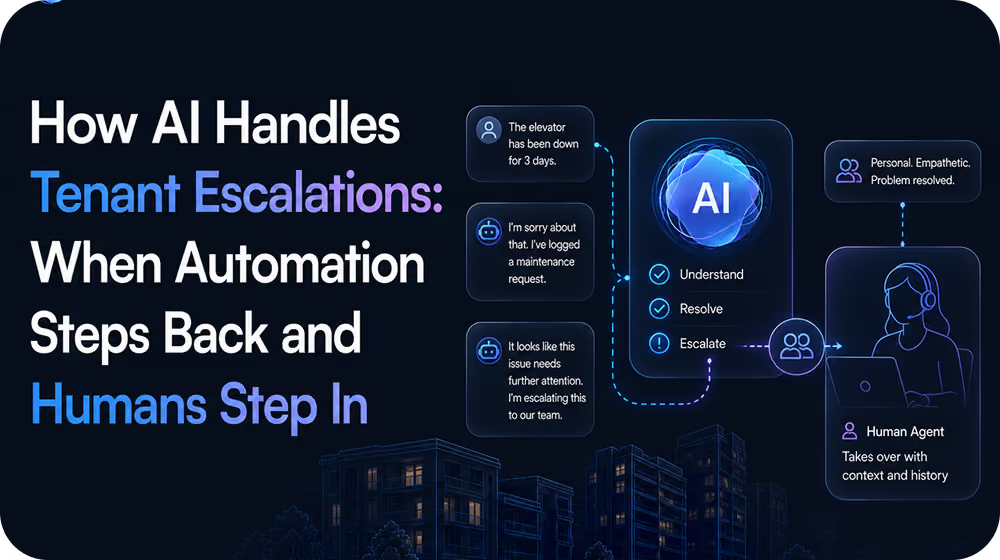
- Handover with the context attached: anything needing judgement escalates to a person with the conversation history, which is the safeguard that matters for violations, disputes and board decisions.
For an association, that shape fits. Routine questions are answered the moment they arrive, and the decisions carrying legal weight stay with the manager and the board. For operators running BTR or student portfolios facing the same communication problem, that fit is direct today.
Book a demo to see how it handles resident communication at scale.