
Real Estate Chatbot: What It Is and Whether You Need One
Most property owners who ask about chatbots are really asking something else. They want to know whether there is a better way to handle the volume of resident and prospect enquiries their team fields every day, without adding headcount or making mistakes.
A chatbot for real estate can solve this problem, but the technology that actually fixes it often looks very different from what most operators imagine.
This guide explains what real estate chatbots are, where they work effectively, where they hit a ceiling, and what to look for if you want a more advanced system. By the end, you will have enough insight to decide which option best suits your operation.
What Is a Real Estate Chatbot?
A real estate AI chatbot is a software application that automates written conversations with residents and prospects via your website widget, messaging apps, or resident portals. At its core, the software responds to incoming messages using either rigid, preset rules or a trained machine learning model.
A wide range of technologies fall under this umbrella. Basic systems rely strictly on rigid decision trees. When a prospect asks about availability, the bot checks a script and returns a predetermined response. Others use machine learning to interpret intent and produce more adaptable answers. Both fall under the general category of property chatbots, although their user experiences differ significantly.
Chatbot vs Conversational AI: The Crucial Difference
Understanding the difference between an enterprise conversational platform and a basic chatbot for real estate is critical. The way the system functions, what it can do, and how much it costs your team when it fails are all fundamentally different.
Even well-configured chatbots operate within predetermined bounds. The bot returns a prepared response after matching an incoming message to a recognised pattern. When the message does not make sense to it, the bot either gives an incorrect answer or transfers the conversation to a human. Unless someone goes back and reprograms it, the bot does not learn from that failure.
A conversational AI platform works differently. It functions across several channels at once, understands context, manages multi-turn conversations, and adapts its response based on previous statements in the same thread. It does more than respond to queries. It moves conversations forward.
The Practical Difference in a Leasing Context
What Real Estate Chatbots Handle Well
It would be unfair to dismiss chatbots entirely. For certain use cases and portfolio sizes, a well-configured real estate AI chatbot delivers real value. The key is knowing where that value starts and where it stops.
24/7 After-Hours Coverage
The most reliable benefit a property chatbot provides is instant availability when your physical office is closed. Instead of waiting for staff to log in the following morning, a prospect who submits an enquiry at 9pm receives an immediate reply. For simple enquiries, that response velocity keeps your asset on the prospect's shortlist.
FAQ Handling at Volume
During peak leasing periods, the same questions come in dozens of times a day. Parking availability. Pet policies. Lease start dates. Move-in costs. A chatbot absorbs these effectively, allowing your leasing team to concentrate on more valuable conversations. This is where a chatbot for real estate delivers genuine ROI. The volume reduction on repetitive questions is measurable, and it is immediate.
Lead Capture and Basic Qualification
Through a controlled conversation flow, a chatbot can gather a prospect's name, contact information, and basic requirements. That information is fed into your CRM without manual data entry. For operators running lean teams across multiple sites, this alone saves meaningful time each week.
Where Real Estate Chatbots Fall Short
Understanding the ceiling is just as important as knowing the floor. The limitations of a standard property chatbot are not bugs or configuration failures. They are structural constraints that stem from how the technology works.
They Cannot Sustain Multi-Turn Conversations
Most chatbots only respond to one query at a time. Within the same conversation, they do not carry context from one message to the next. A prospect who asks three connected questions about a unit gets three disconnected answers. The experience feels robotic, and it often pushes the prospect to call the office anyway, defeating the purpose.
They Break Outside Their Training
A chatbot trained on your property facts and FAQs works well until a prospect asks a question that falls beyond its scope. When that happens, the bot either deflects or confidently provides an incorrect response. Both outcomes damage trust. The prospect no longer knows whether to believe anything the bot tells them.
They Cannot Run Outbound Campaigns
A chatbot waits to be addressed. It does not initiate. As a result, it cannot proactively follow up with residents after a maintenance visit, issue renewal reminders, or run re-engagement campaigns on cold leads. For operators who want automation across the whole resident lifecycle, a chatbot only manages one end of the workflow.
Key Use Cases: Leasing, Maintenance, and Tenant Support
Across the three main operational areas where automation gets deployed in residential real estate, the performance gap between a standard chatbot and a conversational AI platform is consistent and significant.
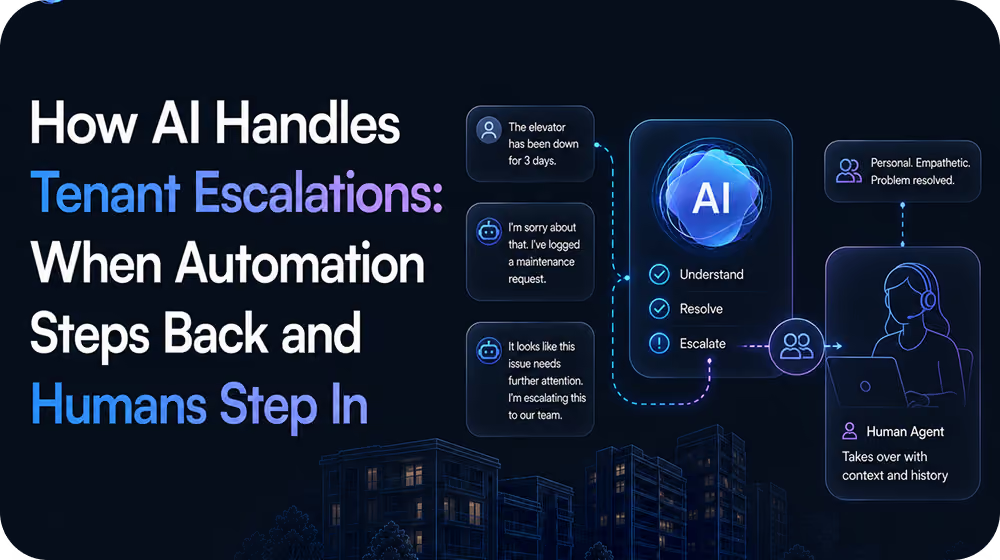
This gap is especially clear in an AI chatbot leasing workflow. A prospect first asks about pricing, availability, and the application process, then wants to schedule a viewing. If a chatbot follows that thread at all, it does so clumsily. Without a leasing agent, a conversational AI platform such as VerbaFlo manages the entire thread in one continuous conversation, qualifies the prospect, and schedules the viewing.
Leasing
A chatbot handles initial questions and FAQs. A conversational AI platform guides the prospect through the booking process, qualifies them, tailors the response to their stated needs, and follows up if they do not respond. There is a significant gap between the two conversion rates. VerbaFlo's approach to leasing automation covers lead acquisition, qualification, viewing scheduling, and follow-up, all within a single system that operates across every channel the prospect prefers.
Tenant Support
General resident support spans a wide range of query types: billing questions, community rules, package collection, noise complaints, move-out procedures. A chatbot handles the subset it was trained on. A conversational AI platform draws from a comprehensive, operator-configured knowledge base and handles a much broader range of queries accurately. For operators managing multiple buildings or regions, consistency of response across every property is a practical concern, and that consistency is enforced by a conversational AI platform.
This comprehensive operational automation is exactly why operators deploy dedicated engines like VerbaFlo. Rather than deploying a passive, single-site widget, scaled portfolios use VerbaFlo to unify inbound web chat, WhatsApp, email, and voice into a single, proactive system that guides prospects from first touchpoint through to an executed lease renewal.
How to Choose Between a Chatbot and a Conversational AI Platform
The problem you are trying to solve, and the scale at which it must be solved, determine the best option. There are clear signals on both sides, and there is no single right answer for everyone.
A Standard Chatbot May Be Sufficient If:
- Your portfolio is small, and enquiry volume is manageable.
- You need after-hours coverage for a narrow set of frequently asked questions.
- Your team has the capacity to handle everything a bot cannot, and that handover volume is low.
- Your budget for automation is limited, and you need a starting point.
A Conversational AI Platform Is the Right Call If:
- You manage multiple buildings or a large number of units.
- Leasing, renewals, and resident support all need to run more efficiently.
- Your team spends significant time on repetitive communication tasks.
- You want outbound campaign capability, not just inbound response.
- Consistency of resident experience across properties matters to your brand.
- You need real analytics, not just message counts.
- Single-channel coverage is not enough for your resident base.
For most operators managing more than 100 to 150 units, a typical real estate AI chatbot takes care of the simple part of the problem. The difficult part, multi-turn conversations, outbound workflows, cross-channel engagement, and renewal campaigns, needs something built for that level of complexity.
That is the gap VerbaFlo is designed to close. It is not a more feature-rich chatbot. It is a conversational AI platform built specifically for real estate operators, covering voice, chat, email, and WhatsApp, from lead generation to lease renewal.
Implementation: What to Expect in the First 30 Days
One concern operators raise about both chatbots and conversational AI platforms is implementation complexity. The fear is that setup takes months and requires significant technical resources. In practice, the timeline for a well-structured deployment is considerably shorter.
Days 1 to 7: Discovery and Configuration
The first week is about translating your operation into the system's knowledge base. This means documenting your properties, policies, pricing structures, and common resident queries. For a conversational AI platform, it also includes defining escalation rules, channel preferences, and the tone and language standards the system should follow. This stage needs input from your leasing and operations team, but it does not require technical expertise. Good platforms are configured through structured onboarding, not code.
Days 8 to 14: Integration and Testing
The system connects to your CRM, property management software, and any calendar or booking tools in your stack. Most modern platforms offer pre-built integrations with common property management systems. VerbaFlo, for instance, interfaces with HubSpot and Salesforce, and its onboarding team guides the setup. Testing includes both edge cases and happy-path conversations. You want to see how the system responds to a typical lease enquiry, a repair request, a negotiation, and a case where escalation is necessary.
Days 15 to 30: Go-Live and Optimisation
The system goes live across your chosen channels. The most data-rich period is the first two weeks after launch. You will see which escalation triggers fire most frequently, where the knowledge base needs expanding, and which intent categories create the greatest volume. Operators who treat the first 30 days as a learning period, rather than expecting a fully optimised system from day one, reach a much stronger steady state by week six or eight.