Gemini Flash vs Pro
Choosing between Gemini Flash and Pro comes down to one question: do you need speed at scale or depth of reasoning? This guide breaks down how both models compare across latency, cost, accuracy & real-world use cases, including Gemini 2 Flash Experimental and 2.5 Flash vs 2.5 Pro, to help you pick the right model for your system.


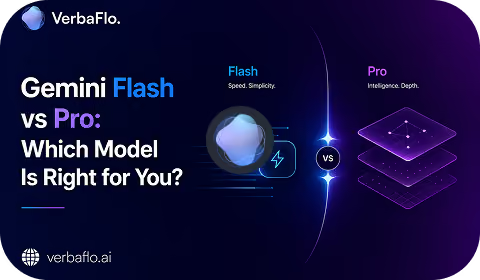
Gemini Flash vs Pro: Which Model Is Right for You?
Choosing between Gemini Flash vs Pro is not just a model comparison. It is a decision about how your system needs to perform in real-world scenarios. Speed, cost, reasoning, and scalability all play different roles depending on the use case.
With the release of newer variants like Gemini 2 Flash Experimental and comparisons such as 2.5 Flash vs 2.5 Pro, the gap between models is becoming more defined. Each model is optimised for a specific type of workload, rather than aiming to be the best at everything.
This guide breaks down how Gemini Flash and Pro differ, where each model performs best, and how to choose the right one based on your application, from real-time voice AI to complex reasoning tasks.
Overview: Same Family, Very Different Purposes
At a high level, Gemini Flash vs Pro is a comparison within the same model family, but designed for very different outcomes. The distinction is not about which model is better overall. It is about which one fits the task.
Gemini Flash is built for speed and scale. It is optimised for low latency, high throughput, and cost efficiency. This makes it suitable for real-time use cases such as chatbots, customer support, and voice assistants, where response time directly affects user experience.
Gemini Pro, on the other hand, is designed for depth and accuracy. It performs better at complex reasoning, long-context understanding, and tasks requiring higher precision. This includes analysis-heavy workflows, detailed content generation, and multi-step problem solving.
This is why comparisons like 2.5 Flash vs 2.5 Pro or Gemini 2 Flash Experimental are important. They highlight a broader shift in model design, where performance is no longer generalised. Instead, models are specialised for specific workloads.
The key takeaway is simple. Flash is built for execution at scale. Pro is built for thinking through complexity.
Gemini Flash vs Pro: Head-to-Head Comparison Table
The difference between Gemini Flash and Pro becomes clearer when comparing key performance factors. Each model is optimised for a specific type of workload, which directly affects its performance in production environments.
| Feature | Gemini 2.5 Flash | Gemini 2.5 Pro |
|---|---|---|
| Primary goal | Low latency, high throughput | Deep reasoning, high accuracy |
| First token latency | Gemini Flash delivers near real-time responses. Flash achieves a first-token latency of 0.21–0.37 seconds, aligning with natural conversational pauses, while delivering output at 163.6 tokens per second. Flash can process a high number of requests simultaneously. It performs well in environments with continuous, high-volume interactions without performance drop-offs. For businesses operating at scale, cost per request becomes a key factor. Gemini Flash processes a million tokens at roughly $0.75, compared to $11.25 for Pro, making it about 15× more cost-efficient. While the 2.5-lineup has narrowed the gap, Flash remains the more economical choice. While it is not built for deep reasoning, Flash performs reliably in repetitive, structured workflows. This includes answering common queries, handling customer interactions, and automating routine processes. This is why variants like Gemini 2 Flash Experimental are gaining attention. They extend these advantages further, especially in real-time and production-heavy environments. In practical terms, Flash is the right choice when the priority is speed, consistency, and scalability without increasing operational costs. Where Gemini Pro Wins (Reasoning, Long Context, Accuracy)In the Gemini Flash vs Pro comparison, Pro is built for depth. It is designed to handle complex tasks where accuracy, reasoning, and context matter more than speed.
In practical terms, Gemini Pro is the better choice when the task requires thinking through complexity rather than responding instantly. The Coding Surprise: Why Flash Outperforms Pro on SWE-benchIn the Gemini Flash vs Pro comparison, one of the more surprising outcomes appears in coding benchmarks. Despite being designed for speed, Flash performs strongly on tasks such as SWE-bench, which evaluates real-world software engineering problems. This advantage comes from how Flash handles structured tasks. Coding workflows are often pattern-driven. They require fast interpretation of context, precise edits, and consistent output. Flash performs well here because it processes instructions quickly and executes tasks efficiently, especially when problems are broken into smaller steps. The same principle extends beyond coding into real-time systems. For voice agents built on Vapi, every millisecond between a query and a response directly impacts the user experience. Flash’s first-token latency of 0.21–0.37 seconds aligns with natural conversational pauses, while delivering output at 163.6 tokens per second. This makes interactions feel fluid and uninterrupted. Gemini Pro still holds an advantage in reasoning-heavy scenarios, particularly where deeper architectural thinking or long-context understanding is required. However, in practical workflows such as debugging, incremental changes, or real-time responses, Flash often delivers faster and more usable results. Which Model Is Best for Voice AI? (Vapi Angle)For voice AI, the Gemini Flash vs Pro choice is driven by one factor. Real-time performance. Voice systems require immediate responses. Even slight delays affect user experience. This makes latency and consistency critical. Gemini Flash is built for real-time execution. It performs best in environments where speed, low latency, and scalability are critical. This includes voice AI, chatbots, customer support, and high-volume automation workflows. In these scenarios, fast and consistent responses matter more than deep reasoning, making Flash the practical choice for production systems that operate continuously. Gemini Pro is designed for depth. It is better suited for tasks that require complex reasoning, long-context understanding, and higher accuracy. This includes research, detailed content generation, analysis-heavy workflows, and post-processing tasks. In these cases, the ability to interpret context and generate precise outputs outweighs the need for speed. Where VerbaFlo FitsPlatforms such as VerbaFlo bring these capabilities together in a structured system. VerbaFlo combines voice, chat, and email into a single workflow, ensuring conversations remain consistent across channels. With shared context, controlled automation, and seamless human handover, it enables businesses to deploy AI at scale without losing visibility or control. Ready to hear it for yourself?Get a personalized demo to learn how VerbaFlo can help you drive measurable business value. Frequently Asked QuestionsKey information to help you explore, understand, and implement VerbaFlo. Is Gemini Pro better than Gemini Flash? Not necessarily. Gemini Pro is better for complex reasoning and long-context tasks, while Gemini Flash is better for speed, scalability, and real-time applications. Is Gemini Flash cheaper than Pro? Yes. Gemini Flash is optimised for lower cost per request, making it more suitable for high-volume use cases. Should I use Gemini 3 Pro or Flash? The choice depends on your use case. Use Flash for real-time interactions and automation, and Pro for tasks that require deeper analysis and accuracy. What is the difference between Gemini Pro and Gemini? Gemini Pro is a more advanced variant designed for higher reasoning and accuracy. "Gemini" is often used as a general term for the model family, which includes both Flash and Pro versions. You may also likeReady to hear it for yourself?Get a personalized demo to learn how VerbaFlo can help you drive measurable business value. ![]() Book a DemoThank you! Your submission has been received! Oops! Something went wrong while submitting the form. |