
AI voice assistants for business are no longer limited to handling scripted calls. In 2026, customer conversations are managed by AI voice assistants in real time, not only voice but also messaging channels. In the real estate industry, this shift is becoming operationally critical because response time directly affects conversion rates. Platforms such as VerbaFlo are enabling this shift at scale, allowing businesses to manage high volumes of interactions consistently and quickly.
Wider patterns in adoption further highlight this shift. A Gartner forecast suggests that by the end of 2026, approximately 40% of enterprise applications will incorporate AI assistants for specific tasks, a significant increase from less than 5% in 2025. This trend indicates a fundamental change in how AI agents for business manage operational workflows and customer interactions.
Property managers must therefore re-evaluate their cross-channel query management strategies. A conversational AI voice assistant enables teams to respond quickly, stay in context, and reduce the risk of missed or delayed responses. This comprehensive guide explores the mechanics of AI voice technology, its specific business advantages, and the essential factors companies must assess prior to integration.
What is an AI Voice Assistant and How Does It Work?
An AI voice assistant for businesses handles spoken conversations in real time by understanding its intent and responding naturally. Unlike traditional IVR systems, which depend on fixed menus. AI voice assistants elucidate how people speak and adjust responses accordingly.
At a system level, a voice assistant works through a few key layers:
- Speech recognition converts voice into text
- Natural language understanding identifies intent and key details
- Decision logic determines the appropriate response or action
- Speech synthesis delivers a natural voice reply
What defines a conversational AI voice assistant in 2026 is its ability to retain context. Conversations do not reset with each query, and responses remain consistent across interactions.
Key Differences Between Consumer Assistants vs Business Voice Agents
While business voice agents and consumer voice assistants share comparable AI frameworks, they are engineered for distinct objectives. Consumer tools such as Apple’s Siri and Amazon’s Alexa are designed for individual convenience and to handle tasks like reminders, searches, and basic queries. In contrast, a business-focused is used to support complex workflows and achieve tangible results. It is built to manage large-scale customer engagement.
A conversational AI voice assistant, such as those used in real estate environments, is expected to handle enquiries, qualify leads, and integrate with backend systems. VerbaFlo extends this further by enabling omnichannel conversations, in which voice interactions are connected to messaging platforms and CRM systems without losing context.
The differences are best understood in terms of function and operational impact:
Where AI Voice Assistants Deliver Real Business Value
80% of businesses plan to integrate AI-driven voice solutions into customer service this year, indicating a clear shift towards automated, real-time interaction handling. For most organisations, the value of an AI voice assistant lies in its ability to manage high volumes of conversations without delays or inconsistencies.
The most common domains where AI-powered voice assistants bring measurable value include:
- Inbound enquiry handling
Calls are answered immediately, even during peak hours or after business hours. This lowers missed interactions and ensures that potential leads are recorded at the right moment. - Lead qualification
During the call, the assistant collects key facts such as budget, preferences, or timelines. High-intent enquiries can be prioritised by teams without manual screening. - Appointment scheduling
Viewings and follow-ups can be arranged within the same interaction. This eliminates delays caused by back-and-forth coordination and improves conversion speed. - Operational support
Repetitive queries around availability, pricing, or procedures are handled automatically. This drastically reduces the workload on teams, allowing them to focus more on closing deals.
For property managers, a real estate voice assistant acts as a consistent first point of contact. When integrated with broader systems, such as those enabled by VerbaFlo, voice interactions can align with messaging channels, ensuring continuity across the customer journey.
What to Look for in an AI Voice Platform
Not all AI voice assistants are built for business purposes. The difference often lies in how efficiently the platform handles real-world operational demands, such as speed, incorporation, and reliability.
When judging an AI virtual assistant, businesses should focus on a few critical elements:
- Latency and response speed
Conversations need to feel natural, with minimal hold up between input and response. Even a minor delay can spoil user experience and reduce interaction during calls. - System integrations
The AI voice assistant for businesses should integrate with CRM systems, property management systems, and communication channels. This assures that responses are reasoned by real data and actions can be performed within existing workflows. - Context retention
AI voice assistants should preserve context within and across interactions. This avoids repetitive questioning and enhances the quality of conversations over time. - Compliance and data handling
Sensitive information is frequently involved in voice interactions. The platform must follow data protection standards and furnish clear audit trails where required. - Scalability
To maintain performance levels, the system must remain capable of managing growing volumes. This is important mainly during peak enquiry periods.
These factors, especially for property managers, determine whether a real estate voice assistant can operate as part of a broader communication system. VerbaFlo is designed to support this by combining voice with messaging channels and backend integrations, ensuring consistency across interactions.
Top AI Voice Assistant Platforms Compared
Various AI voice assistant platforms offer varying levels of capability across voice automation, integrations, and scalability. However, some focus on real-time interaction management, while others prioritise lead generation or contact centre automation. For businesses, particularly in real estate sectors, the key is to review platforms based on how well they align with operational demand, rather than feature lists alone.
1. VerbaFlo
VerbaFlo is a leading AI Voice Assistant platform built for real estate businesses, property managers, and the Purpose-Built Student Accommodation (PBSA) sector. Omnichannel interactions across voice, chat, WhatsApp, and email are automated while combining with CRM and property management systems to support end-to-end lead workflows.
- Latency: Supports real-time conversations with sub-10ms response times, handling high query volumes without noticeable delay.
- Omnichannel presence: Integrates voice, messaging, and email into a single system with seamless delivery to human teams.
- Context retention: Preserves interaction history to personalise responses based on user conduct and preferences.
- Intent recognition and automation: Identifies multiple enquiry types, such as availability, pricing, or bookings, and can trigger actions like scheduling.
- Analytics and control: Provides a centralised dashboard for workflow customisation, performance tracking, and compliance monitoring.
Livserv.ai
Livserv.ai focuses on real estate lead generation through WhatsApp and voice-based automation, enabling businesses to manage enquiries and bookings through conversational interfaces.
- Omnichannel presence: Supports WhatsApp, web widgets, and social platforms, with multilingual capabilities.
- Intent recognition and automation: Handles property queries, recommendations, and booking flows using trained datasets.
Retell AI
Retell AI voice assistant is designed for building production-scale voice agents, particularly for inbound and outbound call handling in high-volume environments.
- Latency: Optimised for low-latency voice interactions, offering real-time conversations.
- Context retention: Preserves call-level factors and updates CRM systems with recorded information.
- Intent recognition and automation: Supports enquiry handling, scheduling, and follow-up workflows.
Google Dialogflow (Voice)
Google Dialogflow provides enterprise-grade voice automation with strong natural language understanding and integration capabilities through Google Cloud.
- Latency and scale: Built to handle enterprise-level traffic with reliable performance.
- Omnichannel presence: Primarily voice-focused, with extensions to chat-based interfaces.
- Intent recognition and automation: Supports complex query handling with multilingual capabilities and integration with Google services.
How to Implement AI Voice in Your Business
Integrating an AI voice assistant in a business environment focuses on workflow alignment rather than just tool deployment. The primary objective is to ensure that voice-driven interactions strengthen operational processes rather than function as a separate entity.
A structured approach helps avoid common gaps:
- Identify high-impact use cases
Prioritise high-impact deployment by targeting workflows where speed directly influences conversion, such as qualifying leads or managing inbound interest. This strategic focus ensures that the implementation provides immediate, quantifiable value to the organisation. - Select the right channels
Voice should complement existing communication channels, not replace them. This means aligning voice with messaging platforms and web enquiries. - Integrate with core systems
Integrate the AI virtual assistant into CRM and property management platforms. This ensures that live data drives interactions and that specific tasks can be carried out directly within operational workflows. - Define escalation and handover flows
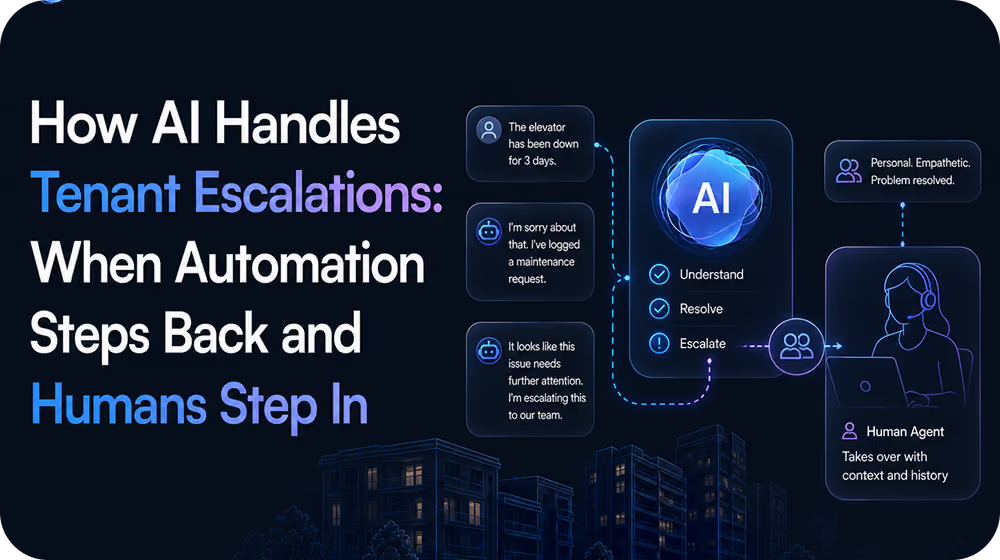
Establish precise handover protocols. To maintain service quality and precision, define specific triggers that transition complicated inquiries from automated systems to human personnel. - Monitor and optimise performance
Track metrics such as response time, enquiry handling rates, and conversion outcomes. Continuous refinement improves both efficiency and user experience.
A real estate voice assistant becomes effective when it operates as part of a broader communication system.
AI voice assistants provide a practical way for businesses to scale customer interactions. For real estate, the emphasis has shifted from simple automation to speed, consistency, and workflow integration. A strategic conversational AI voice assistant reduces operational strain while improving how enquiries are handled and converted.
VerbaFlo is built around this approach, combining voice with messaging and backend systems to deliver consistent, context-driven interactions. If you are evaluating how to implement this in your own workflows, exploring a live demo can provide a clearer view of what structured, end-to-end automation looks like in practice.