
How CRE Is Different from Residential: Why AI Adoption Has Lagged
Commercial real estate operates on a fundamentally different set of variables than residential. Deals are fewer in number but exponentially more complex. Leases run for years, sometimes decades, and contain layers of clauses, rent escalation schedules, CAM reconciliations, co-tenancy provisions, and termination options that require careful tracking across the full lease lifecycle. Tenant relationships are long-term institutional ones rather than individual renters on twelve-month cycles. The data involved in underwriting, asset management, and portfolio forecasting is dense, multi-source, and rarely standardised.
These factors have historically made AI implementation in commercial real estate more complex than in residential property management. The use cases require more than automated communication or basic workflow automation. They involve AI that can analyse complex lease documents, process large volumes of operational and financial data, and support compliance across commercial real estate workflows. Recent advances in AI have made these capabilities increasingly practical, and commercial real estate organisations are applying AI across functions such as lease administration, document processing, portfolio analysis, and operational decision-making.
AI for Lease Administration and Abstraction
Lease administration is one of the most labour-intensive functions in commercial real estate, making it a common area for AI-assisted automation and document processing. A large CRE portfolio may manage hundreds or thousands of leases simultaneously, each containing unique terms, critical dates, and financial obligations that must be tracked, reported on, and acted upon in a timely manner.
AI for lease administration works through a process called lease abstraction. It involves the extraction of key data points from lease documents and their population into a structured database. Traditionally, this was done manually by paralegals or lease administrators working through documents line by line. AI abstraction tools automate much of this process by extracting key lease information into structured records, reducing the amount of manual review required for routine lease administration tasks.
Once lease data is structured, it becomes easier to manage ongoing lease administration tasks. For large portfolios, automated reminders and centralised lease data can help reduce the likelihood of missed deadlines and improve operational visibility across the lease lifecycle.
AI for Tenant Communications and Service Requests
Tenant communication in commercial real estate involves a different profile than residential. CRE tenants, including office occupiers, retail operators, and industrial users, interact with property management teams around a narrower but often more urgent set of issues: building systems, maintenance, access, compliance, and lease-related queries. Timely and consistent communication plays an important role in tenant satisfaction and supports effective property management throughout the lease lifecycle.
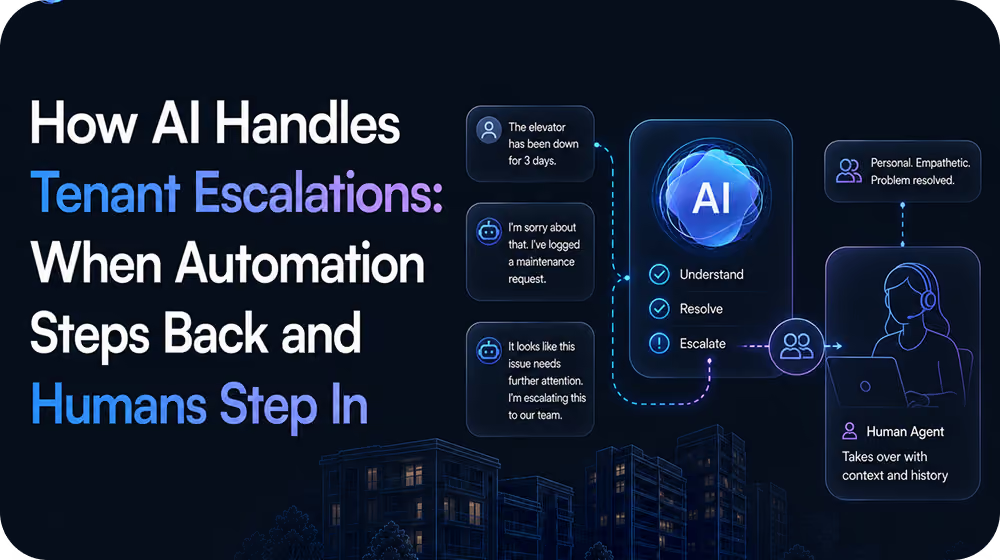
AI is increasingly handling the first layer of this communication. Platforms built for commercial property management can route incoming service requests automatically, classify them by urgency and type, dispatch the appropriate vendor or maintenance team, and keep the tenant updated on resolution status, all without manual intervention from a property manager. For large commercial assets with multiple tenants, this level of automation helps reduce administrative workload while supporting more consistent tenant communication.
For operators managing tenant communications at scale across multiple assets, conversational AI platforms like VerbaFlo provide an additional layer of capability. It engages tenants across voice, email, and chat channels to handle routine queries and service updates, sending complex issues to the appropriate human contact with full context preserved.
AI for Asset Management and Portfolio Forecasting
Asset management in CRE has traditionally relied on a combination of financial modelling, market experience, and periodic reporting cycles. AI is increasingly supporting asset management by enabling more continuous analysis of asset performance data and market conditions, allowing organisations to supplement periodic reviews with more frequent operational insights.
AI tools can monitor NOI performance against projections across a portfolio, flag assets trending below target, and generate scenario models showing the impact of different leasing, capex, or financing decisions on future returns. Advances in AI have made forecasting and scenario modelling more accessible across a wider range of commercial real estate organisations through specialised CRE technology solutions.
At the portfolio level, artificial intelligence in commercial real estate is being used to identify concentrations of risk linked to geography, sector, and tenant credit, and to stress-test portfolio performance against macroeconomic scenarios. The result is a more dynamic and responsive approach to capital allocation and asset strategy than traditional periodic review processes allow.
AI for Deal Sourcing and Market Intelligence
Deal sourcing is another area where AI supports property discovery, market research, and preliminary opportunity evaluation. CRE professionals traditionally relied on broker networks, subscription data services, and manual market scanning to surface deals. AI can automate parts of this process by monitoring transaction data, ownership records, planning applications, and market activity to identify properties that match predefined investment criteria.
Market intelligence platforms powered by AI aggregate data from multiple sources, such as public records, economic indicators, and tenant movement reports, to support property research, market analysis, and investment evaluation. An acquisitions team can receive daily alerts on off-market opportunities matching their investment parameters, with preliminary underwriting data already attached, rather than spending hours scanning databases manually.
For brokers, AI tools assist with comparative market analysis by organising relevant market information and supporting pricing evaluations. The Adventures in CRE tools database catalogs AI applications across multiple commercial real estate functions, including deal sourcing and market intelligence.
The Leading AI Tools in CRE Right Now
The commercial real estate AI landscape has evolved rapidly in recent years, with purpose-built solutions supporting property management, investment analysis, leasing, and portfolio operations. For property management and operations, AI-powered platforms are automating tenant communication, maintenance dispatch, and portfolio reporting. For lease administration and abstraction, dedicated CRE platforms support document processing by automating the extraction and organisation of lease information.
For deal sourcing and market intelligence, AI-driven property data tools support comp analysis and ownership research at scale. For financial modelling and portfolio forecasting, institutional-grade platforms now integrate AI-assisted scenario modelling as a core feature.
Where CRE Firms Are Seeing the Best ROI
The clearest ROI from AI in commercial real estate is currently concentrated in three areas: lease administration efficiency, tenant communication responsiveness, and acquisition research speed.
- Lease administration: teams can use AI to streamline document processing, reduce repetitive manual work, and improve the efficiency of reviewing lease agreements. By automating routine administrative tasks, teams can dedicate more time to higher-value activities such as lease analysis, portfolio planning, and tenant relationship management.
- Tenant communication: AI can help property teams respond more consistently to tenant enquiries and service requests while supporting timely communication throughout the lease lifecycle. This can improve operational efficiency and help maintain a consistent tenant experience.
- Acquisition research speed: AI market intelligence tools support property discovery, market research, and preliminary analysis by helping acquisition teams organise information and evaluate potential opportunities more efficiently, supporting faster decision-making throughout the acquisition process.