.avif)
What Conversational AI Actually Is (And What It Isn’t)
The real estate industry in 2026 is no longer experimenting with digital tools. What were once pilots or side projects now sit at the centre of how portfolios are managed, marketed, and scaled. Digital systems are no longer supporting operations in the background. They are shaping how demand is captured and how decisions are made.
Within this shift, one confusion still persists. Chatbots and conversational AI are often used interchangeably. On the surface, that is understandable. Both automate conversations and appear in similar places across websites and messaging platforms. But the difference becomes clear once you look at how they behave and how they handle real interactions.
The Business Case: 5 Reasons to Invest in 2026
The case for conversational AI is no longer based on future potential. Most organisations are already seeing practical benefits in day-to-day operations.
A growing majority of businesses are investing in AI to improve both customer experience and internal efficiency. In real estate, those benefits tend to show up quickly because of the volume of interactions involved.
Here are five areas where the impact is most visible.
1. Always-on accessibility
Demand does not follow office hours. Enquiries come in late at night, across time zones, and often when teams are unavailable. AI systems handle those interactions as they happen, which means no enquiry is left waiting.
2. Personalisation without additional effort
Instead of giving the same response to everyone, the system adapts based on behaviour. Previous interactions, browsing activity, and preferences all shape the reply. It feels more relevant without adding manual work.
3. Lower operational pressure
A large portion of property management involves repeatedly answering the same types of questions. Automating these interactions reduces that load and gives teams more space to focus on work that requires judgment.
4. Better lead filtering
Not every enquiry needs to reach a leasing team. By capturing key details early, AI helps filter out low-intent interactions and highlights those more likely to convert.
5. Consistent communication
With tighter regulatory expectations, consistency matters more than before. AI systems standardise responses and ensure that interactions are properly recorded, reducing the risk of errors.
Taken together, these changes do not just improve efficiency. They reshape how teams allocate their time and manage communication across the business.
Where Conversational AI Delivers the Most ROI
The strongest returns tend to appear in areas where two things overlap. High interaction volume and existing bottlenecks.
That combination exists in several parts of real estate operations.
Lease administration is a good example. Reviewing documents manually takes time and requires attention to detail. AI can quickly extract key information, shortening the overall cycle.
Lead response is another area where the impact is direct. Even small delays can make a difference.
When responses are immediate, conversations continue. When they are not, interest tends to drop.
These improvements do not operate in isolation. Faster responses, clearer qualifications, and reduced manual work combine to improve occupancy and overall performance.
The Cost of Not Investing
Choosing not to invest in conversational AI is no longer a neutral position. It has a clear set of consequences that become more visible over time.
There are a few patterns that tend to appear.
- Systems become harder to upgrade as legacy tools fall behind
- Response times begin to look slow compared to competitors
- Teams spend more time on repetitive tasks than necessary
- Leads drop off before they are properly engaged
These issues do not appear all at once. They build gradually. The longer adoption is delayed, the harder it becomes to close the gap.
At a certain point, it stops being about efficiency and starts affecting competitiveness more directly.
What to Look For in a Conversational AI Platform
Not every platform is designed for real estate workflows. Evaluating the right system requires looking beyond surface features.
When reviewing solutions such as VerbaFlo, a few capabilities tend to matter more than others.
Omnichannel support
The system should work across messaging, voice, email, and web interactions without breaking the flow of conversation.
Data grounding
Responses should be based on actual property data and documentation. This ensures accuracy and avoids generic answers.
Human handover
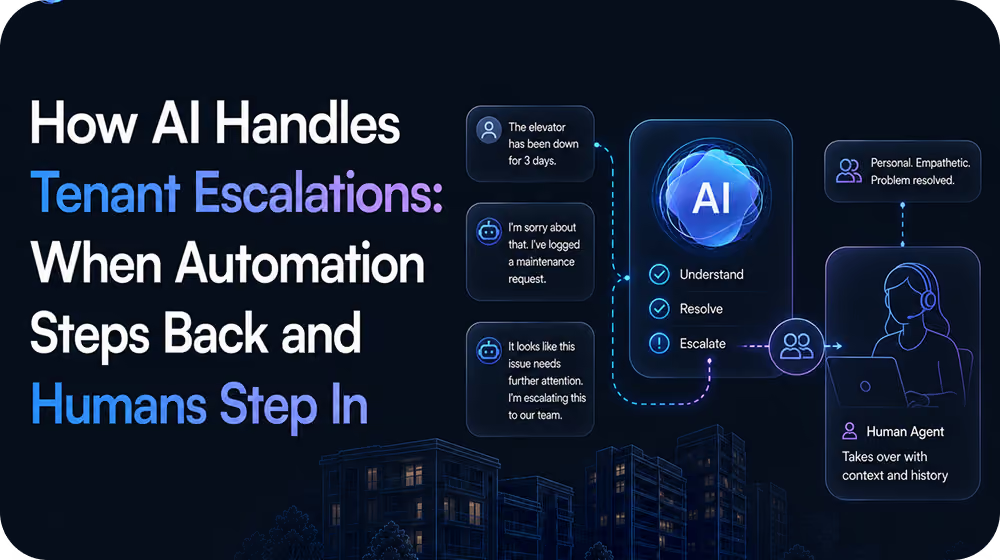
There should always be a clear path for escalating conversations when they require human input.
Compliance and governance
Handling user data responsibly is essential, particularly in regulated environments.
Implementation Roadmap: From Pilot to Portfolio
Introducing conversational AI works best when it is done gradually. Trying to deploy everything at once usually creates unnecessary complexity.
A phased approach tends to be more effective.
Foundation phase
This is where objectives are defined and data readiness is assessed. It sets the direction for everything that follows.
Pilot phase
The system is applied to a specific use case, such as handling enquiries. This allows teams to observe how it performs in a controlled environment.
Optimisation phase
Based on real interactions, responses are refined and integrations are strengthened. This stage often takes longer than expected because it involves continuous adjustment.
Expansion phase
Once performance is consistent, the system is rolled out more broadly. At this stage, it can support more proactive use cases such as follow-ups and recommendations.
This progression allows the system to evolve alongside operational needs rather than being forced into place.
Conversational AI in real estate is no longer about adding another tool to the stack. It is about rethinking how conversations are captured, carried forward, and converted into outcomes. The operators seeing real results are not just automating responses; they are building systems that respond instantly, adapt continuously, and connect every interaction across the journey. In a market where speed, consistency, and experience directly influence occupancy, that shift is becoming hard to ignore. The question is no longer whether conversational AI fits into real estate operations. It is how quickly and effectively it can be integrated to keep pace with changing demand.