Where Leasing AI Stands Today?
The conversation around AI in real estate has changed. A couple of years ago, it was mostly about pilots and small experiments. Teams were testing chatbots, trying to automate a few repetitive tasks, and seeing what worked. In 2026, that phase is over.
Leasing AI is now part of the core operating layer. It is shaping how demand is captured, how prospects are engaged, and how quickly deals move forward. It is not just answering questions. It is influencing outcomes.
This shift is driven by pressure. Prospects expect immediate responses. They switch between channels without thinking. They compare properties quickly and move on just as fast. If a system cannot keep up, the opportunity is gone.
Operators are responding to this reality. They are moving beyond basic automation and investing in systems that can manage the full leasing journey. That is where the real change is happening.
The Shift From Tasks to End-to-End Workflows
Early leasing automation solved narrow problems. It helped teams send follow-up emails more quickly or schedule tours without manual back-and-forth. What is different now is the scope. Leasing AI is no longer focused on isolated tasks. It manages connected workflows.
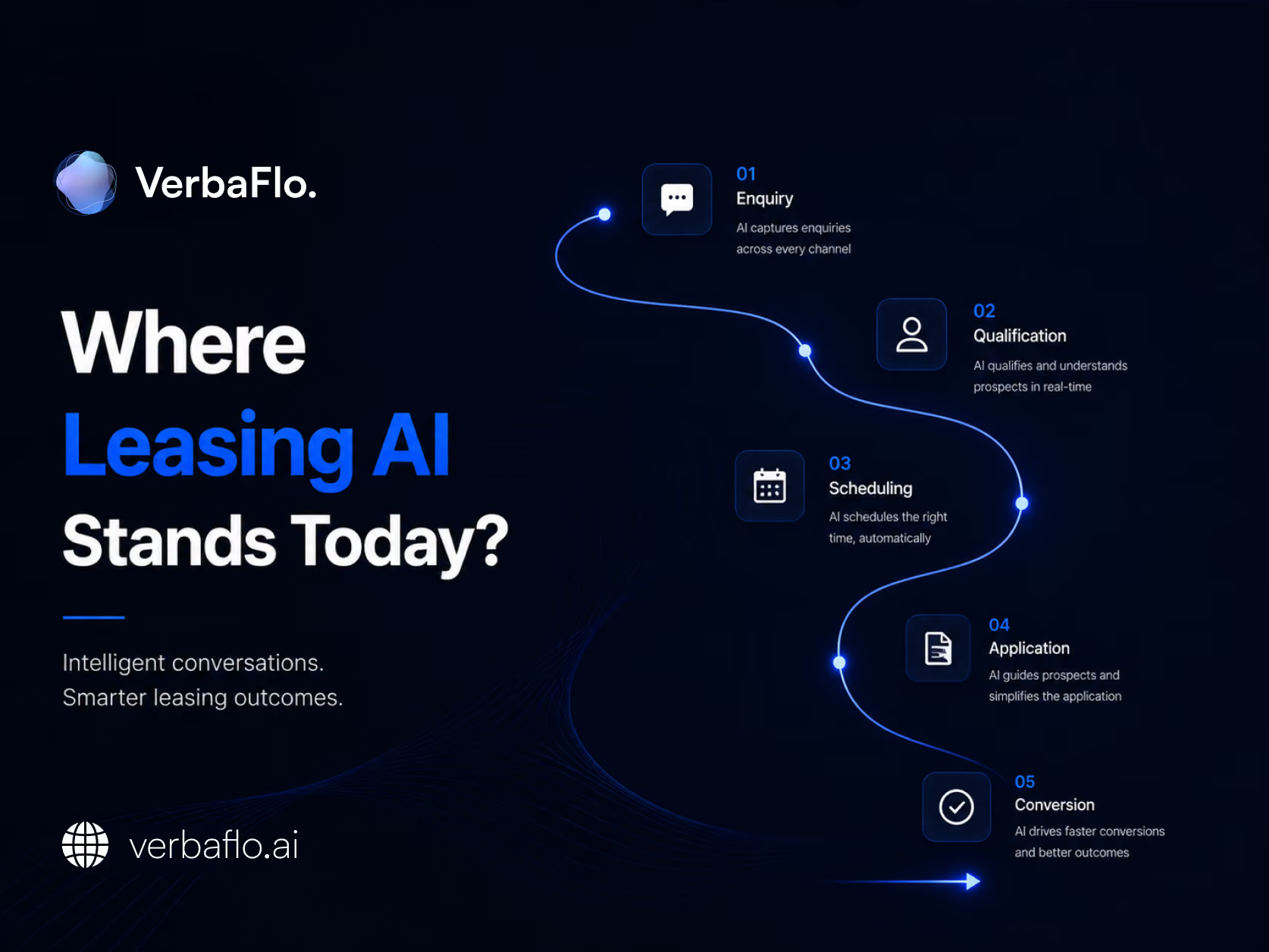
A typical flow today looks less like a set of disconnected actions and more like a continuous process:
This is where the impact becomes visible.
Lead capture and qualification
Instead of waiting for a form submission, AI engages prospects immediately. It asks the right questions, collects relevant details, and adapts based on responses. The interaction feels closer to a real conversation than a static form.
Documentation and processing
This part used to slow everything down. Identity checks, income proof, and lease agreements. Now, much of it is handled within the same interaction. The time from interest to application has shortened significantly.
Real-time synchronisation
Data does not sit in silos anymore. When a prospect interacts, the system updates instantly. Availability, pricing, and lead status all stay aligned. This removes a large portion of operational friction.
It sounds straightforward, but the effect is cumulative. When every step becomes faster and more connected, conversion improves without adding more effort.
The Rise of Agentic Leasing AI
Another shift that is worth paying attention to is the move toward agentic AI. This is where systems start to feel less like tools and more like operators.
Traditional software follows a script. It responds when asked and stops there. Agentic AI behaves differently. It can interpret intent, adjust direction, and take action within a defined framework.
In leasing, this matters because conversations are rarely linear.
A prospect might start with pricing, jump to amenities, ask about availability, and then change preferences midway. A rigid system struggles here. An adaptive one does not.
Some of the changes are subtle but important:
- Proactive engagement
The system does not wait. It identifies signals such as repeated visits or high-intent behaviour and starts the conversation at the right moment. - Multilingual interaction
Communication is no longer limited by language. Platforms can engage users in their preferred language without adding operational overhead. - Context-aware responses
Instead of generic answers, the system uses live property data. It knows what is available, what it costs, and what fits the user’s criteria.
This is where platforms like VerbaFlo are positioning themselves as systems that connect conversation with execution. The difference shows up in how quickly interactions turn into actions.
What This Means for Leasing Teams
There is always a concern that automation replaces people. In leasing, that is not what is happening. The role is changing, not disappearing.
A large part of a leasing agent’s day has traditionally been repetitive. Answering the same questions. Following up with leads. Updating systems. None of this directly drives value, but it takes up time.
With AI handling these tasks, the focus shifts.
- Less administrative load
Routine interactions and follow-ups are managed automatically. - More strategic involvement
Teams spend more time on pricing decisions, positioning, and performance tracking. - Higher quality interactions
When a human steps in, it is usually at a more meaningful stage of the journey.
There is also a measurable productivity impact. Studies continue to show that AI adoption improves efficiency when applied to the right workflows.
The outcome is not fewer roles. It is a better allocation of effort.
Where Things Are Heading Next
Looking ahead, the direction is not hard to see. Leasing is moving toward more automation, but also more precision.
A few patterns are already emerging:
More personalised interactions
Systems are starting to adapt in real time. Recommendations, pricing, even communication tone can shift based on user behaviour.
Faster decision loops
Instead of waiting for reports, operators can respond to demand changes almost instantly. Pricing and marketing adjustments become more dynamic.
Tighter system integration
The boundaries between systems are fading. Website, CRM, PMS, and communication channels are becoming part of one continuous flow.
It is not about adding more tools. It is about reducing the gaps between them.
Preparing for an AI-First Leasing Model
Adopting leasing AI is not just a technology decision. It is an operational one.
Some of the preparation is practical:
Start with data quality
If the underlying data is inconsistent, the system will reflect that. Clean data is not optional.
Rethink team roles
Training should move away from process-heavy tasks and toward decision-making and customer experience.
Choose systems that scale
It is important to avoid short-term fixes. Platforms need to support multiple channels and integrate with existing infrastructure.
A simple way to think about it:
This is also where platform choice becomes important. Systems like VerbaFlo are designed to sit across channels and workflows, rather than operate in isolation. That approach reduces complexity as operations scale.
A More Practical Way to Look at It
Leasing AI is often discussed in terms of features. Chat. Voice. Automation. That view misses the point.
What actually matters is this:
- How quickly can you respond to demand
- How consistently can you qualify leads
- How smoothly can you move from interest to application
If those three things improve, everything else follows.
The shift is already happening. The question is not whether AI will be part of leasing operations. It is how effectively it will be implemented.
Leasing AI today is no longer a layer you add on top. It is becoming the system that holds everything together. The operators who are seeing results are not the ones experimenting with isolated features, but the ones aligning their entire leasing flow around speed, continuity, and precision. As demand becomes more dynamic and expectations continue to rise, the ability to capture intent, respond instantly, and move prospects forward without friction will define performance. In that sense, leasing AI is not just about improving operations. It is quietly redefining what efficient, high-converting leasing actually looks like.