.avif)
AI Leasing Assistants vs Full AI Communications Platforms: What Property Managers Need to Know
If your AI strategy begins and ends with a leasing assistant, you have automated only the smallest part of the problem. AI leasing assistants vs full AI communications platforms is one of the most important decisions a property manager can make.
AI leasing assistants handle the most visible part of the operation, produce results that are easy to measure, and are often treated as sufficient. What they do not address is what happens after the lease is signed, and for most property managers, that is where the majority of operational costs sit.
This guide breaks down the difference between AI leasing assistants and full AI communications platforms, and how choosing the right approach can impact cost, efficiency, and resident retention.
The Scope of an AI Leasing Assistant
The primary objective of the AI leasing assistant is to convert prospective leads into signed leases. Its scope is limited to the top of the sales funnel.
On the communications side, it handles inbound enquiries through web chat and SMS, answers specific questions, and sends generic follow-up messages to leads that have not progressed. Some systems even support tour reminders and cancellation handling within the same workflow.
The leasing assistant operates only between the first contact and lease execution. The limitation of a leasing assistant becomes apparent the moment a lease is signed.
The Operational Gap a Leasing Assistant Leaves Behind
Once a lease is signed, the leasing assistant exits the workflow entirely. Everything that follows falls back to your team: maintenance requests, payment follow-ups, move-in coordination, renewal communications, and resident support queries.
Three main tasks that are not covered by the AI leasing assistant, and still take up a lot of your team’s time.
- Maintenance triage and resident support land on your team’s desk without any prioritisation because they sit outside the scope of the AI leasing assistant. As a result, a heating failure and a loose door handle arrive in the same inbox with no system-level distinction between urgency or impact. Since everything depends on manual judgment, urgent repairs can get delayed. There is no automated separation between what is critical and what can wait, and this can affect your retention.
- Debt collection operates with a similar blind spot. Once a lease is signed, the leasing assistant is not involved in payment workflows, so reminders are sent manually on fixed schedules, no matter how the resident responds. If a resident opens a message and ignores it, the system treats it the same as if they never saw it. There is no channel switching, no escalation logic, and no visibility into which accounts are starting to fall behind until they become a problem.
- Move-in coordination at scale also lacks any automated process. The leasing assistant stops at lease execution, so everything that follows, like document collection, key handovers, utility setup questions, and front desk coordination, is handled manually. During peak move-in periods, especially in Build-to-Rent (BTR) or Purpose-Built Student Accommodation (PBSA) portfolios, this creates severe operational strain on your team.
Even if leasing is fully automated, these tasks still require manual effort. That’s the operational and financial drawback of a leasing-only automation strategy.
How a Full AI Communications Platform Differs
A full AI communications platform manages the entire resident lifecycle: from first enquiry through to lease renewal, across every channel and every operational function. It differs from a leasing assistant in scale and scope.
At the lead stage, a full AI communications platform identifies inbound prospects, sorts them by intent and fit, and responds in real time to help with lead acquisition. It also handles lead reactivation by identifying dormant prospects and re-engaging them with contextual messages that reference their original enquiry instead of generic follow-ups.
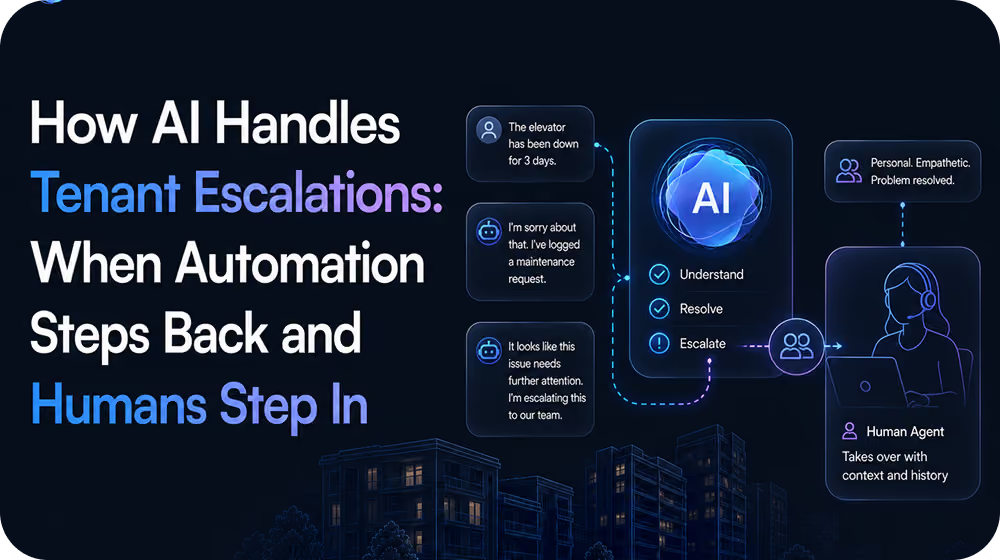
Post-lease, it manages customer support through a unified inbox that brings together voice, email, chat, and WhatsApp, while automatically routing and prioritising urgent maintenance requests over routine queries.
It supports debt collection by running multi-channel reminder campaigns, adjusting escalation logic based on account status, and providing real-time visibility into payment recovery. It provides check-in assistance through automated reminders, scheduled arrival slots, and instant ticket creation for any issues that arise during the check-in process.
Every interaction is saved to a single resident record. When your team picks up a conversation, the full history is already there: messages, open tickets, payment status, and sentiment profile are all visible at the point of handover in real time and context. Nothing needs to be reconstructed from a separate system or recalled from memory.
A Direct Comparison: AI Leasing Assistant vs Full AI Communications Platform
The AI leasing assistant is built for lead management and lease conversion, while a full communications platform is built to manage everything from lead conversion through the entire post-lease resident journey, and the difference is about purpose rather than features or pricing.
Eliminating Tech Debt Through AI Consolidation
The instinct to close the operational gap by adding point solutions is understandable: a standalone ticketing system for maintenance, a separate collections tool for payments, a different platform for move-in reminders. Each point solution solves a specific problem and seems like the best solution for it.
The problem emerges at the integration. Most point solutions operate on their own data model, API, and require their own maintenance cycle. When a resident's data needs to move between systems, migration is difficult or sometimes impossible, leaving teams to reconcile and match records manually.
As a result, you encounter a tech debt: the accumulated cost of maintaining multiple technology stacks. API updates often break integrations, contracts overlap, and data gets stuck in separate systems. Over time, the effort needed to keep everything working together can cost more than the savings the tools were meant to create.
Instead of using different tools for leads, residents, and renewals, everything can be brought into one system on top of the property management software through tech stack consolidation. This system becomes the main place where all messages come in and go out, no matter the channel or stage. As you scale, having everything in one system becomes even more important, and the benefits of a full AI communications platform will become clearer.
How VerbaFlo Delivers Full-Lifecycle AI Communications for Real Estate
VerbaFlo is a conversational AI platform built for real estate operators across BTR, PBSA, and residential portfolio asset classes. Its four-channel modules, VerbaCall (voice), VerbaMail (email), VerbaChat (web chat), and VerbaMessenger (WhatsApp and SMS), operate as a single omnichannel system, maintaining contextual continuity across every resident interaction from first enquiry through to renewal.
The platform integrates natively with property management systems, including Entrata, and connects across Microsoft 365, Google Workspace, Salesforce, and WhatsApp.
For property managers who have reached the ceiling of what a leasing assistant can deliver, VerbaFlo covers both those functions and the ones that follow.
Extend automation past leasing into full operations: Book a Demo