
A homeowner emails the association manager on a Sunday night. Can I paint my front door navy, or does that need architectural approval? The manager sees it Monday, checks the governing documents and replies Tuesday. By then the homeowner has painted the door.
Multiply that by a portfolio of communities, each with its own covenants, and the pattern is familiar. The questions are repetitive, the answers live in documents nobody reads, and the manager becomes a bottleneck for information that could have been instant.
This article covers how HOA management differs from multifamily, the use cases that earn their place, and how to measure the return without leaning on a vendor's headline number.
How HOA Management Differs From Multifamily (And Why AI Needs to Adapt)
The community association market is large. The Foundation for Community Association Research estimates 373,000 community associations housing 78.1 million residents, a communication load spread across managers who often handle several communities at once.
Multifamily is professionally managed rental housing, where a company owns the building and residents lease their units. The relationship is landlord and tenant, and the work centres on filling and keeping units full.
An HOA, or homeowners association, is the governing body of a community of owned homes. Residents own their properties and elect a board that sets the rules and collects dues, and a management company runs the day-to-day on its behalf. The relationship is association and owner, and the work centres on governance rather than leasing.
Those two starting points pull an AI in different directions.
A dismissive automated reply lands worse with an owner than a prospect, and the rules that are the product sit in documents nobody reads before asking. An AI built only for leasing does not transfer cleanly. It has to hold community-specific rules, respect the owner relationship, and fit the governance calendar.
Top AI Use Cases for HOA Management in 2026
The useful applications cluster around the communication a manager repeats across every community. Four earn their place before any others.
- Answering rule and fee questions: the high-volume queries that fill a manager's inbox, from dues amounts to pet policies, answered instantly from the governing documents.
- Routing maintenance and common-area requests: a resident reports a broken gate, and the request reaches the right vendor or manager tagged and logged.
- Supporting board and meeting communication: reminders, notices and document distribution around the annual meeting and board cycle.
- Handling violation and architectural queries: the sensitive questions about what a homeowner may do, answered consistently and on the record.
Each of these is a communication task rather than a governance decision. The AI handles the repetitive information layer while the board still governs and the manager still manages.
AI for Resident Enquiries: Fees, Rules, Amenities, and Violations
Most homeowner questions have answers that already exist in writing. The problem is access, not information. The covenants run to dozens of pages, and no owner reads them before asking whether they can install a satellite dish. Conversational AI puts those answers in front of the homeowner at the moment they ask:
- Fees and dues: what is owed, when and how to pay, drawn from the current schedule rather than a manager's memory.
- Rules and covenants: whether a fence or short-term rental is allowed under this community's documents, with the relevant clause cited.
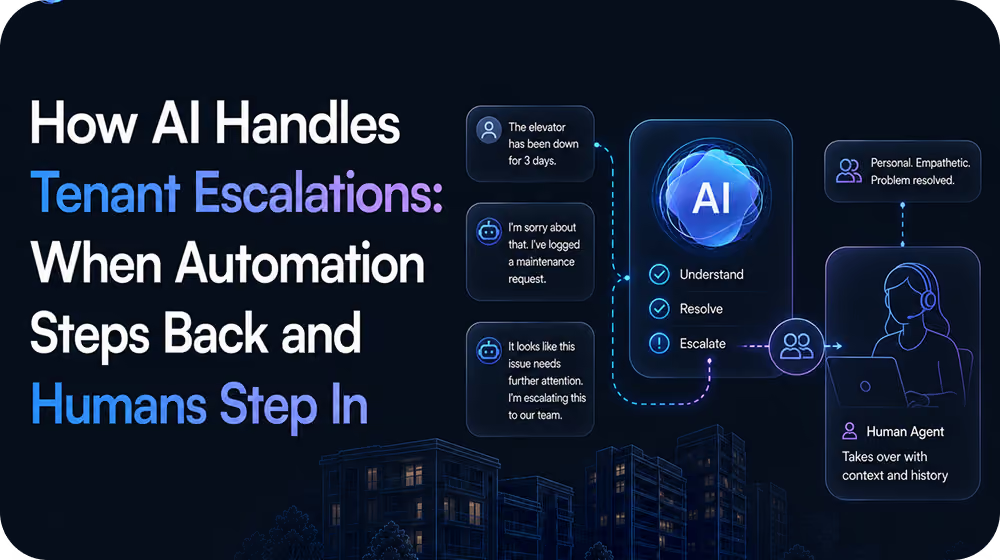
Violations need a lighter touch. A homeowner asking why they received a notice is often frustrated, and the answer carries legal and financial weight. The right pattern is for the AI to explain the rule and the process plainly, then hand a genuinely contested case to a person with the full thread attached, informing the homeowner without adjudicating the dispute.
AI for Maintenance Request Routing in HOA Communities
Maintenance in an HOA splits along a line that does not exist in a rental. Some issues are the association's responsibility, from the shared roof to the entrance gate. Others belong to the homeowner, inside their own lot.
That distinction is exactly the kind of rule an AI can apply at intake. The system asks the questions that establish whether it is a common-area issue or a homeowner one, then routes accordingly:
- Common-area issues: tagged by category and urgency, sent to the association's vendor or manager, and logged against the community record.
- Homeowner responsibilities: explained to the resident, with a pointer to what they arrange themselves, rather than a ticket that sits unactioned.
The gain is twofold. Genuine association issues reach the right place faster, and requests outside the association's remit get answered without a manager declining them by hand. When a request does need a person, the conversation transfers with its full context.
AI for Annual Meeting Prep, Voting Reminders, and Board Communications
The governance calendar is predictable and repetitive, which makes it a strong fit for automation. Every year brings the same cycle of notices, quorum chasing and document distribution, and a manager spends hours on it across each community.
Conversational AI carries the communication load around that cycle. It sends meeting notices that satisfy the timing rules and chases responses to help reach quorum. It also answers the questions that arrive in the run-up, from where the meeting is to how to submit a proxy.
The line to hold is between communication and governance. The AI distributes the notice and answers the logistics. It does not count votes or make rulings, which keeps the automation safe where process has legal consequences. The manager stops fielding the same logistical questions before each meeting and can focus on the substance the board needs.
ROI: What HOA Management Companies Are Seeing With AI
Be cautious with the ROI numbers in circulation. The headline figures for HOA AI tend to come from the software vendors selling it, with undisclosed methodology, which makes them marketing rather than evidence. Measure the return on your own communities rather than trusting a slide.
The return shows up in three measurable places:
- Manager hours returned: the clearest gain. Hours spent answering repeat questions and chasing meeting responses return to the work that needs judgement. Measure the share of enquiries resolved without a manager touching them.
- Response time: a homeowner who gets an answer in seconds rather than two days is a homeowner less likely to escalate to a board member or file a complaint. Measure the change in time-to-first-answer.
- Fewer disputes: clear, consistent, on-the-record answers reduce the misunderstandings that turn into formal complaints. Measure the trend in complaint and dispute volume over a few cycles.
To size the return, run it against your own portfolio. Track the questions your managers answer most, the hours they consume, and the response times homeowners get. The gap between that baseline and what an AI handles is your return, calculated on your data rather than borrowed from a vendor.
What to Look for in an AI Platform for HOA
The evaluation criteria differ from a leasing tool, because the job differs. Four things matter most.
- Per-community rule handling: the platform has to hold different governing documents for different communities and answer from the right set. A manager running twenty associations cannot have one community's rules bleeding into another's.
- A clean handover: violation disputes and contested questions have to escalate cleanly, because the sensitive cases are exactly the ones an AI should not force to a conclusion.
- Channel coverage: owners skew towards email and phone more than app chat, so a platform that meets them on those channels reaches more of them.
- Integration with your management system: the AI has to read from and write to the system your team already runs, so answers reflect current dues and rules and every interaction is logged where you track it.
Ask each vendor to show these against a real community rather than a demo script, since handling one polished scenario differs sharply from holding twenty communities' rules apart under load.
How VerbaFlo's Approach Applies to HOA Communication
The HOA communication problem is a specific case of a general one. A large volume of repetitive enquiries, answers that live in documents, and a manager who becomes the bottleneck. That is the problem VerbaFlo is built to solve for residential real estate operators, and the same capability maps onto community association work.
The pieces that matter for HOAs are the ones the platform is designed around:
- Answers from your documents: enquiries across voice, chat, WhatsApp and email answered from the source documents, on the channels owners actually use.
- Tagged and routed: requests arrive classified by category and urgency, so a common-area emergency and a dues question go to different places.
- Handover with context: a contested violation reaches a person with the full thread attached, so the sensitive cases get human judgement.
- Connected to your system: because the platform is API-first and connects to the systems you already run, answers reflect current rules and every interaction is logged.
VerbaFlo's published focus is residential real estate across multifamily, build-to-rent and student housing, so an HOA management company should test the fit against its own communities using the criteria above. Book a demo.