
Property technology spent a decade promising to change real estate and much of that decade failing to. The tools were clunky, the data was messy, and the industry was slow to trust them.
In 2026, that has shifted. AI has moved from a pitch-deck buzzword to something operators actually run their businesses on.
This is a practical snapshot of where AI-powered proptech stands in the US this year. It covers the categories reshaping the industry and the segments drawing the most investment, and what the picture means for the operators, investors and agents deciding where to place their bets.
The State of Proptech in the US in 2026: A Snapshot
Proptech investment recovered in 2025, and the shape of that recovery says a lot about where the industry is heading. Investors put $16.7 billion into proptech globally, a 67.9% rise on the year before, surpassing pre-pandemic levels, according to the Center for Real Estate Technology and Innovation.
The money did not spread evenly. It concentrated in a small number of large deals, with a handful of companies taking the bulk of the capital, a sign of a market backing proven models rather than spreading bets across everything.
AI sat at the centre. The CRETI analysis describes it shifting from a differentiator to a baseline expectation, with capital flowing to companies that pair AI with deep real estate specificity and measurable impact on performance.
The takeaway for 2026 is that proptech has grown up. The open question has shifted from whether AI belongs in real estate to which tools deliver a return, and where.
The AI Categories Reshaping the Industry Right Now
AI in real estate splits into distinct categories, each at a different stage of maturity and each solving a different problem. Four broad categories cover most of the activity:
- Leasing and marketing: AI that handles prospect enquiries, qualifies leads and books tours, aimed at the top of the funnel where speed decides who wins the lease.
- Property management and operations: AI that runs the day-to-day, from maintenance triage to resident communication to reporting.
- Investment and analytics: AI that values assets, forecasts markets and supports acquisition and portfolio decisions.
- Construction and development: AI applied to design, project management and the build itself, the newest and least settled of the four.
These categories move at different speeds. Leasing and operations have matured fastest. Investment analytics is close behind, and construction is earlier, with more promise than proof so far.
Leasing and Marketing AI: The Fastest-Growing Segment
Leasing is where AI has spread fastest, because the problem is simple to state and expensive to get wrong. A prospect who does not get a fast reply goes elsewhere, and every missed enquiry is a missed lease.
AI in this segment answers enquiries the moment they arrive, across the channels prospects use. It qualifies leads against criteria, books tours straight into a calendar, and follows up with prospects who go quiet. The work runs day and night without a leasing team staffing every hour.
The reason this segment leads is the clarity of the return. A faster response lifts conversion, which maps to revenue, so the value is easy to prove. That has made leasing the most crowded corner of the market.
Early tools auto-replied and little else. Current ones hold a genuine conversation, handle the scheduling, and hand over to a human at the right moment.
Property Management and Operations AI: Maturing Fast
If leasing is the fastest-growing segment, operations is the one maturing most steadily, because it touches the widest range of daily tasks.
Operations AI covers a lot of ground. It triages maintenance requests by urgency, handles resident enquiries about payments, policies and renewals, and pulls performance data into reports that once took analysts days. Each is a real cost saved and a task done more consistently than a stretched team can manage.
The value compounds. A set of tools that handle maintenance, communication and reporting changes how a company runs, letting the same team cover more units without a drop in service.
Operations AI has moved from pilot projects to standard practice at many larger operators, part of the core stack rather than an experiment on the side.
Investment and Analytics AI: The Institutional Layer
Investment AI is the layer the largest players lean on, because the decisions it supports carry the most money and the most risk.
This category runs the analytical heavy lifting. It powers valuation models that price assets in seconds, market analysis that forecasts prices, and due diligence tools that read a full data room overnight. It reaches into portfolio management too, flagging the assets that need attention.
The users here are institutional, from investment managers to large owners to lenders. For them, the value is speed and scale applied to decisions that once depended on analyst headcount. A model that screens a hundred markets, or reads a full data room overnight, changes the economics of the work.
The honest limit is that these tools inform decisions rather than make them. A forecast is a probability, not a certainty, and the judgement on where to deploy capital stays with people who weigh factors no model holds.
Construction and Development AI: The Emerging Frontier
Construction is the frontier, the category with the most room to grow and the least settled set of tools. It has been slower to adopt AI than leasing or operations, for reasons that make sense on a building site.
The obstacles are real. Construction data is fragmented and often unstructured, every project is different, and the on-site nature of the work resists the automation that suits document-heavy tasks. These are hard problems, and they explain why the category trails.
The momentum is real too. AI is being applied to project scheduling, cost estimation, design optimisation and site monitoring, and autonomous construction equipment is drawing serious investment. Some of the largest recent funding rounds in proptech have gone to this frontier.
For now, construction AI is more promise than standard practice, the category to watch rather than the one to bank on.
Which Proptech Categories Are Making the Most Noise in 2026
Attention and capital are not spread evenly across proptech. A few segments are drawing the noise this year, and the pattern reveals what the market believes will pay off.
- AI-native operations platforms: tools that run real estate workflows end to end, rather than digitising a single step, are drawing the loudest interest and the largest rounds.
- Investment and underwriting AI: platforms that sharpen acquisition and lending decisions attract institutional money, because the value maps straight to returns.
- Autonomous construction: the frontier category has produced some of the year's biggest funding rounds, a bet on a problem that is hard but valuable to solve.
The established players matter too. Property management systems such as Yardi, RealPage, Entrata and AppFolio, along with data providers like CoStar and Altus Group, are building AI into their platforms. The noise extends well beyond startups to AI becoming a standard feature of the tools the industry already runs on.
What This Means for Operators, Investors, and Agents
The practical question is what to do with all this, and the answer differs by role.
For operators, AI has moved from optional to expected in leasing and operations. A competitive gap is opening between those who use these tools to run leaner and respond faster, and those who do not. The starting point is a specific problem worth solving, not a shopping list of features.
For investors, AI market analysis, valuation and due diligence tools compress the work of screening and underwriting, letting a team cover more ground. The discipline is to treat the output as a fast first read that human judgement then tests, rather than a decision the model makes.
For agents, AI handles the repetitive work of qualifying leads and answering routine questions, freeing time for the relationship-building a machine cannot do. The agents who benefit treat it as a way to multiply their time, not a threat.
The common thread is that AI in 2026 rewards the ones who pair it with judgement. The advantage goes to those who know what to ask of it.
Where VerbaFlo Fits in the 2026 Proptech Landscape
The categories drawing the loudest interest this year run workflows end to end rather than digitising a single step. In residential real estate, that end-to-end layer is communication, from the first prospect enquiry to the resident renewal, and it is where the return shows up fastest in occupancy and retention.
VerbaFlo is built for that layer. It lets an operator run multiple specialised AI agents, each trained for its function and connected to the operator's live systems. The agents do more than answer. They act, and update the records as they go:
- Leasing: answer enquiries, qualify leads and book viewings the moment a prospect makes contact, at any hour.
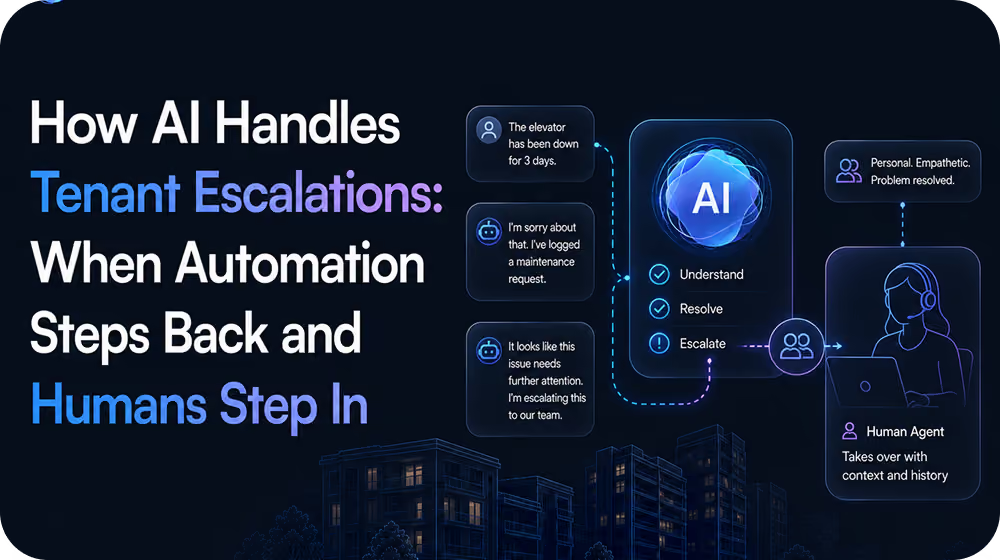
- Resident support: handle questions on payments, policies and renewals, and log maintenance requests into the right system.
- Across every channel: run these conversations over webchat, WhatsApp, email and voice, so the operator holds one consistent view.
Responses stay brand-safe and configurable, with handover to a person at the right moment, so the automation runs without losing control. Communication is a sensible place for an operator to start, because the problem is clear and the return is measurable. See how it fits your portfolio. Book a demo.