An operator who has filed no claims in three years opens a renewal quote and finds the premium has doubled. Nothing about the building has changed. The roof was replaced, the sprinklers were upgraded, and the loss history is clean.
The increase is driven by conditions in the wider market rather than anything happening at the property.
That experience has become common enough to reshape how operators think about risk, and it explains why risk management has moved up the agenda in multifamily operations.
This article covers what has happened to multifamily insurance costs, where AI genuinely helps across verification, documentation and building monitoring, and the honest limits on what better risk management achieves at renewal.
How AI Is Changing Property Insurance Risk Assessment
The pressure behind this topic is severe, and it is worth establishing before discussing what technology can do about it.
A Federal Reserve Bank of Minneapolis survey of multifamily owners found annual premiums rising by an average of 14% from 2021 to 2022, 22% the following year, and 45% from 2023 to 2024. That leaves 2024 premiums at roughly double their 2021 level.
The study covers 35 owners across four states, so it is a regional picture rather than a national one, but it puts numbers to an experience owners report across the country.
Coverage has narrowed alongside the price rises. The same survey found around a third of respondents carrying more wind and hail exclusions than three years earlier, with deductibles climbing as owners accepted more risk to keep premiums manageable.
Nationally, NMHC's State of Multifamily Risk work reports that 2024 brought the first decline in property insurance rates since 2017, after 27 consecutive quarters of increases, while liability lines continued to worsen under rising litigation costs.
On the underwriting side, insurers increasingly assess properties using data rather than questionnaires, drawing on aerial imagery, catastrophe modelling and claims databases.
For operators, the practical consequence is that the record a property can produce about its own condition and incident history matters more than it used to.
AI for Renters Insurance Compliance: Automating Verification at Scale
Renters insurance requirements are standard in most leases, and enforcement of them is where the requirement usually fails.
The administrative problem is straightforward. Policies lapse quietly, certificates arrive in inconsistent formats, and checking coverage across hundreds of units by hand is the kind of task that slips when a team is busy. A requirement nobody verifies leaves the operator exposed.
AI handles the mechanics well. It reads certificates in whatever format they arrive, checks the coverage against the lease requirement, and tracks expiry dates so residents are prompted ahead of renewal. What was a periodic manual audit becomes continuous.
The consequence side needs a person. Where a policy has lapsed, the response might be a reminder, a fee or a lease matter, and those decisions carry the same fairness considerations as any other enforcement.
Applying them inconsistently across residents creates exposure. Automate the checking and the prompting, and keep the decision about consequences with staff, applied to a written policy.
AI for Incident Documentation: Building a Defensible Claims Record
Incident documentation is where AI delivers value that shows up directly in claims outcomes.
A slip in a lobby, water damage from a failed valve, a dispute in a car park. Each generates a claim risk, and the quality of the contemporaneous record often determines how the claim resolves. Records reconstructed months later under legal pressure carry far less weight.
AI supports this by structuring capture at the moment of the incident. Staff record what happened through a guided sequence, with photographs timestamped and tied to a location.
Witness details are captured while people are still present, and the record files itself against the property and date.
The value compounds across a portfolio. An operator who can produce consistent, dated incident records for every property is in a stronger position with insurers at renewal and with counsel if a claim becomes contested.
Liability claims are where multifamily insurance pressure is currently worst, which makes this the documentation most worth getting right.
How Predictive AI Identifies Building Risks Before Incidents Occur
Prediction in this context means building systems rather than people, and the distinction matters.
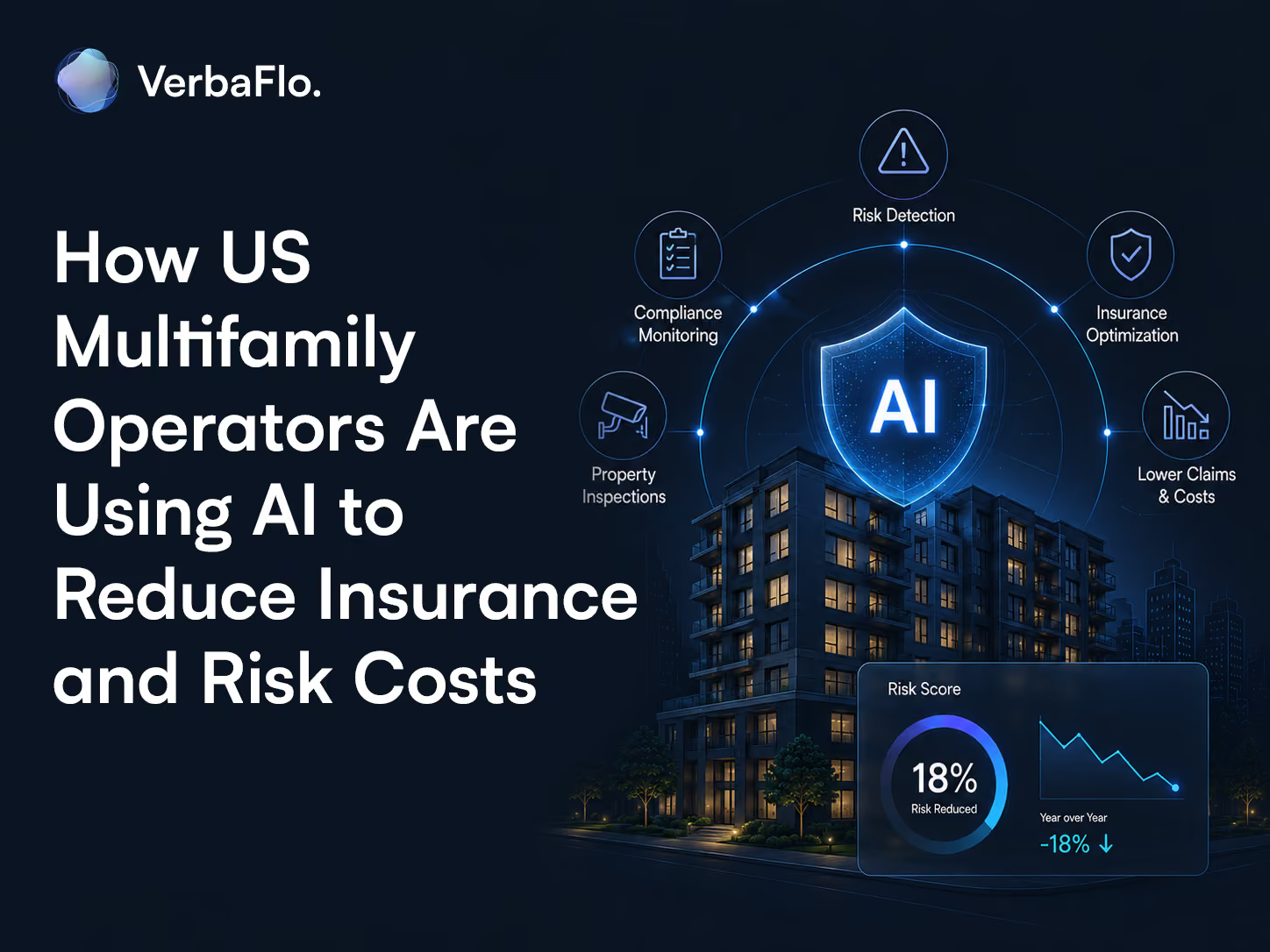
Applied to physical assets, predictive monitoring is genuinely useful. Sensors and maintenance histories indicate when a water heater is nearing failure, when a roof section is deteriorating, or when a pipe run is at risk during a freeze.
Water damage is among the most frequent and expensive multifamily claims, and much of it is preventable with warning.
The pattern extends to maintenance records. A system flagging repeated repairs to the same component identifies an asset likely to fail rather than a series of unrelated jobs, which changes the decision from repair to replace.
Predicting which residents pose risk is a different proposition, and it belongs outside this. Scoring people for likely incidents or claims runs directly into fair housing law.
HUD has stated that the Fair Housing Act applies to housing practices including when artificial intelligence and algorithms perform them, covering unjustified discriminatory effects as well as intent. Keep predictive risk work on the building.
AI for Building Condition Monitoring: Reducing Insurer Risk Scores
Condition monitoring produces the evidence an underwriter responds to, which is a narrower claim than it sounds.
Continuous monitoring covers the systems that drive claims. Water detection in risk-prone areas catches leaks early. Temperature monitoring flags freeze conditions before pipes burst. Fire system monitoring confirms that suppression equipment is functional rather than assumed to be.
Two benefits follow, and they are worth separating. The first is loss prevention, which is real and immediate. A leak caught at 2am costs a call-out rather than a claim and a damaged unit below.
The second is what an operator can demonstrate at renewal. Documented monitoring, maintenance and resiliency work gives an underwriter something concrete to consider, which is more than most operators can currently produce.
What Better Risk Management Actually Achieves at Renewal
An honest answer here matters more than an optimistic one, because operators are being sold a promise the market is not always keeping.
The Minneapolis Fed survey found more than half of respondents had implemented resiliency measures such as roof upgrades or sprinkler installation, and that several of those owners received no discounted rate from their insurers.
One commented that however hard they worked at resilient housing, insurers seemed to rate the risk the same. Another with zero claims saw a premium increase of 200%.
That reflects a market where pricing is driven substantially by catastrophe exposure, reinsurance capacity and litigation trends, none of which an individual operator controls. Risk work does not override those forces.
What it does achieve is worth having. Fewer incidents mean a cleaner loss history, which is one of the few inputs an operator does influence. Better documentation supports claims and gives a broker something to work with. And loss prevention saves money directly, whatever the insurer does with it.
The realistic framing is that risk management pays for itself through avoided losses, with any underwriting benefit as a welcome addition.
What to Ask Your Insurance Broker About AI-Enhanced Risk Management
A broker conversation is the fastest way to establish what your carrier actually credits.
- Does my carrier recognise any of this? Ask specifically which monitoring, documentation or resiliency measures affect pricing with your current insurer, rather than assuming they all do.
- What evidence would they want? If a measure is credited, establish what proof the underwriter requires and in what format.
- How is my loss history weighted? Understand how much of your premium reflects your own claims record against market-wide factors, since that determines what prevention can influence.
- What would move the deductible? Where premium reductions are unavailable, deductible or coverage terms may be more negotiable.
- Which exclusions have changed? Coverage has narrowed across the market, so confirm what your policy no longer covers before assuming a risk is insured.
The useful outcome is knowing which investments your carrier will recognise before making them, rather than discovering afterwards that the market rated the risk the same regardless.
Where Risk Communication Meets VerbaFlo
Two parts of risk management are communication work rather than technical work. Renters insurance requires chasing residents for certificates and renewals, and incidents require residents to report problems quickly enough for the damage to stay small.
Both fail the same way, through messages that go unanswered and issues reported late. A resident who cannot easily report a leak at the weekend reports it on Monday, by which point it is a claim.
VerbaFlo is a conversational AI platform for residential real estate operators that runs this layer. Three parts fit the risk context:
- Reporting at any hour: it takes resident enquiries and reports across webchat, WhatsApp, email and voice, so a leak reported at midnight reaches someone immediately.
- Chasing documentation: reminders for insurance certificates and renewals go out consistently, which is what turns a lease requirement into actual coverage.
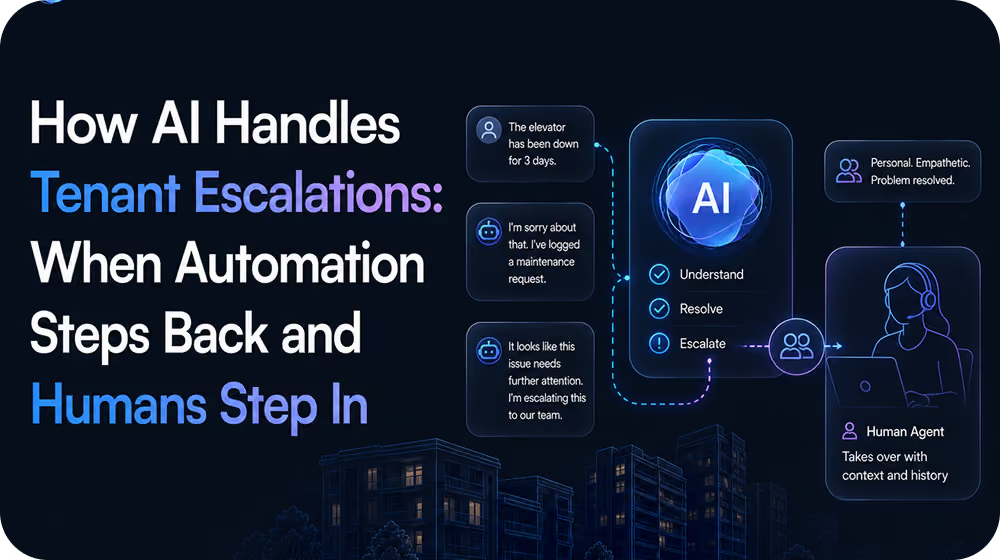
- Escalation with context: an incident report passes to a person with the details captured, so the response starts with information rather than a callback.
The division is straightforward. Assessing risk, monitoring building systems and negotiating cover are specialist work. Making sure residents can report problems immediately, and that documentation requirements are actually met, is communication work that determines how much the specialists have to deal with.
Book a demo to see how it handles resident communication at scale.