
Ethical AI: Principles, Challenges, and What Businesses Must Do
AI is now embedded in how businesses operate, from decision-making to customer communication. As adoption grows, so does the need to define what responsible use actually looks like. This is where ethical AI becomes a practical requirement, not a theoretical concept.
The ethics of artificial intelligence are no longer limited to research or policy discussions. It directly affects how systems are built, how data is used, and how decisions impact real users. For businesses, understanding what ethical AI involves building systems that are transparent, accountable, and aligned with user trust.
This guide breaks down the core principles of AI and ethics, the challenges businesses face, and how to apply the ethical use of artificial intelligence in real-world operations.
What is Ethical AI?
Ethical AI defines how artificial intelligence should be designed, deployed, and governed. It sets the standard for building systems that are fair, transparent, accountable, and aligned with human values.
In practice, the ethical use of artificial intelligence goes beyond model performance. It applies to how data is sourced, how decisions are generated, and how outcomes impact users. Every stage of the system carries responsibility.
For businesses, this requires a shift in approach. Accuracy is not enough. Systems must be explainable. Decisions must be traceable. Outcomes must be defensible.
At its core, AI and ethics are about control and accountability. Who owns the decision, how it is made, and whether it can be reviewed or challenged. Without this, even high-performing systems introduce risk.
The 7 Core Principles of Ethical AI
The principles of ethical AI are not abstract guidelines. They define how systems should be designed, deployed, and governed in real-world environments.
1. Fairness
AI systems must produce consistent outcomes across users. Decisions should not introduce bias or treat similar groups differently.
2. Inclusiveness
AI should be accessible and usable for all. Systems must account for diverse users and avoid reinforcing existing biases.
3. Transparency
Users should know when AI is being used and how it influences decisions. Clarity is critical, especially in high-impact scenarios.
4. Accountability
Responsibility must be clearly defined. Organisations need ownership over how AI systems operate, the outcomes they produce, and their impact.
5. Privacy
Data should be handled with strict controls. Users need confidence that their information is protected and used appropriately.
6. Security
AI systems must be resilient. Protecting data, access points, and system integrity is essential to maintaining trust.
7. Reliability
Systems should perform consistently within defined parameters. Continuous monitoring is required to detect and correct unintended behaviour.
The Biggest Ethical AI Challenges Businesses Face
Applying ethical AI in practice is a data and governance problem. The risks show up in how data is sourced, how models behave, and how decisions are made.
- Bias in data and outcomes
AI systems learn from existing data. If that data reflects historical bias, the system will replicate it. Detecting and correcting this requires continuous monitoring. - Lack of transparency in decision-making
Many models remain opaque. Organisations often cannot trace how inputs translate into outputs. With limited documentation of data sources and processing, audits become difficult, and trust weakens. - Data privacy and consent
AI systems consume large volumes of data. The risk increases when data is not anonymised or tightly governed. A significant share of breaches is linked to poor data handling, making privacy a central concern. - Accountability gaps
Ownership is often unclear. Data, models, and outcomes sit across teams. Without defined responsibility, issues go unaddressed, and governance breaks down. - Regulatory uncertainty
Frameworks such as GDPR and the EU AI Act are tightening expectations. Businesses are required to prove traceability and control, but many still operate with fragmented processes.
Example Case Study:
Company N implements an AI system to prioritise incoming customer enquiries based on their likelihood of conversion. The model is trained on historical data to identify high-value profiles and optimise response handling.
Over time, the system begins to favour certain user segments more consistently. Enquiries from specific locations or demographics are prioritised, while others receive slower responses. The bias is unintentional but reflects patterns in the training data.
At the same time, the team cannot clearly explain how these decisions are being made. The model lacks transparency, and ownership is distributed across teams.
This scenario highlights how multiple ethical AI challenges can surface together: bias, lack of transparency, unclear accountability, and weak governance, when systems are deployed without structured oversight.
Ethical AI and Regulation: EU AI Act, GDPR, and What’s Coming
Regulation is now shaping how ethical AI is built and deployed. It defines the baseline for transparency, accountability, and control. This is no longer guidance. It is enforceable.
- EU AI Act: risk defines responsibility
Introduced in 2024 and rolling out through 2027, the EU AI Act classifies AI systems by risk. High-risk use cases such as hiring and credit scoring must meet strict standards. This includes data governance, bias audits, human oversight, and full documentation. Penalties can reach up to 7% of global turnover. - Clear limits on harmful use cases
The Act restricts applications such as social scoring and manipulative targeting. The message is direct. Not all AI use is acceptable, regardless of capability. - GDPR: data use is tightly governed
GDPR continues to define how personal data is used in AI systems. Most deployments rely on user data, which brings strict requirements around consent, data minimisation, and explainability. Opaque systems are increasingly difficult to justify. - Rising standards for explainability and traceability
By 2026, even general-purpose AI models will need to disclose how they are trained and operate. Documentation, audit trails, and system visibility are becoming standard requirements.
Ethical AI in Chatbots, Communication and Messaging
Conversational AI systems, including chatbots, now sit at the centre of customer communication. They handle enquiries, guide decisions, and represent the brand in real time. This makes ethical AI especially important in messaging environments, where every interaction directly shapes user trust.
An ethical conversational system is built on clarity and control. It should clearly:
- Identify itself as an AI
- Respect user privacy
- Avoid misleading or manipulative responses.
Without these safeguards, systems risk collecting sensitive data without consent, generating incorrect or overconfident responses, or creating experiences that feel restrictive or deceptive.
Building ethically responsible systems requires a structured approach. Businesses need to define clear guidelines early, audit data and models regularly, and design interactions that are transparent and easy to understand. Human oversight remains critical, especially in complex or sensitive scenarios, and user feedback should continuously inform system improvements.
How VerbaFlo Supports Ethical AI in Practice
Ethical AI is not achieved through principles alone. It requires systems that are designed with control, visibility, and accountability built in from the start. This is where platforms such as VerbaFlo play a critical role.
VerbaFlo approaches conversational AI as a structured system rather than a standalone chatbot layer. This allows businesses to manage interactions with consistency, while maintaining oversight across channels and workflows.
- Clear identification and transparency
Interactions are designed to clearly signal AI involvement. Users understand when they are engaging with an automated system, which reduces confusion and builds trust. - Context-driven conversations
VerbaFlo maintains context across interactions and channels. This reduces repetition and ensures responses remain relevant and consistent. - Controlled automation with human oversight
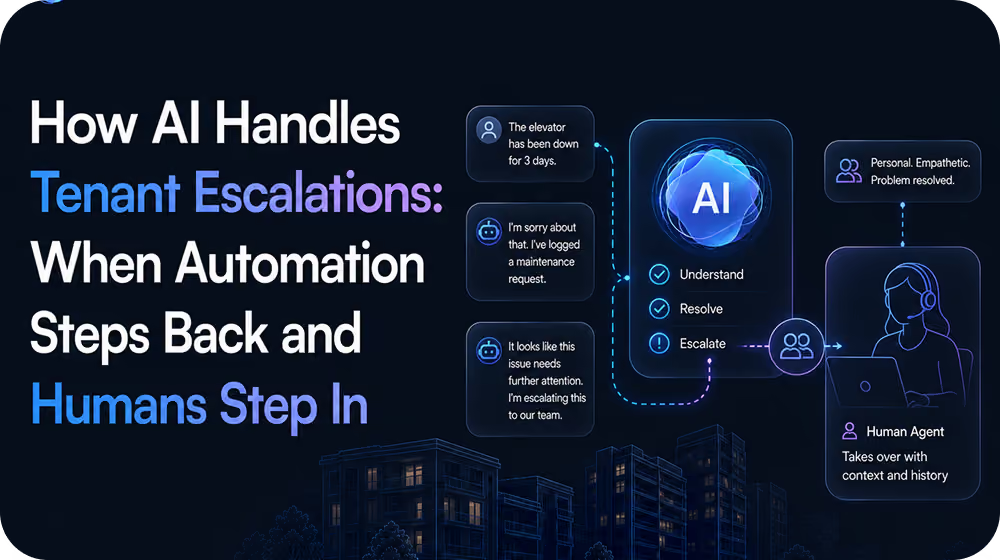
Workflows are structured to include escalation paths. Complex or sensitive queries can be routed to human teams without breaking the experience. - Data handling and privacy alignment
The platform operates with defined data flows and system-level controls, supporting responsible data usage and compliance requirements. - Consistency and auditability
Centralised workflows and analytics provide visibility into decision-making. This allows businesses to monitor performance, identify issues, and maintain accountability.
Ethical AI is no longer a theoretical concern. It is a practical requirement for how systems are built, deployed, and governed. As AI becomes central to business operations, the focus shifts from capability to responsibility.
For organisations, this means moving beyond isolated principles and building structured systems with clear accountability, transparency, and control. The ethical use of artificial intelligence is not a one-time effort. It requires continuous monitoring, disciplined data practices, and alignment with evolving regulations.
Businesses that treat AI and ethics as a core part of system design will be better positioned to scale responsibly, build trust, and avoid long-term risk.