
A running toilet in a third-floor apartment can waste hundreds of gallons a day. On a master-metered property, nobody notices until the water bill arrives four weeks later, by which point the money is gone and the cause is anyone's guess.
Multiply that across a portfolio and utilities become one of the least controlled lines in the operating budget. That combination, high spend and poor visibility, is why utilities management has drawn technology attention.
This article covers where the money goes, how the two billing models differ, how AI applies to billing and anomaly detection, and the regulatory ground to understand first.
The Utilities Challenge in US Multifamily: Where the Money Goes
Utilities sit among the largest controllable operating expenses at most multifamily properties. On a master-metered building, the property pays the utility company while residents consume the service, so whoever pays the bill has no control over usage.
That disconnect produces three costs. The obvious one is consumption, since usage tends to be higher when residents do not see a bill tied to it. The second is waste, because leaks and faults run undetected when nobody is watching a meter. The third is recovery, in that whatever the property does not bill back, it absorbs.
The response has been to push cost and visibility towards the unit, and how an operator does that determines everything downstream.
RUBS vs Sub-Metering: Which Model Is Right for Your Portfolio?
Two models dominate, and they differ fundamentally in what they measure.
Sub-metering installs a meter on each unit and bills residents for their measured consumption. The charge reflects what that household actually used.
RUBS, or Ratio Utility Billing System, applies where individual meters do not exist. The property receives one master bill and divides it among units using a formula based on factors such as square footage, bedroom count or number of occupants. The charge estimates a household's share instead of measuring its usage.
The honest summary is that sub-metering is the more defensible model. It bills people for what they used, and disputes have an evidentiary answer. RUBS exists because retrofitting meters into older buildings is expensive.
RUBS also carries risks operators should weigh openly. The National Consumer Law Center, writing for tenant advocates, notes that RUBS bills rest on building-wide formulas that tenants may not be able to see or verify. State utility consumer protections generally do not apply to RUBS charges unless a state has legislated for them specifically.
Regulation varies considerably. Some jurisdictions prohibit RUBS outright, some permit it with disclosure and consumer-protection requirements, and some restrict it for particular utilities. Before adopting or automating either model, confirm the position in each jurisdiction you operate in with counsel who knows local landlord-tenant and utility law.
How AI Automates RUBS Calculation and Billing at Scale
Where RUBS is permitted and properly disclosed, the administrative work is repetitive and error-prone, which is what automation addresses.
AI-supported systems handle the mechanics. They ingest the master bill, apply the allocation formula against current occupancy data, generate resident statements, and reconcile what was billed against what the property was charged. Across a portfolio, that removes a substantial manual burden.
Two cautions belong alongside that capability.
The first is that automation scales whatever formula it is given. If the allocation basis is unfair or the disclosure is inadequate, running it faster across more properties multiplies the problem rather than solving it. The formula deserves review before it is automated.
The second concerns the amount billed. NCLC documents a practice where a property pays a commercial utility rate on the master bill and charges residents at a higher residential rate, keeping the difference. Some states prohibit billing residents more than the utility charged the property. Any automated system should bill from actual master-bill costs, and third-party fees added to resident statements deserve the same scrutiny.
AI for Sub-Metering: Reading, Billing, and Disputing Usage Data
Sub-metering generates far more data than RUBS, and that data is where AI earns its place. Modern metering infrastructure supports this directly. EPA notes that advanced meters record consumption at least hourly and transmit data daily or more frequently, which produces the granularity that automated analysis depends on.
AI applies to three tasks. It validates readings, flagging implausible values that suggest a fault rather than genuine consumption. It generates bills from validated data on a schedule. And it supports dispute resolution, because a resident questioning a charge can be shown the usage pattern behind it.
A disputed sub-metered bill has an evidentiary answer in the meter data, which is what a disputed RUBS charge lacks.
How AI Identifies Unusual Consumption and Flags Water Leaks Early
Leak detection is the clearest operational win here, because it saves money without billing anyone. Continuous consumption data establishes a normal pattern for each unit, and deviations indicate a problem. A unit drawing water steadily through the night points to a running toilet rather than household use.
EPA's guidance supports this application, noting that submeters help identify leaks and indicate when equipment is malfunctioning, and that metering systems can trigger alerts when leaks or other operational anomalies are detected.
The value is in the timing. A leak caught on the day it starts costs a maintenance visit. The same leak found on a quarterly bill has run for weeks, and in the worst cases has damaged the unit below. Anomaly detection converts a billing dataset into an early warning system, which benefits the operator and the resident at once.
AI for Energy Cost Allocation Across Mixed-Use Properties
Mixed-use properties complicate allocation, because a ground-floor restaurant and a one-bedroom flat draw on shared systems in different patterns.
Allocation requires separating common-area consumption from tenant consumption, then apportioning what remains on a defensible basis. Commercial tenants often carry lease terms specifying how utilities are allocated, which the residential side lacks.
AI helps by holding this complexity consistently, applying the correct method for each space type and producing an auditable record of how each charge was derived. The audit trail matters, since a commercial tenant querying an allocation will expect to see the working.
The prerequisite is metering that reflects the building's structure. Where common areas, retail and residential units are not separately metered, the allocation rests on assumptions, and no processing converts an assumption into a measurement.
What Operators Should Measure to Assess the Return
Published savings figures in this category come predominantly from companies selling billing and metering services, so they are marketing claims rather than independent benchmarks. Rather than repeat numbers that cannot be verified, it is more useful to know where the return actually comes from and how to measure it on your own portfolio.
The return arrives through four channels:
- Recovery: the share of utility cost billed back rather than absorbed, tracked as a percentage of the master bill.
- Consumption: total usage per unit, which typically falls when residents see a charge tied to their own use.
- Leak and fault avoidance: the cost of issues caught early, measured against what a comparable undetected fault has historically cost.
- Administrative time: hours spent on billing cycles, reconciliation and dispute handling.
Track those four before and after any change. Numbers measured on your own portfolio are worth more than a vendor benchmark, because they reflect your buildings, rates and residents.
Where Utility Billing Meets Resident Communication, and Where VerbaFlo Fits
Any utility billing programme produces a steady stream of resident questions, and they arrive at the leasing office whichever model a property uses. A resident who receives a prompt explanation treats a bill as a bill, while one who cannot get an answer treats it as a grievance, and utility disputes have a way of surfacing at renewal.
VerbaFlo is a conversational AI platform for residential real estate operators that runs this communication layer. Three parts of it fit the questions a billing cycle generates:
- Immediate answers, any hour: it handles resident enquiries and support across webchat, WhatsApp, email and voice, so a query about a charge gets a reply when the resident opens the bill.
- Responses from approved content: answers come from the operator's own approved material, which keeps explanations of a charge consistent across a portfolio.
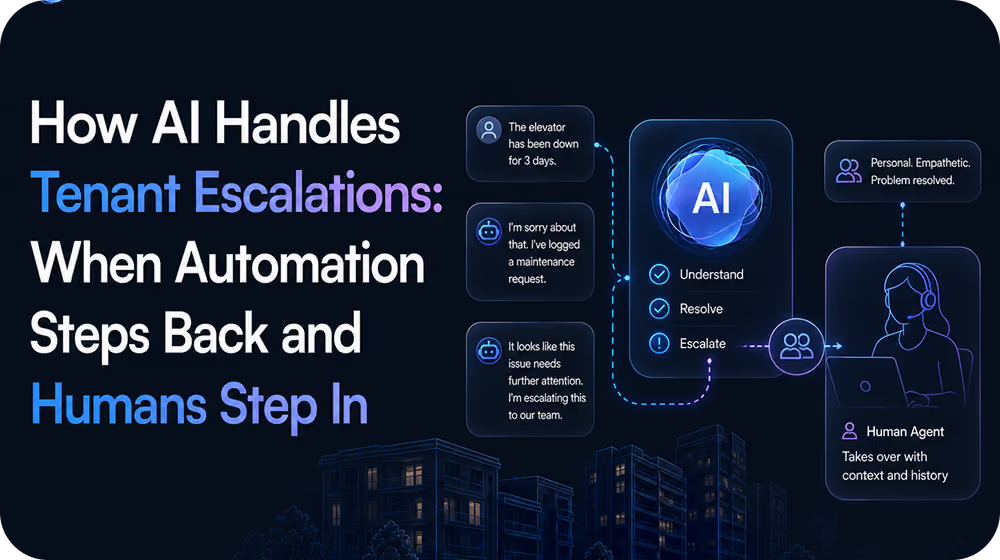
- Escalation with context: anything contested passes to a person with the conversation attached, which is what a disputed charge or a suspected leak needs.
The division is worth stating plainly. Calculating the bill, validating meter data and setting the allocation method are utility management functions. Answering the resident who has questions about the result is communication work, and that part shapes how residents experience the billing programme.
Book a demo to see how it handles resident queries at scale.