A market-rate leasing team that loses a document has an inconvenience. An affordable housing team that loses a recertification file has a compliance event, one that can trigger a reportable finding and, in the worst case, threaten the tax credits the property was financed on.
That asymmetry shapes how affordable housing is run. The paperwork is the product, in a sense, because a qualifying household is only qualifying if the file proves it.
This article covers why the compliance burden is unlike other sectors, how AI is applied to reporting and recertification, and the legal limits that make some applications risky.
The Compliance Burden of Affordable Housing: Why It's Unlike Any Other Sector
Affordable housing operators run under obligations that market-rate operators never encounter, and often several sets at once. A single property may be subject to HUD programme rules, Low-Income Housing Tax Credit (LIHTC) requirements under Section 42, state agency conditions and local funding covenants. Each carries its own forms and deadlines, and they do not always align.
Three features make this burden distinctive:
- Eligibility must be proven: household income has to be documented, verified against third-party sources and certified at move-in, then maintained through the tenancy.
- The rules vary by programme and by state: recertification requirements differ between HUD programmes and LIHTC, and state agencies layer their own requirements on top, so a portfolio operating in several states is running several rulebooks.
- Errors carry financial consequences: noncompliance means reportable findings to a state agency, and in tax credit properties it can put credits at risk.
Timing matters as much as accuracy. Guidance in the IRS 8823 Guide indicates that recertification non-compliance an owner corrects before a state agency's file review notice need not be reported, which Novogradac summarises as the owner having demonstrated due diligence by addressing the issue independently.
The same error found after that notice becomes reportable, which is the practical case for automation. Catching a lapse early is materially different from catching it late.
How AI Is Automating HUD Reporting and Certification Workflows
HUD programmes run on structured, deadline-bound submissions, the kind of work software handles well. AI supports three parts of the cycle. It extracts data from source documents, pulling figures from pay stubs and benefit letters into the fields a certification form requires. It checks internal consistency, flagging where a stated income does not match supporting documentation or where a document is missing. And it monitors deadlines across a portfolio, surfacing the certifications falling due.
The gain is that files arrive complete. Many compliance findings come from incomplete paperwork rather than ineligible households, which is the failure mode a checking layer catches.
The limit is equally clear. The certification is a regulated determination made by a qualified person, so AI assembles and checks the file and a compliance professional signs it.
AI for Section 8 Voucher Management and Income Verification
Voucher administration involves a housing authority, a landlord and a household, and the coordination between them generates most of the friction.
Income verification is where AI is most useful and most sensitive. It reads and structures the documents a household provides, identifies what is missing and reconciles figures across sources. An afternoon of reading becomes a reviewable summary.
The sensitivity is that income determination decides whether a family gets housing assistance. An error in either direction causes harm, either denying a household support it qualifies for or creating an overpayment the household will later be asked to repay. Autonomous decisions have no place here.
Practical use therefore keeps AI on the document side. Gathering, reading and flagging are automatable. Determining eligibility and issuing the decision remain human tasks, with the AI output serving as a prepared file rather than a conclusion.
AI for LIHTC Compliance: Tracking Tenant Income Limits at Scale
LIHTC compliance turns on income limits, and the rules are more intricate than they first appear.
Requirements vary by state and property type. Annual recertification is waived for fully affordable tax credit properties under federal law, yet state agencies impose their own requirements and mixed-income properties differ again. An operator in several states tracks several sets of obligations at once.
AI helps by holding that complexity consistently, tracking each household against the applicable limit, monitoring anniversary dates, and flagging households approaching thresholds that trigger further obligations.
The next-available-unit rule is the clearest example. It is triggered when a household's income rises above 140% of the applicable limit, and governs how the next comparable unit must be let. Missing that transition creates a compliance problem. Software monitoring income against thresholds catches it as it happens rather than at the next audit.
None of this changes the underlying obligation. Owners should verify requirements with their state housing agency, and an automated system is only as correct as the rules configured into it.
How AI Handles Recertification Reminders and Document Collection
Recertification is an administrative problem before it is a compliance one. The household has to produce documents by a date, and much of the work is getting them to do it.
This is where automation is least controversial. Reminders go out ahead of the anniversary date, follow-ups continue if documents do not arrive, and the household gets clear prompts about what is needed, through the channel they actually read.
Document collection follows the same pattern. A resident submits paperwork by photograph or upload, the system checks it is legible and complete, and requests anything missing rather than leaving a gap found weeks later.
The operational effect is that fewer recertifications go past due for want of chasing. Since the difference between a self-corrected file and a reportable finding often comes down to timing, keeping the paperwork moving has compliance value beyond convenience.
Fair Housing Compliance for Affordable Housing Operators Using AI
This section carries the most risk in the article, and deserves direct treatment rather than reassurance.
HUD has been explicit that the Fair Housing Act applies to automated systems. In May 2024 it issued guidance on tenant screening and digital advertising, stating that housing providers, screening companies and platforms should be aware the Act applies including when artificial intelligence and algorithms perform these functions.
Two points from that guidance matter for any operator deploying AI:
- Discriminatory effect counts alongside intent: the Act prohibits both intentional discrimination and practices with an unjustified discriminatory effect, so a model producing disparate outcomes creates exposure even where no one intended it.
- Using a vendor does not transfer liability: HUD's guidance makes clear that using third-party screening companies, including those relying on AI, must comply with the Act, and applicants must be evaluated on their own merit.
The practical implications follow. Screening and eligibility applications need testing for disparate outcomes, decisions need documenting so an adverse outcome can be explained, and a model's output is not a defence. Applications touching who gets housing warrant far more caution than applications that chase paperwork.
What Affordable Housing Operators Should Look for in AI Tools in 2026
The useful question is which capabilities matter in a regulated setting.
- Programme-specific configuration: the tool should reflect the rules of the programmes and states you operate in, since generic rental software misses these requirements entirely.
- Audit trail by default: every extracted figure, flag and reminder should be traceable, because a compliance review asks how a determination was reached.
- Human sign-off built in: certifications and eligibility determinations should require explicit approval by a qualified person rather than defaulting to automated acceptance.
- Integration with systems of record: output should flow into the compliance and property management platforms already in use rather than creating a parallel file.
- Fair housing testing: for anything touching screening or eligibility, ask the vendor how the system has been tested for disparate outcomes, and document the answer.
Sequencing matters too. Operators seeing genuine gains start with the document and communication workload, where risk is low and time saved is immediate, before touching anything that affects determinations.
Where Communication Fits, and Where VerbaFlo Sits
Running through this article is a division between two kinds of work. Determinations and eligibility decisions are regulated judgements that belong with qualified people. Chasing documents and answering routine questions is communication work, and it consumes a large share of a compliance team's time.
VerbaFlo is a conversational AI platform built for residential real estate operators, working on that second category. Its stated markets are build-to-rent and multifamily alongside student accommodation, so affordable housing compliance is not a product it currently claims.
The capability that transfers is the communication layer, and three parts of it map onto the work around a recertification:
- Reaching residents where they are: it handles enquiries and support across webchat, WhatsApp, email and voice, which matters when a household responds to a text but never opens a letter.
- Answering from approved content: responses come from the operator's own approved material, so a resident asking what a notice means gets a consistent answer rather than an improvised one.
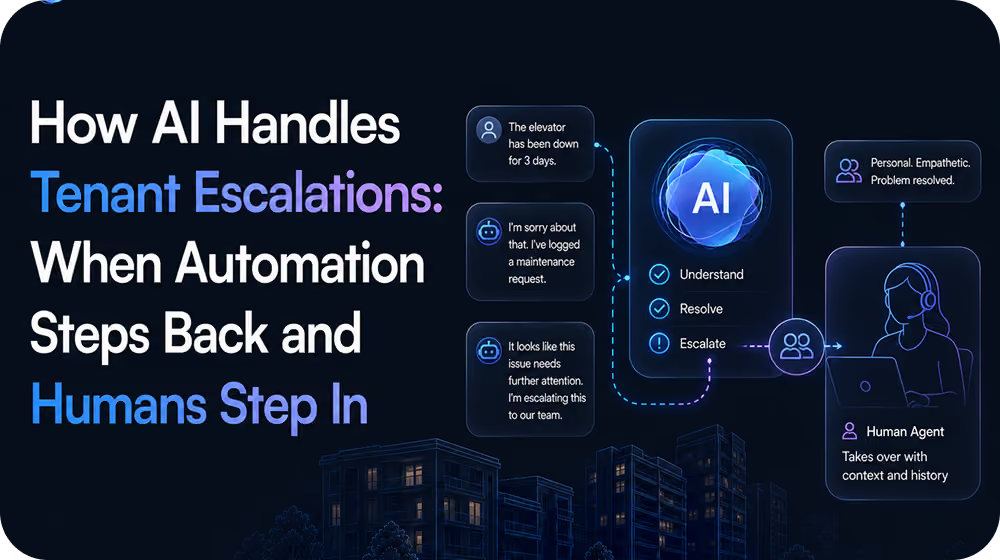
- Escalating with the context attached: anything needing judgement passes to a person with the conversation history, which is the safeguard that keeps determinations where they belong.
For a compliance team, that shape fits the chasing and answering around recertification, while every determination stays with the staff qualified to make it. For operators running BTR or student portfolios weighing the same communication load, book a demo to see how it works at scale.